ليون
Lyon
Liyon (Arpitan) | |
|---|---|
 Flag  الدرع | |
| Motto(s): Avant, avant, Lion le melhor (Old Franco-Provençal for "إلى الأمام، إلى الأمام، ليون هي الأفضل")[أ] Virtute duce, comite fortuna ("بالفضيلة دليل والثروة رفيق")[ب] | |
 موقع Lyon | |
  Lyon الموقع ضمن فرنسا  Lyon الموقع ضمن أوڤرن-رون-ألپ | |
| الإحداثيات: 45°46′03″N 4°50′06″E / 45.7675°N 4.8350°E | |
| البلد | فرنسا |
| المنطقة | Auvergne-Rhône-Alpes |
| Metropolis | Lyon Metropolis |
| Arrondissement | Lyon |
| التقسيمات | 9 الدوائر |
| الحكومة | |
| • Mayor (2020-2026) | Grégory Doucet[1] (The Greens) |
المساحة 1 | 47٫87 كم² (18٫48 ميل²) |
| • العمران (2020[2]) | 6٬018٫62 كم² (2٬323٫80 ميل²) |
| التعداد (يناير 2019) | 522٬969 |
| • الترتيب | الثالثة في فرنسا |
| • الكثافة | 11٬000/km2 (28٬000/sq mi) |
| • العمران | 2٬327٬861 |
| الكثافة العمرانية | 390/km2 (1٬000/sq mi) |
| منطقة التوقيت | UTC+01:00 (CET) |
| • الصيف (التوقيت الصيفي) | UTC+02:00 (CEST) |
| INSEE/Postal code | 69123 /69001-69009 |
| Elevation | 162–349 m (531–1،145 ft) |
| الموقع الإلكتروني | www |
| 1 French Land Register data, which excludes lakes, ponds, glaciers > 1 km2 (0.386 sq mi or 247 acres) and river estuaries. | |
.jpg&filetimestamp=20251207152710&)
.jpg&filetimestamp=20251207152708&)
-mai2011.jpg&filetimestamp=20251207152708&)

.jpg&filetimestamp=20251207152707&)

ليون (بالفرنسية: Lyon [ت] (Franco-Provençal: Liyon) هي مدينة فرنسية تقع في جنوب شرق البلاد، تقع عند ملتقى نهري الرون والساؤن، إلى الشمال الغربي من الألپ الفرنسية، على بعد 391 كم جنوب شرق پاريس، و 278 كم شمال مارسيليا و 113 جنوب غرب جنيڤ، سويسرا.
ليون هي ثالث أكبر المدن الفرنسية[11] بتعداد 520,774 نسمة في تعداد يناير 2022 داخل حدود بلديتها الصغيرة التي تبلغ مساحتها 48 كم²،[12] but together with its suburbs and exurbs the Lyon metropolitan area had a population of 2,327,861 that same year,[3] the second largest in France. Lyon and 58 suburban municipalities have formed since 2015 the Metropolis of Lyon, a directly elected metropolitan authority now in charge of most urban issues, with a population of 1,433,613 in 2022.[13] Lyon is the prefecture of the Auvergne-Rhône-Alpes region and seat of the Departmental Council of Rhône (whose jurisdiction, however, no longer extends over the Metropolis of Lyon since 2015).
The capital of the Gauls during the Roman Empire, Lyon is the seat of an archbishopric whose holder bears the title of Primate of the Gauls. Lyon became a major economic hub during the Renaissance. The city is recognised for its cuisine and gastronomy, as well as historical and architectural landmarks; as such, the districts of Old Lyon, the Fourvière hill, the Presqu'île and the slopes of the Croix-Rousse are inscribed on the UNESCO World Heritage List. Lyon was historically an important area for the production and weaving of silk. Lyon played a significant role in the history of cinema since Auguste and Louis Lumière invented the cinematograph there. The city is also known for its light festival, the Fête des lumières, which begins every 8 December and lasts for four days, earning Lyon the title of "Capital of Lights".
والمدينة ملتقى نهري الرون ورافده السون اللذين يقسمان المدينة إلى ثلاثة أجزاء. وتحاذي أرصفة تحميل السفن والمستودعات مقدمة النهر. أما المنطقة التجارية الرئيسية فتقع في شبه جزيرة تمتد بين النهرين. والقسم الثالث هو الضفة الغربية لنهر السون حيث يوجد أقدم أحياء المدينة بشوارعها الضيقة ومنازلها القبابية. تقع المنطقة الجديدة من ليون على الضفة الشرقية من نهر الرون. وتضم هذه المنطقة مصانع وجامعة ضخمة وكثيرًا من المباني السكنية الجذابة.
تشتهر ليون بصناعة الأنسجة، خاصة الحرير والرايون. وبالمدينة عدد كبير من شركات الغزل والنسيج والصباغة. وفي ليون صناعات أخرى مثل صناعة السيارات، والصناعات الكيميائية، والكهربائية والتعدينية، وكذلك منتجات الزراعة.
Economically, Lyon is a major centre for banking, chemical, pharmaceutical and biotech industries. The city contains a significant software industry with a particular focus on video games; in recent years it has fostered a growing local start-up sector.[14] The home of renowned universities and higher education schools, Lyon is the second-largest student city in France, with a university population of nearly 200,000 students within the Metropolis of Lyon.[15] Lyon hosts the international headquarters of Interpol, the International Agency for Research on Cancer, as well as Euronews. According to the Globalization and World Rankings Research Institute, Lyon is considered a Beta city, اعتبارا من 2018[تحديث].[16] It ranked second in France and 40th globally in Mercer's 2019 liveability rankings.[17]
التاريخ
 مقالة مفصلة: تاريخ ليون
اسم المكان
The name of the city has taken the forms Lugdon, Luon, and since the 13th century, Lyon. The Gallic Lugdun or Lugdunon that was Latinized in Roman as Lugdunum is composed of two words. The first may be the name of the Celtic god Lug (in charge of order and law), or the derived word lugon, meaning "crow" (the crow being the messenger of Lug), but might also be another word lug, meaning "light". The second is dunos ('fortress', 'hill'). The name thus may designate the hill of Fourvière, on which the ancient city of Lyon is founded, but could mean "hill of the god Lug", "hill of the crows" or "shining hill".[18][19]
Alternatively Julius Pokorny associates the first part of the word with the Indo-European radical *lūg ('dark, black, swamp'), the basis of the toponyms Ludza in Latvia, Lusatia in Germany (from Sorbian Łužica), and several places in the Czech Republic named Lužice;[20] it could then also be compared to Luze in Franche-Comté and various hydronyms such as Louge.
Further down, in the current Saint-Vincent district, was the Gallic village of Condate, probably a simple hamlet of sailors or fishermen living on the banks of the Saône. Condate is a Gallic word meaning "confluence", from which the Confluence district gets its name.
In Roman times the city was called Caput Galliae, meaning "capital of the Gauls". As an homage to this title, the Archbishop of Lyon is still called the Primate of Gaul.
During the revolutionary period, Lyon was renamed Commune-Affranchie ("Emancipated Commune") on 12 October 1793 by a decree of the Convention Nationale. It resumed its name in 1794, after the end of the Terror.
Lyon is called Liyon in Franco-Provençal.[21]
Historical affiliations
Western Roman Empire (Gallia Lugdunensis), 286-411
Kingdom of the Burgundians, 411–534
Francia, 534–843
Middle Francia, 843–855
Lotharingia, 855–879
Lower Burgundy, 879–933
Kingdom of Arles, 933–1312
 Kingdom of France (Lyonnais), 1312–1792
 French First Republic, 1792–1793
 Counter-revolutionary, 1793
 French First Republic, 1793–1804
First French Empire, 1804–1814
 Kingdom of France, 1814–1815
First French Empire, 1815
Kingdom of France, 1815–1830
Kingdom of France, 1830–1848
French Second Republic, 1848–1852
Second French Empire, 1852–1870
French Third Republic, 1870–1940
Vichy France, 1940–1944
French Fourth Republic, 1944–1958
 فرنسا, 1958–الحاضر
ليون القديمة
حسب المؤرخ Dio Cassius، في عام 43 ق.م. أمر مجلس الشيوخ الروماني بإنشاء مستعمرة للاجئين الرومان النازحين من الحرب مع Allobroges. These refugees had been expelled from Vienne and were now encamped at the confluence of the Saône and Rhône rivers. The foundation was built on Fourvière hill and officially called Colonia Copia Felix Munatia, a name invoking prosperity and the blessing of the gods. The city became increasingly referred to as Lugdunum (and occasionally Lugudunum[22]).[23] The earliest translation of this Gaulish place-name as "Desired Mountain" is offered by the 9th-century Endlicher Glossary.[24] In contrast, some modern scholars have proposed a Gaulish hill-fort named Lug[o]dunon, after the Celtic god Lugus (cognate with Old Irish Lugh, Modern Irish Lú), and dúnon (hill-fort).
.jpg&filetimestamp=20251207152705&)
The Romans recognised that Lugdunum's strategic location at the convergence of two navigable rivers made it a natural communications hub. The city became the starting point of main Roman roads in the area, and it quickly became the capital of the province, Gallia Lugdunensis. Two Emperors were born in this city: Claudius, whose speech is preserved in the Lyon Tablet in which he justifies the nomination of Gallic Senators, and Caracalla.
Early Christians in Lyon were martyred for their beliefs under the reigns of various Roman emperors, most notably Marcus Aurelius and Septimius Severus.[25] Local saints from this period include Blandina, Pothinus, and Epipodius, among others. The Greek Irenaeus was the second bishop of Lyon during the latter part of the second century.[26] To this day, the archbishop of Lyon is still referred to as "Primat des Gaules".[27]
Burgundians fleeing the destruction of Worms by the Huns in 437 were re-settled in eastern Gaul. In 443 the Romans established the Kingdom of the Burgundians, and Lugdunum became its capital in 461. In 843, under the Treaty of Verdun, Lyon went to the Holy Roman Emperor Lothair I. It later was made part of the Kingdom of Arles which was incorporated into the Holy Roman Empire in 1033. Lyon did not come under French control until the 14th century.
Modern Lyon
Fernand Braudel remarked, "Historians of Lyon are not sufficiently aware of the bi-polarity between Paris and Lyon, which is a constant structure in French development...from the late Middle Ages to the Industrial Revolution".[28] In the late 15th century, the fairs introduced by Italian merchants made Lyon the economic counting house of France. Even the Bourse (treasury), built in 1749, resembled a public bazaar where accounts were settled in the open air. When international banking moved to Genoa, then Amsterdam, Lyon remained the banking centre of France.
During the Renaissance, the city's development was driven by the silk trade, which strengthened its ties to Italy. Italian influence on Lyon's architecture is still visible among historic buildings.[29] In the late 1400s and 1500s Lyon was also a key centre of literary activity and book publishing, both of French writers (such as Maurice Scève, Antoine Héroet, and Louise Labé) and of Italians in exile (such as Luigi Alamanni and Gian Giorgio Trissino).
.jpg&filetimestamp=20231219061149&)

In 1572, Lyon was a scene of mass violence by Catholics against Protestant Huguenots in the St. Bartholomew's Day Massacre. Two centuries later, Lyon was again convulsed by violence during the French Revolution, when the citizenry rose up against the National Convention and supported the Girondins. The city was besieged by Revolutionary armies for over two months before it surrendered in October 1793. Many buildings were destroyed, especially around the Place Bellecour, and Jean-Marie Collot d'Herbois and Joseph Fouché administered the execution of more than 2,000 people. The Convention ordered that its name be changed to "Liberated City", and a plaque was erected that proclaimed "Lyon made war on Liberty; Lyon no longer exists". A decade later, Napoleon ordered the reconstruction of all the buildings demolished during that period.
The convention was not the only target within Lyon during the French Revolution. After the Convention faded into history, the French Directory appeared and days after the 4 September 1797 Coup of 18 Fructidor, a Directory's commissioner was assassinated in Lyon.
The city became an important industrial town in the 19th century. In 1831 and 1834, the canuts (silk workers) of Lyon staged two major uprisings for better working conditions and pay. In 1862, the first of Lyon's extensive network of funicular railways began operation. During the repression of January and February 1894, the police conducted at least dozens of raids targeting the anarchists living there, without much success.[30][31][32] Some months later, in June 1894, companion Sante Caserio assassinated the French president responsible for the repression, Sadi Carnot.[33]
كانت ليون مركز المقاومة الفرنسية للاحتلال الألماني أثناء الحرب العالمية الثانية (1939-1945م).
During World War II, Lyon was a centre for the occupying Nazi forces, including Klaus Barbie, the infamous "Butcher of Lyon". However, the city was also a stronghold of the French Resistance, the many secret passages known as traboules, enabled people to escape Gestapo raids. On 3 September 1944, Lyon was liberated by the 1st Free French Division and the Forces Françaises de l'Intérieur. The city is now home to a Resistance museum.[34][35]

الجغرافيا

The Rhône and Saône converge to the south of the historic city centre, forming a peninsula – the "Presqu'île" – bounded by two large hills to the west and north and a large plain eastward. Place Bellecour is located on the Presqu'île between the two rivers and is the third-largest public square in France. The broad, pedestrian-only Rue de la République leads north from Place Bellecour.
The northern hill is La Croix-Rousse, known as "the hill that works" because it is traditionally home to many small silk workshops, an industry for which the city has long been renowned.[36]
The western hill is Fourvière, known as "the hill that prays" because it is the location for Basilica of Notre-Dame de Fourvière, several convents, and Archbishop's residence. The district, Vieux Lyon, also hosts the Tour métallique (a highly visible TV tower, replicating the last stage of the Eiffel Tower) and one of the city's railways.[37] Fourvière, along with portions of the Presqu'île and much of La Croix-Rousse, is designated as a UNESCO World Heritage Site.[38]
East of the Rhône from the Presqu'île is a large flat area upon which sits much of modern Lyon and contains most of the city's population. Situated in this area is La Part-Dieu urban centre, which clusters the landmark structures Tour To-Lyon, Tour Incity, Tour Part-Dieu, Tour Oxygène, and Tour Swiss Life, as well as the city's primary railway station, Gare de Lyon-Part-Dieu.
North of this district lays the sixth arrondissement, which is home to one of Europe's largest urban parks, the Parc de la Tête d'or, as well as Lycée du Parc and Interpol's world headquarters.

المناخ

Lyon has a humid subtropical climate (Köppen: Cfa).[39] The mean temperature in Lyon in the coldest month is 4.1 °C (39.4 °F) in January and in the warmest month in July is 22.6 °C (72.7 °F). Precipitation is adequate year-round, at an average of 820 mm (32.3 in); the winter months are the driest. The highest recorded temperature was 40.5 °C (104.9 °F) on 13 August 2003 while the lowest recorded temperature was −24.6 °C (−12.3 °F) on 22 December 1938.[40]
| بيانات المناخ لـ Lyon (LYN), elevation: 197 m (646 ft), 1991–2020 normals, extremes 1920–present | |||||||||||||
|---|---|---|---|---|---|---|---|---|---|---|---|---|---|
| الشهر | ينا | فب | مار | أبر | ماي | يون | يول | أغس | سبت | أكت | نوف | ديس | السنة |
| القصوى القياسية °س (°ف) | 19.1 (66.4) |
21.9 (71.4) |
26.0 (78.8) |
30.1 (86.2) |
34.2 (93.6) |
38.4 (101.1) |
40.4 (104.7) |
41.4 (106.5) |
35.8 (96.4) |
28.4 (83.1) |
23.0 (73.4) |
20.2 (68.4) |
41.4 (106.5) |
| متوسط القصوى اليومية °س (°ف) | 7.1 (44.8) |
9.0 (48.2) |
13.8 (56.8) |
17.4 (63.3) |
21.5 (70.7) |
25.6 (78.1) |
28.2 (82.8) |
28.0 (82.4) |
23.1 (73.6) |
17.7 (63.9) |
11.4 (52.5) |
7.7 (45.9) |
17.5 (63.5) |
| المتوسط اليومي °س (°ف) | 4.1 (39.4) |
5.2 (41.4) |
9.0 (48.2) |
12.3 (54.1) |
16.3 (61.3) |
20.3 (68.5) |
22.6 (72.7) |
22.3 (72.1) |
17.9 (64.2) |
13.7 (56.7) |
8.1 (46.6) |
4.8 (40.6) |
13.0 (55.4) |
| متوسط الدنيا اليومية °س (°ف) | 1.1 (34.0) |
1.4 (34.5) |
4.2 (39.6) |
7.2 (45.0) |
11.2 (52.2) |
15.0 (59.0) |
17.0 (62.6) |
16.6 (61.9) |
12.8 (55.0) |
9.6 (49.3) |
4.9 (40.8) |
2.0 (35.6) |
8.6 (47.5) |
| الصغرى القياسية °س (°ف) | −23.0 (−9.4) |
−22.5 (−8.5) |
−10.5 (13.1) |
−4.4 (24.1) |
−3.8 (25.2) |
2.3 (36.1) |
6.1 (43.0) |
4.6 (40.3) |
0.2 (32.4) |
−4.5 (23.9) |
−9.4 (15.1) |
−24.6 (−12.3) |
−24.6 (−12.3) |
| متوسط تساقط الأمطار mm (inches) | 49.8 (1.96) |
41.6 (1.64) |
49.4 (1.94) |
68.9 (2.71) |
80.9 (3.19) |
74.1 (2.92) |
67.4 (2.65) |
65.5 (2.58) |
82.5 (3.25) |
99.8 (3.93) |
87.2 (3.43) |
53.7 (2.11) |
820.8 (32.31) |
| Average precipitation days (≥ 1.0 mm) | 8.1 | 7.9 | 8.4 | 9.0 | 10.3 | 8.5 | 7.5 | 7.2 | 7.3 | 9.9 | 9.4 | 9.2 | 102.8 |
| Mean monthly ساعات سطوع الشمس | 71.1 | 102.4 | 173.7 | 197.7 | 223.8 | 256.5 | 288.1 | 263.1 | 204.1 | 131.4 | 78.9 | 58.7 | 2٬049٫5 |
| Source 1: Meteo France[41] | |||||||||||||
| Source 2: Meteo Lyon[42] | |||||||||||||
| بيانات المناخ لـ Lyon (LYN), elevation: 201 m, 1961–1990 normals and extremes | |||||||||||||
|---|---|---|---|---|---|---|---|---|---|---|---|---|---|
| الشهر | ينا | فب | مار | أبر | ماي | يون | يول | أغس | سبت | أكت | نوف | ديس | السنة |
| القصوى القياسية °س (°ف) | 16.3 (61.3) |
21.4 (70.5) |
25.7 (78.3) |
28.0 (82.4) |
29.4 (84.9) |
34.4 (93.9) |
39.8 (103.6) |
37.1 (98.8) |
33.8 (92.8) |
28.4 (83.1) |
22.6 (72.7) |
20.2 (68.4) |
39.8 (103.6) |
| متوسط القصوى اليومية °س (°ف) | 6.1 (43.0) |
8.2 (46.8) |
11.6 (52.9) |
15.2 (59.4) |
19.1 (66.4) |
22.9 (73.2) |
26.1 (79.0) |
26.0 (78.8) |
22.4 (72.3) |
17.1 (62.8) |
10.0 (50.0) |
6.4 (43.5) |
15.9 (60.7) |
| المتوسط اليومي °س (°ف) | 3.0 (37.4) |
4.9 (40.8) |
7.4 (45.3) |
10.2 (50.4) |
14.0 (57.2) |
17.6 (63.7) |
20.6 (69.1) |
20.0 (68.0) |
17.1 (62.8) |
12.7 (54.9) |
6.7 (44.1) |
3.9 (39.0) |
11.5 (52.7) |
| متوسط الدنيا اليومية °س (°ف) | 0.2 (32.4) |
1.4 (34.5) |
2.9 (37.2) |
5.2 (41.4) |
9.1 (48.4) |
12.5 (54.5) |
14.8 (58.6) |
14.4 (57.9) |
11.7 (53.1) |
8.3 (46.9) |
3.5 (38.3) |
0.7 (33.3) |
7.1 (44.7) |
| متوسط الدنيا °س (°ف) | −7.0 (19.4) |
−4.7 (23.5) |
−1.4 (29.5) |
3.2 (37.8) |
7.6 (45.7) |
10.9 (51.6) |
13.1 (55.6) |
12.9 (55.2) |
8.1 (46.6) |
4.5 (40.1) |
1.0 (33.8) |
−4.7 (23.5) |
−7.0 (19.4) |
| الصغرى القياسية °س (°ف) | −23.0 (−9.4) |
−19.3 (−2.7) |
−10.5 (13.1) |
−3.2 (26.2) |
−0.3 (31.5) |
3.6 (38.5) |
6.1 (43.0) |
5.2 (41.4) |
1.9 (35.4) |
−3.2 (26.2) |
−7.1 (19.2) |
−16.0 (3.2) |
−23.0 (−9.4) |
| متوسط تساقط الأمطار mm (inches) | 54.0 (2.13) |
53.8 (2.12) |
72.2 (2.84) |
56.1 (2.21) |
72.6 (2.86) |
73.2 (2.88) |
54.5 (2.15) |
71.6 (2.82) |
53.2 (2.09) |
56.2 (2.21) |
68.0 (2.68) |
55.8 (2.20) |
741.2 (29.19) |
| Average precipitation days (≥ 1.0 mm) | 10.4 | 9.3 | 9.7 | 9.6 | 10.9 | 8.2 | 6.8 | 8.2 | 7.3 | 8.5 | 8.9 | 9.8 | 107.6 |
| متوسط الرطوبة النسبية (%) | 84 | 80 | 74 | 71 | 72 | 70 | 65 | 70 | 76 | 82 | 84 | 86 | 76 |
| Mean monthly ساعات سطوع الشمس | 62.6 | 89.8 | 147.5 | 184.2 | 215.9 | 250.9 | 292.6 | 259.0 | 208.1 | 134.3 | 75.3 | 55.4 | 1٬975٫6 |
| نسبة السطوع المحتمل للشمس | 23 | 31 | 41 | 46 | 47 | 54 | 62 | 60 | 56 | 40 | 27 | 21 | 42 |
| Source 1: NOAA[43] | |||||||||||||
| Source 2: Infoclimat.fr (humidity)[44] | |||||||||||||
الإدارة
Commune

Like Paris and Marseille, the commune (municipality) of Lyon is divided into a number of municipal arrondissements, each of which is identified by a number and has its own council and town hall. Five arrondissements were originally created in 1852, when three neighbouring communes (La Croix-Rousse, La Guillotière, and Vaise) were annexed by Lyon. Between 1867 and 1959, the third arrondissement (which originally covered the whole of the Left Bank of the Rhône) was split three times, creating a new arrondissement in each case. Then, in 1963, the commune of Saint-Rambert-l'Île-Barbe was annexed to Lyon's fifth arrondissement. A year later, in 1964, the fifth was split to create Lyon's 9th – and, to date, final – arrondissement. Within each arrondissement, the recognisable quartiers or neighbourhoods are:
- 1st arrondissement: Slopes of La Croix-Rousse, Terreaux, Martinière/St-Vincent
- 2nd arrondissement: Cordeliers, Bellecour, Ainay, Perrache, Confluence, Sainte-Blandine
- 3rd arrondissement: Guillotière (north), Préfecture, Part-Dieu, Villette, Dauphiné/Sans Souci, Montchat, Grange Blanche (north), Monplaisir (north)
- 4th arrondissement: Plateau de la Croix-Rousse, Serin
- 5th arrondissement: Vieux Lyon (Saint-Paul, Saint-Jean, Saint-Georges), Saint-Just, Saint-Irénée,[45] Fourvière, Point du Jour, Ménival, Battières, Champvert (south)
- 6th arrondissement: Brotteaux, Bellecombe, Parc de la Tête d'or, Cité Internationale
- 7th arrondissement: Guillotière (south), Jean Macé, Gerland
- 8th arrondissement: Monplaisir (south), Bachut, États-Unis, Grand Trou/Moulin à Vent, Grange Blanche (south), Laënnec, Mermoz, Monplaisir-la-Plaine
- 9th arrondissement: Vaise, Duchère, Rochecardon, St-Rambert-l'Île-Barbe, Gorge de Loup, Observance, Champvert (north)
Geographically, Lyon's two main rivers, the Saône and the Rhône, divide the arrondissements into three groups:
- To the west of the Saône, the fifth arrondissement covers the old city of Vieux Lyon, Fourvière hill and the plateau beyond. The 9th is immediately to the north, and stretches from Gorge de Loup, through Vaise to the neighbouring suburbs of Écully, Champagne-au-Mont-d'Or, Saint-Didier-au-Mont-d'Or, Saint-Cyr-au-Mont-d'Or and Collonges-au-Mont-d'Or.
- Between the two rivers, on the Presqu'île, are the second, first, and fourth arrondissements. The second includes most of the city centre, Bellecour and Perrache railway station, and reaches as far as the confluence of the two rivers. The first is directly to the north of the second and covers part of the city centre (including the Hôtel de Ville) and the slopes of La Croix-Rousse. To the north of the Boulevard is the fourth arrondissement, which covers the Plateau of La Croix-Rousse, up to its boundary with the commune of Caluire-et-Cuire.
- To the east of the Rhône, are the third, sixth, seventh, and eighth arrondissements.
Mayors
This is a list of mayors of the commune of Lyon since the end of the 19th century.

| Mayor | Term start | Term end | Party | |
|---|---|---|---|---|
| Antoine Gailleton | 1881 | 1900 | ||
| Victor Augagneur | 1900 | 30 October 1905 | PRS | |
| Édouard Herriot | 30 October 1905 | 20 September 1940 | Radical | |
| Georges Cohendy | 20 September 1940 | 1941 | Nominated and dismissed by Vichy | |
| Georges Villiers | 1941 | 1942 | Nominated and dismissed by Vichy | |
| Pierre-Louis-André Bertrand | 1942 | 1944 | Nominated by Vichy | |
| Justin Godart | 1944 | 18 May 1945 | Radical | |
| Édouard Herriot | 18 May 1945 | 26 March 1957 | Radical | |
| Pierre Montel, ad interim | 26 March 1957 | 14 April 1957 | Radical | |
| Louis Pradel | 14 April 1957 | 27 November 1976 | DVD | |
| Armand Tapernoux, ad interim | 27 November 1976 | 5 December 1976 | DVD | |
| Francisque Collomb | 5 December 1976 | 24 March 1989 | DVD | |
| Michel Noir | 24 March 1989 | 25 June 1995 | RPR | |
| Raymond Barre | 25 June 1995 | 25 March 2001 | DVD | |
| Gérard Collomb | 25 March 2001 | 17 July 2017 | PS | |
| Georges Képénékian | 17 July 2017 | 5 November 2018 | LREM | |
| Gérard Collomb | 5 November 2018 | 4 July 2020 | LREM | |
| Grégory Doucet | 4 July 2020 | Incumbent | EELV |
Metropolis


Since 2015, the commune of Lyon (48 km2؛ 19 sq mi in land area) and 58 suburban communes have formed the Metropolis of Lyon (534 km2؛ 206 sq mi in land area), a directly elected metropolitan authority now in charge of most urban issues. The Metropolis of Lyon is the only metropolitan authority in France which is a territorial collectivity, on par with French communes and departments. Its metropolitan council was for the first time directly elected by universal suffrage in 2020 within 14 electoral wards, the only directly elected metropolitan council in France.
The 14 electoral wards are the following (see map for location):
The six wards with names starting with "Lyon" are all located within the commune of Lyon. The Villeurbanne ward is coterminous with the namesake commune. All other seven wards each group various suburban communes.
The division of the Metropolis of Lyon in large electoral wards often grouping various communes and dividing the commune of Lyon into six wards was criticized by the suburban mayors, as it ended the rule of 'one commune, one metropolitan councilor'. The goal of this electoral division of the metropolis was to focus metropolitan elections more on metropolitan issues than parochial communal issues, and ensure the 'one person, one vote' rule be respected, by creating electoral wards of more homogeneous population sizes. Opponents said it diluted the voice of the small suburban communes, which are now part of large electoral wards and do not each possess a representative in the metropolitan council anymore.
Presidents of the Metropolitan Council
The two first presidents of the Metropolis of Lyon's metropolitan council were chosen by indirectly elected metropolitan councilors. The current president since July 2020 was elected by new metropolitan councilors following their election by universal suffrage in March (1st round) and June (2nd round) 2020, the first direct election of a metropolitan council in France.
| President of the Metropolitan Council | Term start | Term end | Party | |
|---|---|---|---|---|
| Gérard Collomb | 1 January 2015 | 10 July 2017 | PS | |
| David Kimelfeld | 10 July 2017 | 2 July 2020 | LREM | |
| Bruno Bernard | 2 July 2020 | Incumbent | EELV |
المعالم
القِدم
- The Roman ruins on the hillside near the Fourvière Basilica, with the Ancient Theatre of Fourvière, the Odeon of Lyon and the accompanying Gallo-Roman museum
- Amphitheatre of the Three Gauls – ruins of a Roman amphitheatre.


Middle Ages and Renaissance
- Cathedral of St. John, a medieval church with architectural elements of the 13th, 14th and 15th centuries, also the principal religious structure in the city and the seat of the Archbishop of Lyon
- Basilica of St-Martin-d'Ainay, one of the rare surviving Romanesque basilica-style churches in Lyon
- Église Saint-Paul, Romanesque (12th and 13th century) and Gothic (15th–16th century) church
- Église Saint-Bonaventure, 14th- and 15th-century Gothic church
- Église Saint-Nizier, Gothic church from the 15th century, having a doorway carved in the 16th century by Philibert Delorme
- Vieux Lyon (English: Old Lyon) area, Medieval and Renaissance quarter of the town, with shops, dining and cobbled streets
- The many Renaissance hôtels particuliers of the Old Lyon quarter, such as the Hôtel de Bullioud, were also built by Philibert Delorme
-

-
 Maison du Crible (16th century) in the Vieux Lyon
 -

-

-

-

-

-


.jpg&filetimestamp=20251207152717&)

17th and 18th centuries
- City Hall on the Place des Terreaux, built by architects Jules Hardouin-Mansart and Robert de Cotte
- Musée des beaux-arts de Lyon, fine arts museum housed in a former convent of the 17th century, including the Baroque chapelle Saint-Pierre
- Hôtel-Dieu de Lyon (17th and 18th century), historical hospital with a baroque chapel
- Temple du Change (17th and 18th century), former stock exchange of Lyon, Protestant temple since the 18th century
- Place Bellecour, one of the largest town squares in Europe
- Chapelle de la Trinité (1622), the first Baroque chapel built in Lyon, and part of the former École de la Trinité, now Collège-lycée Ampère
- Église Saint-Polycarpe (1665–1670), Classical church
- Église Saint-Just (16th to 18th century), Classical church
- Saint-Bruno des Chartreux (17th and 18th century), church, masterpiece of Baroque architecture
- Église Notre Dame Saint-Vincent (18th century), Neo-classical church


.jpg&filetimestamp=20251207152727&)


19th century and modern city
- Opéra Nouvel (1831), renovated in 1993 by Jean Nouvel
- Théâtre des Célestins (1877), designed by Gaspard André
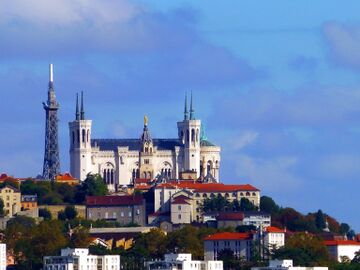
- Basilica of Notre-Dame de Fourvière, large 19th-century basilica on the top of Fourvière Hill
- Tour métallique de Fourvière (1894)
- Vacherie du Parc (1904–1905), designed by Tony Garnier.
- La Mouche Cattle Market and Abattoir (1914, 1928), also by Garnier
- Sainte Marie de La Tourette monastery (1960), designed by Le Corbusier
- Saint-Exupéry International Airport (formerly Satolas Airport), designed by Guillaume Gillet
- Gare de Lyon Saint-Exupéry (1994) by Santiago Calatrava
- Palais des congrès de Lyon (1998), designed by Renzo Piano and a group of buildings for various functions
- Tour du Crédit Lyonnais
- Tour Oxygène
- Tour Incity
- Great mosque of Lyon
-

-

-
-
 Fountain, place des Jacobins
 -

-
 Arch-epsicopal palace of Lyon (5th district public library)
 -

-
 Museum of Institut Lumière
 -
 Grande mosquée de Lyon
منظر من حديقة la Tête d'Or التي تحتوي على العديد من المنتزهات 
رسم جداري في منطقة الولايات المتحدة في الحي الثامن في 1995

.jpg&filetimestamp=20251207152724&)
.JPG&filetimestamp=20251207152723&)

_en_juin_2019.jpg&filetimestamp=20251207152733&)


Museums

- Musée des beaux-arts de Lyon (Fine Arts Museum), main museum of the city and one of the larger art galleries in France. Housed in the Palais Saint Pierre, a former 17th-century convent, it displays a major collection of paintings by artists (including Tintoretto; Paolo Veronese; Nicolas Poussin; Rubens; Rembrandt; Zurbaran; Canaletto; Delacroix; Monet; Gauguin; Van Gogh; Cézanne; Matisse; Picasso; Francis Bacon...); collections of sculptures, drawings and printings, decorative arts, Roman and Greek antiquities; the second largest collection of Egyptian antiquities in France after that of the Louvre; and a medal cabinet of 50.000 medals and coins.
- The Gallo-Roman Museum displaying many valuable objects and artworks found on the site of Roman Lyon (Lugdunum) such as Circus Games Mosaic, Coligny calendar and the Taurobolic Altar
- Centre d'histoire de la résistance et de la déportation
- Musée des Confluences, new museum of sciences and anthropology, which opened its doors on 20 December 2014
- La Sucrière, contemporary art centre
- Hôtel-Dieu de Lyon houses the "Musée des Hospices Civils", a permanent exhibit tracing the history and practice of medicine from the Middle Ages to modern times
- Musée des Tissus et des Arts décoratifs, decorative arts and textile museum, which is one of the world's larger textile collections with 2.5 million works
- Musée d'art contemporain de Lyon, contemporary art museum
- Musée de L'imprimerie, printing museum
- Musée Gadagne, museum of the history of Lyon housed in a historic building in Vieux Lyon, which includes a large collection of marionettes
- Musée des Automates, museum of automated puppets in Vieux Lyon, open since 1991
- Musée Miniature & Cinéma, museum featuring miniature movie sets, movie props, and special effects[46]
Parks and gardens

- Parc de la Tête d'or, aka Golden Head Park, in central Lyon is the largest urban park in France at 117 هكتار (290 acre). Located in the 6th arrondissement, it features a large lake on which boating takes place during the summer months.
- Jardin botanique de Lyon (8 هكتار؛ 20 acre), included in the Parc de la Tête d'Or, is a municipal botanical garden and is open weekdays without charge. The garden was established in 1857 as a successor to earlier botanical gardens dating to 1796, and now describes itself as France's largest municipal botanical garden.
- Parc de Gerland, in the south of the city (80 هكتار؛ 200 acre)
- Parc des hauteurs, in Fourvières
- Parc de Miribel-Jonage (2،200 هكتار؛ 5،400 acre)
- Parc de Lacroix-Laval (115 هكتار؛ 280 acre)
- Parc de Parilly (178 هكتار؛ 440 acre)
Economy

The GDP of Lyon was 124 billion US dollars in 2019,[ث][47] making it the second richest city in France after Paris. Lyon and its region Rhône-Alpes represent one of the most important economies in Europe and, according to Loughborough University, can be compared to Philadelphia, Mumbai or Athens with regard to its international position. The city of Lyon is working in partnership to more easily enable the establishment of new headquarters in the territory (ADERLY, Chambre du commerce et d'industrie, Grand Lyon...). High-tech industries such as biotechnology, software development, video game (Arkane Studios, Ivory Tower, Eden Games, EA France, Bandai Namco Entertainment Europe), and internet services are also growing. Other important sectors include medical research and technology, non-profit institutions, and universities. Lyon is home to the P4-Inserm–ean Merieux Laboratory which conducts top-level vaccine research.[48]
The city is home to the headquarters of many large companies such as Groupe SEB, Sanofi Pasteur, Renault Trucks, Norbert Dentressangle, LCL S.A., Descours & Cabaud, Merial, Point S, BioMérieux, Iveco Bus, Compagnie Nationale du Rhône, GL Events, April Group, Boiron, Feu Vert, Panzani, Babolat, Lyon Airports, LVL Medical, and inter-governmental agencies IARC and Interpol. The specialisation of some sectors of activities has led to the creation of many main business centres: La Part-Dieu, located in the 3rd arrondissement is the second biggest business quarter after La Défense in Paris with over 1،600،000 m2 (17،222،256.67 sq ft) of office space and services and more than 55,000 jobs.[49] Cité Internationale, created by the architect Renzo Piano is located in the border of the Parc de la Tête d'Or in the 6th arrondissement. The worldwide headquarters of Interpol is located there. The district of Confluence, in the south of the historic centre, is a new pole of economical and cultural development.
Tourism is an important part of the Lyon economy, with one billion euros in 2007 and 3.5 million hotel-nights in 2006 provided by non-residents.[citation needed] Approximately 60% of tourists visit for business, with the rest for leisure.[citation needed] In January 2009, Lyon ranked first in France for hostels business.[citation needed] The festivals most important for attracting tourists are the Fête des lumières, the Nuits de Fourvière every summer, the Biennale d'art contemporain and the Nuits Sonores.
الثقافة

Since the Middle Ages, the region residents have spoken several dialects of Franco-Provençal. The Lyonnais dialect was replaced by the French language as the importance of the city grew. However some "frenchified" Franco-Provençal words can also be heard in the French of the Lyonnais, who call their little boys and girls "gones" and "fenottes" for example.[50]
- The Lumière brothers pioneered cinema in the town in 1895. The Institut Lumière, built as Auguste Lumiere's house, and a fascinating piece of architecture in its own right, holds many of their first inventions and other early cinematic and photographic artifacts.
- 8 December each year is marked by the Festival of Lights (la Fête des lumières), a celebration of thanks to the Virgin Mary, who purportedly saved the city from a deadly plague in the Middle Ages. During the event, the local population places candles (luminions) at their windows and the city of Lyon organizes large-scale light shows onto the sides of important Lyonnais monuments, such as the medieval Cathédrale St-Jean.
- The Saint Francis of Sales church is famous for its large and unaltered Cavaillé-Coll pipe organ, attracting audiences from around the world.
- The Opéra Nouvel (New Opera House) is the home of the Opéra National de Lyon. The original opera house was re-designed by the distinguished French architect Jean Nouvel between 1985 and 1993 and is named after him.
- Lyon is also the French capital of "trompe l'œil" walls, a very ancient tradition. Many are to be seen around the city. This old tradition is now finding a contemporary expression, for example in the art of Guillaume Bottazzi.[51][52]
- The Brothers of the Sacred Heart, a Roman Catholic congregation that operates schools in Europe and North America, was founded in Lyon in 1821.
- The African Museum of Lyon is one of the oldest museums situated in Lyon.[53]
- The Museum of Resistance and Deportation looks at the various individuals prominent in the Resistance movement in World War II. The building is strongly linked to Klaus Barbie. Lyon sees itself as the centre of the French resistance and many members were shot in Place Bellecour in the town centre. The exhibition is largely a series of mini-biographies of those involved.
- Lyon is a pilot city of the Council of Europe and the European Commission Intercultural cities program.
UNESCO World Heritage Site

The historic site of Lyon was designated a UNESCO World Heritage Site in 1998. In its designation, UNESCO cited the "exceptional testimony to the continuity of urban settlement over more than two millennia on a site of great commercial and strategic significance."[38] The specific regions comprising the historic site include the Roman district and Fourvière, the Renaissance district (Vieux Lyon), the silk district (slopes of Croix-Rousse), and the Presqu'île, which features architecture from the 12th century to modern times.[54]
Both Vieux Lyon and the slopes of Croix-Rousse are known for their narrow passageways (named traboules) that pass through buildings and link streets on either side. The first examples of traboules are thought to have been built in Lyon in the 4th century.[55] The traboules allowed the inhabitants to get from their homes to the Saône quickly and allowed the canuts on the Croix-Rousse hill to get from their workshops to the textile merchants at the foot of the hill.
Gastronomy

Lyon has a long and chronicled culinary arts tradition. The noted food critic Curnonsky referred to the city as "the gastronomic capital of the world",[56] a claim repeated by later writers such as Bill Buford.[57] Renowned 3-star Michelin chefs such as Marie Bourgeois[58] and Eugénie Brazier[59] developed Lyonnaise cuisine into a national phenomenon favoured by the French elite; a tradition which Paul Bocuse later turned into a worldwide success.[60] The bouchon is a traditional Lyonnais restaurant that serves local fare such as sausages, duck pâté or roast pork, along with local wines. Two of France's best known wine-growing regions are located near the city: the Beaujolais region to the north and the Côtes du Rhône region to the south. Another Lyon tradition is a type of brunch food called "mâchons", made of local charcuterie and usually accompanied by Beaujolais red wine. Mâchons were the customary meal of the canuts, the city's silk workers, who ate a late-morning meal after they finished their shifts in the factories.[61]
Other traditional local dishes include coq au vin; quenelle; gras double; salade lyonnaise (lettuce with bacon, croûtons and a poached egg); and the sausage-based rosette lyonnaise and andouillette. Popular local confections include marron glacé and coussin de Lyon. Cervelle de canut (literally, "silk worker's brains") is a cheese spread/dip made of a base of fromage blanc, seasoned with chopped herbs, shallots, salt, pepper, olive oil and vinegar.
More recently, French tacos appears to have been invented in the early 2000s in the Lyon suburb Vaulx-en-Velin, though it might plausibly have been invented in nearby Grenoble. This street food became popular in the Lyon region and then across France; it is now famous worldwide.[62][63]
Sport

Lyon is home to the football club Olympique Lyonnais (OL), whose men's team plays in Ligue 1 and has won the championship of that competition seven times, all consecutively from 2002 to 2008.[64] OL played until December 2015 at the 43,000-seat Stade de Gerland, which also hosted matches of the 1998 FIFA World Cup. Since 2016, the team has played at the Parc Olympique Lyonnais, a 59,000-seat stadium located in the eastern suburb of Décines-Charpieu.[65] OL operates a women's team, OL Lyonnes, which competes in and dominates Division 1 Féminine. They won fourteen consecutive top-flight championships (2007–2020), and additionally claim the four titles won by the original incarnation of FC Lyon, a women's football club that merged into OL in 2004 (the current FC Lyon was founded in 2009). OL Lyonnes have also won the UEFA Women's Champions League eight times, including in five consecutive editions from 2016 to 2020, and hosted the 2019 FIFA Women's World Cup semi-finals as well as the Final on 7 July at Stade de Lyon.

Lyon has a rugby union team, Lyon OU, in the Top 14, which moved into Stade de Gerland full-time in 2017–18. In addition, Lyon has a rugby league side called Lyon Villeurbanne that plays in the French rugby league championship. The club's home is the Stade Georges Lyvet in Villeurbanne.
Lyon is also home to the Lyon Hockey Club, an ice hockey team that competes in France's national ice hockey league. The Patinoire Charlemagne is the seat of Club des Sports de Glace de Lyon, the club of Olympic ice dancing champions Marina Anissina and Gwendal Peizerat, and world champions Isabelle Delobel and Olivier Shoenfelder.[66] Lyon-Villeurbanne also has a basketball team, ASVEL, that plays at the Astroballe arena.
Street art
Since 2000, Birdy Kids, a group of graffiti artists from the city, has decorated several random buildings and walls along the Lyon ring road. In 2012, the artist collective was chosen to represent the city as its cultural ambassadors.[67]
Demographics
The population of the city (commune) of Lyon proper was 520,774 at the January 2022 census.[12] As of 2011, 14% of its population was born outside Metropolitan France.[68]
|
|
| |||||||||||||||||||||||||||||||||||||||||||||||||||||||||||||||||||||||||||||||||||||||||||||||||||||||||||||||||||||
| All figures come from population censuses. Figures from 1911 to 1936 (incl.) are the redressed figures calculated by INSEE to correct the overestimated population of Lyon published by the municipal authorities at the time (10,000s of false residents had been added by the municipal authorities to artificially inflate the population figures and remain the 2nd largest city of France ahead of Marseille).[69] The 1906 figure is the one published by the municipal authorities, probably already inflated, but not corrected by INSEE because the overestimate was smaller than 10,000. Source: EHESS[70] and INSEE[71] | |||||||||||||||||||||||||||||||||||||||||||||||||||||||||||||||||||||||||||||||||||||||||||||||||||||||||||||||||||||||
The city of Lyon and 58 suburban municipalities have formed since 2015 the Metropolis of Lyon, a directly elected metropolitan authority now in charge of most urban issues, with a population of 1,433,613 in 2022.[13]
|
|
| ||||||||||||||||||||||||||||||||||||||||||||||||||||||||||||||||||||||||||||||||||||||||||
| All figures come from population censuses. Figures from 1911 to 1936 (incl.) are computed using the redressed figures for the commune of Lyon calculated by INSEE to correct the overestimated population of Lyon published by the municipal authorities at the time (10,000s of false residents had been added by the municipal authorities to artificially inflate the population figures and remain the 2nd largest city of France ahead of Marseille).[69] The 1906 figure is computed using the figure for the commune of Lyon published by the municipal authorities, probably already inflated, but not corrected by INSEE because the overestimate was smaller than 10,000. Source: EHESS[72] and INSEE[73] | ||||||||||||||||||||||||||||||||||||||||||||||||||||||||||||||||||||||||||||||||||||||||||||
Foreign-born
| Country of birth | Population (2020) |
|---|---|
 الجزائر الجزائر |
14,779 |
 المغرب المغرب |
5,245 |
 تونس تونس |
4,879 |
 إيطاليا إيطاليا |
3,351 |
 الپرتغال الپرتغال |
3,068 |
 إسپانيا إسپانيا |
2,064 |
 الكونغو الديمقراطية الكونغو الديمقراطية |
1,520 |
 الصين الصين |
1,429 |
 الكاميرون الكاميرون |
1,364 |
 السنغال السنغال |
1,198 |
التعليم

الكليات والجامعات
- CPE Lyon
- École Centrale de Lyon
- ECAM Lyon (École Catholique d'Arts et Métiers de Lyon)
- EM Lyon (École de Management de Lyon)
- École Nationale des Travaux Publiques de l'Etat (ENTPE)
- École Normale Supérieure de Lyon
- École Normale Supérieure Lettres et Sciences Humaines
- École Nationale des beaux-arts de Lyon
- Institut National des Sciences Appliquées de Lyon (located in Villeurbanne)
- Institut d'études politiques de Lyon
- ISARA-Lyon Institut Supérieur D'Agriculture Rhône Alpes
- Institution des Chartreux
- Université Claude Bernard (Lyon I)
- Université Louis Lumière (Lyon II)
- Université Jean Moulin (Lyon III)
- Institut d'Administration des Entreprises de Lyon, Université Jean Moulin (Lyon III)
- Catholic University of Lyon
- Université professionelle internationale de Lyon (UPIL)
- ESDES Business School
- École Nationale des Travaux Publics de l'État
- Le Lycée du Parc
- La Martiniere Lyon
- Centre Européen d'Enseignement Supérieur de l'Ostéopathie- (CEESO)

المدارس الدولة في ليون
هناك العديد من المدارس الدولية في ليون ومن أهمها:
- EM مدرسة ليون التجارية
- أمبروسا(مدرسة خاصة)
- المدرسة الدولية في ليون (مدرسة خاصة)
- Cité Scolaire Internationale de Lyon

الرياضة

النقل
النقل الجوي
هناك مطار سانت إكسوپيري الدولي ويقع على بعد 20 كم من شرق مدينة ليون ، ويعمل على رحلات دولية وداخلية.
السكك الحديدية
يعمل خط القطار السريع للسكك الحديدية للتوصيل بين مدينة ليون والعديد من المدن مثل باريس وبروسيل وليل.وتعتبر مدينة ليون أول مدينة يعمل عليها خط القطار السريع منذ عام 1981.
حوادث
هجوم 2020

في 31 أكتوبر 2020، نقلت صحيفة پروگرس البريطانية، عن شهود عيان سماعهم دوي أعيرة نارية في الدائرة السابعة بمدينة ليون الفرنسية بالقرب من كنيسة الأرثودكس. ووفقاً للصحيفة، فإن الشرطة ضربت طوقاً أمنياً ووصلت وحدات خاصة إلى منطقة الحادثة. وأضافت الصحيفة أن أجهزة الأمن قامت بإجلاء جريح واحد، وحسب المعلومات الأولية يعمل كاهنا في الكنيسة. وبحسب قناة بي.إف.إم الفرنسية، تعرض كاهن أرثودكسي بالقرب من كنيسة الأرثودكس في الدائرة السابعة من مدينة ليون إلى إطلاق نار، مما أدى إلى إصابته بجراح خطرة، وقد لاذ المعتدي بالفرار. وقالت القناة أن الهجوم وقع عندما كان الكاهن يغلق الكنيسة، حيث أطلق المهاجم عليه النار مرتين. وبحسب عدد من وسائل الإعلام الفرنسية، يبلغ عمر المهاجم نحو 40 عاماً. كما دعا وزير الداخلية الفرنسي إلى تجنب منطقة ليون، حيث وقعت حادثة إطلاق النار.[75]
مدن شقيقة
Lyon is a pilot city of the Council of Europe and the European Commission "Intercultural cities" program.[76] Lyon is twinned with:[77]
 بير سبع، إسرائيل
 برمنگهام، المملكة المتحدة، منذ 1951
 كوريتيبا، البرازيل
 گوانگژو، الصين، منذ 1988
 ميلانو، إيطاليا، منذ 1966
 بيروت، لبنان
 سانت لويس، مزوري، الولايات المتحدة، منذ 1975
- فيلادلفيا، الولايات المتحدة
 فرانكفورت، ألمانيا، منذ 1960
- لايپتسيگ، ألمانيا، منذ 1981
 يوكوهاما، اليابان، منذ 1959
 كوتايسي، جورجيا، منذ 2006
 يرڤان، أرمنيا
 ووچ، پولندا، منذ 1992
 مونتريال، كويبك، كندا، منذ 1979[78]
 گوتنبورگ، السويد
 پتش، المجر
 كرايوڤا، رومانيا، منذ 1992
 ڤارنا، بلغاريا
 مونتينلوپا، الفلبين
 سانت پطرسبورگ، روسيا
- Paterson, New Jersey, United States
- Addis Ababa, Ethiopia
- Bamako, Mali
- Barcelona, Spain
- Beersheba, Israel
- Birmingham, England
- Boston, United States
- Craiova, Romania
- Curitiba, Brazil
- Frankfurt, Germany, since 1960
- Gothenburg, Sweden
- Guangzhou, China, since 1988
- Haute Matsiatra, Madagascar
- Ho Chi Minh City, Vietnam, since 1997
- Jericho, Palestine
- Leipzig, Germany, since 1981
- Łódź, Poland, since 1991
- Melbourne, Australia
- Milan, Italy, since 1966
- Montreal, Canada, since 1979
- Oran, Algeria
- Osaka, Japan, since 1984
- Ouagadougou, Burkina Faso
- Porto-Novo, Benin
- Rabat, Morocco
- St. Louis, United States[79]
- Saint Petersburg, Russia
- Sétif, Algeria
- Tinca, Romania
- Turin, Italy
- Yerevan, Armenia, since 1992
- Yokohama, Japan, since 1959
انظر أيضاً

- Gallia Lugdunensis
- List of movies set in Lyon
- List of people from Lyon
- List of streets and squares in Lyon
- Mères of France
مرئيات
| قوات الشرطة في محيط كنية الأرثوذكس بمدينة ليون، فرنسا ، بعد هجوم 31 أكتوبر 2020. |
ملاحظات
- ^ صيحة حرب من 1269، متهجاة باللهجة الفرانكو-پروڤنسال كالتالي Avant, Avant, Liyon lo mèlyor.
- ^ Quote من رسالة لـ شيشرون إلى لوكيوس موناتيوس پلانكوس، مؤسس المدينة.[4]
- ^ Pronunciation: UK: /ˈliːɒ̃/,[5][6] US: /liˈoʊn/ lee-OHN;[7][8] فرنسية: [ljɔ̃] استمع ; formerly spelled in English as Lyons (/ˈlaɪənz/ LY-ənz).[8][9] Arpitan: Liyon [ʎjɔ̃]; أوكسيتان: Lion, hist. Lionés.[10]
- ^ Constant PPP US dollars, base year 2015.
الهامش
- ^ "Répertoire national des élus: les maires" (in الفرنسية). data.gouv.fr, Plateforme ouverte des données publiques françaises. 13 September 2022.
- ^ "Comparateur de territoire - Aire d'attraction des villes 2020 de Lyon (002)". INSEE. Retrieved 16 January 2023.
- ^ أ ب INSEE. "Statistiques locales - Lyon : Aire d'attraction des villes 2020 - Population municipale 2022". Retrieved 8 July 2025.
- ^ "Cicero". Epistulae ad familiares, X.3. Retrieved 2 January 2020.
- ^ Wells, John C. (2008). Longman Pronunciation Dictionary (3 rd ed.). Longman. ISBN 978-1-4058-8118-0.
- ^ "Lyons". Lexico UK English Dictionary. Oxford University Press. Archived from the original on 24 January 2020.
- ^ Jones, Daniel (2011), Cambridge English Pronouncing Dictionary (18 ed.), Cambridge University Press, ISBN 978-0-521-15255-6
- ^ أ ب "Lyon". Merriam-Webster.com Dictionary. Merriam-Webster. OCLC 1032680871. Retrieved 8 August 2018.
- ^ "Lyons". Collins English Dictionary. HarperCollins. Retrieved 8 August 2018.
- ^ "dicod'Òc - Recèrca". locongres.org. Retrieved 1 April 2022.
- ^ "The main cities and towns of France". About-France.com. Retrieved 15 January 2025.
- ^ أ ب INSEE. "Statistiques locales - Lyon : Commune - Population municipale 2022" (in الفرنسية). Retrieved 8 July 2025.
- ^ أ ب "Statistiques locales - Métropole de Lyon : Intercommunalité-Métropole - Population municipale 2022". INSEE. Retrieved 8 July 2025.
- ^ "Lyon entrepreneurship, Lyon company, Invest Lyon – Greater Lyon". Business.greaterlyon.com. Archived from the original on 8 March 2010. Retrieved 3 April 2011.
- ^ "Classement 2019 des villes étudiantes les plus importantes en France". www.investirlmnp.fr. Retrieved 8 April 2022.
- ^ "GaWC - The World According to GaWC 2018". www.lboro.ac.uk.
- ^ "Quality of Living City Ranking | Mercer". mobilityexchange.mercer.com.
- ^ Mailhes, François; Piot, Cyrille; Rapini, Jean-Louis (2021). Les Miscellanées des Lyonnais. éditions du poutan.
- ^ "Lyon, d'où vient ton nom ?". Le Figaro (in الفرنسية). 30 March 2017. Retrieved 8 September 2023.
- ^ Pokorny, Julius (1959). Indogermanisches Etymologisches Wörterbuch (in الألمانية). French & European Publications, Inc.
- ^ Stich, Domenico (2003). Dictionnaire francoprovençal-français et français-francoprovençal (in الفرنسية). Le Carré. p. 189. ISBN 978-2908150155.
- ^ Cassius Dio, Roman History, Book 46: Lepidus and Lucius Plancus [...] founded the town called Lugudunum, now known as Lugdunum
- ^ Louis, Jaucourt de chevalier (1765). "Lyon". Encyclopedia of Diderot & d'Alembert - Collaborative Translation Project. hdl:2027/spo.did2222.0000.159.
- ^ "Endlichers Glossar/Endlicher's Glossary". www.maryjones.us. n.d. Retrieved 7 November 2021.
Lugduno – desiderato monte: dunum enim montem Lugduno: "mountain of yearning"; dunum of course is mountain.
www.maryjones.us/ctexts/endlicher_glossary.html - ^ Patrick Boucheron, et al., eds. France in the World: A New Global History (2019) pp 63-68.
- ^ "Saint Irenaeus". Sanctoral.com. Magnificat.
- ^ "2847-Primat des Gaules". France-catholique.fr. 13 September 2002. Archived from the original on 30 October 2019. Retrieved 20 December 2017.
- ^ Braudel 1984 p. 327
- ^ Pierre Edmond DESVIGNES. "Quartier renaissance Lyon : Vieux Lyon, quartier ancien et secteur sauvegarde Lyon". Vieux-lyon.org. Archived from the original on 19 January 2011. Retrieved 3 April 2011.
- ^ "Les anarchistes" [The anarchists]. La Dépêche. 3 January 1894. p. 2.
- ^ "Deux mille perquisitions". L'Estafette: 2. 2 January 1894.
- ^ "Une série générale de perquisitions : résultat négatif des recherches" [A general series of raids: negative results]. L'Éclair. 3 January 1894.
- ^ Bouhey 2009, p. 294-298.
- ^ "CHRD Lyon". Chrd.lyon.fr. 2017. Archived from the original on 24 January 2011. Retrieved 21 December 2017.
- ^ Cosgrove, Michael (4 June 2009). "Lyon: The Resistance and Deportation Museum". Digitaljournal.com.
- ^ (in فرنسية) Georges Duby (ed), Histoire de la France : Dynasties et révolutions, de 1348 à 1852 (vol. 2), Larousse, 1999 p. 53 ISBN 2-03-505047-2
- ^ "Lyon, France: Local Transport". Lonely Planet. Retrieved 2 February 2017.
- ^ أ ب "Historic Site of Lyon". unesco.org. UNESCO World Heritage Centre. Retrieved 31 July 2015.
- ^ Gregory, Stanley (1954). "Climatic Classification and Climatic Change (Klimaklassifikation und Klimaänderung)". Erdkunde. 8 (4): 246–252. doi:10.3112/erdkunde.1954.04.02. ISSN 0014-0015. JSTOR 25636095.
- ^ "Données climatiques de la station de Lyon: Relevés de 2016 – Lyon" (in الفرنسية). Meteo France. Archived from the original on 4 October 2016. Retrieved 2 October 2016.
- ^ "Lyon-Bron (69)" (PDF). Fiche Climatologique: Statistiques 1991–2020 et records (in الفرنسية). Meteo France. Retrieved 14 July 2022.
- ^ "Température et records en Août pour Lyon". meteo-lyon.net (in الفرنسية). Météo Villes. Retrieved 7 September 2023.
- ^ "Lyon–Bron (07480) - WMO Weather Station". NOAA (FTP). Retrieved 8 February 2019. (To view documents see Help:FTP) Archived 8 February 2019, at the Wayback Machine
- ^ "Normes et records 1961–1990: Lyon-Bron (69) – altitude 198m" (in الفرنسية). Infoclimat. Archived from the original on 3 March 2016. Retrieved 8 February 2019.
- ^ "St-Irénée – France". sacred-destinations.com.
- ^ "Discover the Musée Miniature et Cinéma in Lyon | Unique in Europe". Musée Miniature et Cinéma.
- ^ OECD. "City statistics : Economy". Retrieved 16 January 2023.
- ^ "Le laboratoire P4, ménagerie virale". Le Monde. France. Archived from the original on 6 June 2009. Retrieved 8 July 2009.
- ^ "Official site of Lyon". Grandlyon.com. Archived from the original on 24 April 2010. Retrieved 3 April 2011.
- ^ Jean-Baptiste Onofrio : Essai d'un glossaire des patois de Lyonnais, Forez et Beaujolais, Lyon 1864
- ^ "Pierre Alain Muet Archives 2008". Pa-muet.com. 17 June 2008. Archived from the original on 24 January 2010. Retrieved 25 January 2010.
- ^ "Bottazzi fait le mur". Brefonline.Com. Archived from the original on 25 November 2007. Retrieved 5 February 2009.
- ^ "The African Museum of Lyon Website". Musee-africain-lyon.org. Archived from the original on 19 February 2009. Retrieved 5 February 2009.
- ^ UNESCO World Heritage Site Archived 18 يوليو 2011 at the Wayback Machine. City of Lyon official website. Retrieved 26 November 2009.
- ^ Perret, Aurelie. "Les traboules de Lyon". histoire-pour-tous.fr. SF Webmedia. Retrieved 31 July 2015.
- ^ Curnonsky, Marcel E. Grancher (1935). Lyon, capitale mondiale de la gastronomie. Editions Lugdunum. Retrieved 30 July 2015.
- ^ Buford, Bill (12 February 2011). "Why Lyon is food capital of the world". The Guardian. Retrieved 11 December 2014.
- ^ "Priay Il y a 80 ans " La mère Bourgeois " obtenait 3 étoiles". leprogres.fr. Le Progres. 9 January 2013. Retrieved 30 July 2015.
- ^ "Histoire de la gastronomie 2/4". franceculture.fr. Radio France. Archived from the original on 5 June 2012. Retrieved 30 July 2015.
- ^ Gaudry, François-Régis (26 September 2014). "Paul Bocuse: derniers secrets du "pape" de la gastronomie française". lexpress.fr. Groupe Express-Roularta. Retrieved 30 July 2015.
- ^ "Cuisine et boissons Lyon et ses environs". routard.com. Cyberterre / Hachette tourisme. Retrieved 30 July 2015.
- ^ Bassets, Marc (20 June 2023). "The secret of the taco: modern, multicultural France's fast food phenomenon". El País. Retrieved 13 August 2024.
- ^ Collins, Lauren (12 April 2021). "The Unlikely Rise of the French Tacos". The New Yorker. Retrieved 13 August 2024.
- ^ "Avant d'être une compétition, le Trophée des champions est une vitrine pour la Ligue 1". webfootballclub.fr. Web Football Club. Archived from the original on 31 July 2015. Retrieved 31 July 2015.
- ^ Joly, Maxime. "Le Grand Stade de Lyon pourrait rapporter 70 millions d'euros par an à l'OL". lefigaro.fr. Le Figaro. Archived from the original on 5 September 2015. Retrieved 31 July 2015.
- ^ "Lyon 2e : 60 ans de sport de glace". leprogres.fr. Le Progres. 26 May 2015. Retrieved 31 July 2015.
- ^ "Birdy Kids – cultural ambassador of Lyon". lyon.fr. Archived from the original on 5 March 2016.
- ^ "Le nouveau profil de la population active immigrée". Institut national de la statistique et des études économiques.
- ^ أ ب Bienfait, Jean (1968). "La population de Lyon à travers un quart de siècle de recensements douteux (1911-1936)". Géocarrefour. Revue de géographie de Lyon. 43 (1): 80. doi:10.3406/geoca.1968.2625. Retrieved 16 October 2020.
- ^ Des villages de Cassini aux communes d'aujourd'hui: Commune data sheet Lyon, EHESS (in فرنسية).
- ^ "Évolution et structure de la population en 2022 - POP T1 - Population en historique depuis 1968". INSEE. Retrieved 14 July 2025.
- ^ EHESS. "Des villages de Cassini aux communes d'aujourd'hui". Retrieved 9 April 2022.
- ^ "Évolution et structure de la population en 2022 - POP T1 - Intercommunalité-Métropole de 7229 Métropole de Lyon (200046977) - Population en historique depuis 1968". INSEE. Retrieved 14 July 2025.
- ^ "IMG1B - Population immigrée par sexe, âge et pays de naissance en 2020 − Recensement de la population – Résultats pour toutes les communes, départements, régions, intercommunalités... −Étrangers - Immigrés en 2020 | Insee".
- ^ "إطلاق نار بالقرب من كنيسة الأرثودكس في مدينة ليون الفرنسية وإصابة كاهن بجروح". سپوتنك نيوز. 2020-10-31. Retrieved 2020-10-31.
- ^ Council of Europe (2011). "Intercultural city: Lyon, France". coe.int. Retrieved 22 May 2011.
- ^ "Jumelage". economie.grandlyon.com (in الفرنسية). Grand Lyon économie. Retrieved 14 November 2019.
- ^ Montreal partner city
- ^ "World Trade Center Saint Louis". worldtradecenter-stl.com. World Trade Center Saint Louis. Retrieved 18 May 2020.
وصلات خارجية
- Official website(in فرنسية)
- Visit Lyon, the official website for tourism in France
- Lyon Tourist Office and Convention Bureau
- Lyon’s English Language News and Information


| إيل دو فرانس |
|  |
|---|---|---|
| الحوض الپاريسي | ||
| أراضي كاليه الشمالية | ||
| الشرق |
| |
| الغرب | ||
| الجنوب الغربي | ||
| الشرق-الوسط | ||
| البحر المتوسط |
| |
| أقاليم متعددة | ||
| الأقسام والمناطق وراء البحار | ||
| ||
- Pages using gadget WikiMiniAtlas
- صفحات ذات رسوم بيانية قديمة فيغا
- صفحات بها مخططات
- Articles containing Arpitan-language text
- Pages with فرنسية IPA
- Pages including recorded pronunciations
- Pages with Franco-Provençal IPA
- Articles containing أوكسيتان (بعد 1500)-language text
- CS1 الفرنسية-language sources (fr)
- CS1 الألمانية-language sources (de)
- CS1: Julian–Gregorian uncertainty
- Articles with فرنسية-language sources (fr)
- Short description is different from Wikidata
- Articles with hatnote templates targeting a nonexistent page
- Missing redirects
- Pages using multiple image with auto scaled images
- Pages using infobox settlement with possible motto list
- Coordinates on Wikidata
- Pages using infobox French commune with unknown parameters
- مقالات فيها عبارات متقادمة منذ 2018
- جميع المقالات التي فيها عبارات متقادمة
- Articles with unsourced statements from November 2022
- Articles containing فرنسية-language text
- Official website different in Wikidata and Wikipedia
- ليون
- Communes of Rhône (department)
- أماكن مأهولة على الرون
- أقسام فرنسا
- Segusiavi
- ليونيه
- مواقع التراث العالمي في فرنسا
- مدن فرنسا
- صفحات مع الخرائط