توت أزرق
| توت أزرق | |
|---|---|

| |
| Vaccinium caesariense | |
التصنيف العلمي 
| |
| أصنوفة غير معروفة (أصلحها): | Vaccinieae |
| Genus: | Vaccinium |
| Section: | Blueberry Rydb. |
| Species | |
|
See text | |

التوت الأزرق (Blueberries) هو مجموعة منتشرة على نطاق واسع من النباتات المعمّرة المزهرة التي تنتج ثمارًا زرقاء أو أرجوانية. تُصنَّف هذه النباتات ضمن القسم Cyanococcus داخل جنس Vaccinium.[1] التوت الأزرق التجاري—سواء البري (منخفض الشجيرات) أو المزروع (مرتفع الشجيرات)—موطنه الأصلي جميعًا أمريكا الشمالية. وقد أُدخلت الأصناف مرتفعة الشجيرات إلى أوروبا خلال ثلاثينيات القرن العشرين.[2]
عادةً ما يكون التوت الأزرق شجيرات زاحفة شجيرية، ويتراوح ارتفاعها بين 10 سنتيمتر (4 بوصات) و4 متر (13 أقدام). في الإنتاج التجاري للتوت الأزرق، تُعرف الأنواع التي تحمل ثمارًا صغيرة بحجم حبة البازلاء وتنمو على شجيرات منخفضة باسم "lowbush blueberries" (وهي مرادفة لـ "wild")، بينما تُعرف الأنواع التي تنتج ثمارًا أكبر وتنمو على شجيرات أطول ومزروعة باسم "highbush blueberries". في عام 2024، كانت كندا أكبر منتج لتوت lowbush الأزرق، في حين أنتجت الولايات المتحدة نحو 29٪ من الإمداد العالمي لتوت highbush الأزرق.
الوصف

تنمو العديد من أنواع التوت الأزرق بريًا في أمريكا الشمالية، بما في ذلك Vaccinium myrtilloides، وV. angustifolium، وV. corymbosum، والتي تنمو على أرضيات الغابات أو بالقرب من المستنقعات.[3]
يتكاثر التوت الأزرق البري عن طريق التلقيح الخلطي، حيث تنتج كل بذرة نباتًا بتركيب وراثي مختلف، مما يؤدي داخل النوع الواحد إلى اختلافات في النمو، والإنتاجية، واللون، وخصائص الأوراق، ومقاومة الأمراض، والنكهة، وغيرها من خصائص الثمار.[3] يطوّر النبات الأم سيقانًا تحت الأرض تُسمّى الجذامير، مما يسمح للنبات بتكوين شبكة من الجذامير تُشكّل رقعة كبيرة (تُسمّى clone|نسيلة) تكون مميّزة وراثيًا.[3] تتكوّن الزهور وبراعم الأوراق بشكل متقطّع على طول سيقان النبات، حيث يعطي كل برعم زهري من 5 إلى 6 أزهار ثم الثمرة النهائية.[3] يفضّل التوت الأزرق البري تربةً حمضية يتراوح رقمها الهيدروجيني بين 4.2 و5.2 pH، مع كميات معتدلة فقط من الرطوبة.[3] ويتميّز بقدرة عالية على تحمّل البرودة ضمن نطاق انتشاره في كندا وشمال الولايات المتحدة.[3] تختلف إنتاجية ثمار التوت الأزرق البري منخفض النمو حسب درجة التلقيح، والتركيب الوراثي للنسيلة، وخصوبة التربة، وتوافر المياه، وانتشار الحشرات، وأمراض النبات، وظروف النمو المحلية.[3] ويبلغ متوسط الوزن الناضج لثمرة التوت الأزرق البري (منخفض النمو) نحو 0.3 غرام (1⁄128 oz).[3]
عادةً لا يقوم المزارعون بزراعة التوت الأزرق منخفض النمو، والذي يُسمّى أحيانًا «التوت الأزرق البري»، بل تتم إدارته في حقول توت تُعرف باسم “barrens|الأراضي البور”.[4] أما التوت الأزرق عالي النمو المزروع فيُفضّل التربة الرملية أو الطميّة، إذ يمتلك نظام جذور سطحيًا يستفيد من الغطاء العضوي والأسمدة.[5]
يمكن أن تكون أوراق التوت الأزرق عالي النمو إما متساقطة أو دائمة الخضرة، ويتراوح شكلها من بيضوي إلى رمحي، ويبلغ طولها 1–8 cm (1⁄2–3+1⁄4 in) وعرضها 0.5–3.5 cm (1⁄4–1+3⁄8 in). أما الأزهار فهي جرسية الشكل، بيضاء أو وردية فاتحة أو حمراء، وأحيانًا مائلة إلى الأخضر.
الثمرة هي عنبة يتراوح قطرها بين 5–16 mm (3⁄16–5⁄8 in)، ولها تاج متسع عند الطرف؛ تكون في البداية خضراء شاحبة، ثم أرجوانية مائلة إلى الأحمر، وأخيرًا زرقاء متجانسة عند النضج.[5] وتكون مغطاة بطبقة واقية من الشمع السطحي ذي القوام المسحوقي، ويُعرف عاميًّا باسم “bloom|الإزهار الشمعي”.[3] وعادةً ما يكون مذاقها حلوًا عند النضج، مع درجة حموضة متغيرة.[3][5]
تحمل شجيرات التوت الأزرق ثمارها غالبًا في منتصف موسم النمو؛ ويتأثر توقيت الإثمار بالظروف المحلية مثل المناخ، والارتفاع، وخط العرض، لذلك قد يختلف موسم الحصاد في نصف الكرة الشمالي من مايو إلى أغسطس.[3][5]
التعريف
عادةً ما تكون أنواع التوت الأزرق المعروضة تجاريًا مشتقة من أنواع لا توجد طبيعيًا إلا في شرق ووسط شمال أمريكا الشمالية. وتوجد أقسام أخرى ضمن نفس الجنس النباتي في مناطق مختلفة من العالم، بما في ذلك شمال غرب المحيط الهادئ وجنوب الولايات المتحدة،[6] وأمريكا الجنوبية، وأوروبا، وآسيا.
وفي العديد من هذه المناطق، تنتج شجيرات برية أخرى ثمارًا صالحة للأكل تشبه التوت الأزرق في شكلها، مثل هاكلبيري ووورتلبيري في أمريكا الشمالية، وbilberries (في أوروبا). وتُسمّى هذه الأنواع أحيانًا «توتًا أزرق»، وتُباع على شكل مربّى التوت الأزرق أو منتجات أخرى.
غالبًا ما تُترجم أسماء التوت الأزرق في اللغات غير الإنجليزية إلى معنى «التوت الأزرق»، مثل اللغة الاسكتلندية blaeberry، والنرويجية blåbær. وتشير كلمتا blaeberry وblåbær، وكذلك الفرنسية myrtilles، عادةً إلى النوع الأوروبي المحلي V. myrtillus (bilberry)، في حين تشير كلمة bleuets إلى التوت الأزرق القادم من أمريكا الشمالية.[citation needed]
الأنواع
Note: habitat and range summaries are from the Flora of New Brunswick, published in 1986 by Harold R. Hinds, and Plants of the Pacific Northwest coast, published in 1994 by Pojar and MacKinnon.
- Vaccinium angustifolium (lowbush blueberry):[7][8] acidic barrens, bogs and clearings, Manitoba to Labrador, south to Nova Scotia; and in the United States, from Maine westward to Iowa and southward to Virginia
- Vaccinium boreale (northern blueberry): peaty barrens, Quebec and Labrador (rare in New Brunswick), south to New York and Massachusetts[9]
- Vaccinium caesariense (New Jersey blueberry)
- Vaccinium corymbosum (northern highbush blueberry)[7]
- Vaccinium darrowii (evergreen blueberry)
- Vaccinium elliottii (Elliott blueberry)
- Vaccinium formosum (southern blueberry)
- Vaccinium fuscatum (black highbush blueberry; syn. V. atrococcum)
- Vaccinium hirsutum (hairy-fruited blueberry)
- Vaccinium myrsinites (shiny blueberry)
- Vaccinium myrtilloides (sour top, velvet leaf, or Canadian blueberry)
- Vaccinium pallidum (dryland blueberry)
- Vaccinium simulatum (upland highbush blueberry)
- Vaccinium tenellum (southern blueberry)
- Vaccinium virgatum (rabbiteye blueberry; syn. V. ashei)[7]
Some other blue-fruited species of Vaccinium:
- Vaccinium koreanum (Korean blueberry)
- Vaccinium myrtillus (bilberry or European blueberry)
- Vaccinium uliginosum (bog bilberry/blueberry, northern bilberry or western blueberry)
-
 Wild blueberry in autumn foliage, Pilot Mountain, North Carolina, in October
 -
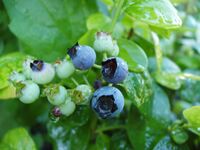 A maturing 'Polaris' blueberry (Vaccinium corymbosum)
 -
 A selection of blueberries, showing the typical sizes of the berries. The scale is marked in centimeters.


The lowbush varieties are V. angustifolium, V. boreale, V. mytilloides, V. pallidum, and V. angustifolium × V. corymbosum. They are still grown similarly to pre-Columbian semi-wild cultivation, i.e. slash and burn. The highbush varieties are darrowii and corymbosum. Rabbiteye (V. ashei/V. virgatum) differ from both high- and lowbush.[8]
التوزيع

.jpg&filetimestamp=20260126055809&)
يتميّز جنس Vaccinium بانتشارٍ واسعٍ في المناطق شبه القطبية، حيث تتواجد أنواعه بشكل رئيسي في أمريكا الشمالية، وأوروبا، وآسيا.[1] وتنتمي العديد من الأنواع المتاحة تجاريًا، والتي تحمل أسماء شائعة باللغة الإنجليزية مثل «التوت الأزرق»، إلى أمريكا الشمالية،[8] ولا سيّما كندا الأطلسية وشمال شرق الولايات المتحدة بالنسبة للتوت الأزرق البري (منخفض الشجيرات)، وكذلك عدة ولايات أمريكية وكولومبيا البريطانية بالنسبة للتوت الأزرق المزروع (عالي الشجيرات).[10][11]
تُزرع الأنواع الأصلية من التوت الأزرق في أمريكا الشمالية تجاريًا في نصف الكرة الجنوبي، في أستراليا ونيوزيلندا ودول أمريكا الجنوبية. ويُعد Vaccinium meridionale (توت الأنديز الأزرق) نوعًا يُجمع بريًا، وهو متوفر على نطاق واسع محليًا.[12]
كما تنتج عدة شجيرات برية أخرى من جنس Vaccinium ثمارًا زرقاء تُؤكل على نطاق واسع، مثل النوع الأوروبي الغالب V. myrtillus وأنواع أخرى من البيلبيري، والتي تحمل في العديد من اللغات اسمًا يُترجم إلى «التوت الأزرق» باللغة الإنجليزية.
الزراعة

Blueberries may be cultivated, or they may be picked from semiwild or wild bushes. In North America, the most common cultivated species is V. corymbosum, the northern highbush blueberry. Hybrids of this with other Vaccinium species adapted to southern U.S. climates are known collectively as southern highbush blueberries.[13] Highbush blueberries were first cultivated in New Jersey around the beginning of the 20th century.[11][8]
So-called "wild" (lowbush) blueberries, smaller than cultivated highbush ones, have intense color. V. angustifolium (lowbush blueberry) is found from the Atlantic provinces westward to Quebec and southward to Michigan and West Virginia. In some areas, it produces natural "blueberry barrens", where it is the dominant species covering large areas. Several First Nations communities in Ontario are involved in harvesting wild blueberries.
"Wild" has been adopted as a marketing term for harvests of managed native stands of lowbush blueberries. The bushes are not planted or selectively bred, but they are pruned or burned over every two years, and pests are "managed".[14]
Numerous highbush cultivars of blueberries are available, with diversity among them, each having individual qualities. A blueberry breeding program has been established by the USDA-ARS breeding program at Beltsville, Maryland, and Chatsworth, New Jersey. This program began when Frederick Vernon Coville of the USDA-ARS collaborated with Elizabeth Coleman White of New Jersey.[15] In the early part of the 20th century, White offered pineland residents cash for wild blueberry plants with unusually large fruit.[16] After 1910 Coville began to work on blueberry, and was the first to discover the importance of soil acidity (blueberries need highly acidic soil), that blueberries do not self-pollinate, and the effects of cold on blueberries and other plants.[17] In 1911, he began a program of research in conjunction with White, daughter of the owner of the extensive cranberry bogs at Whitesbog in the New Jersey Pine Barrens. His work doubled the size of some strains' fruit, and by 1916, he had succeeded in cultivating blueberries, making them a valuable crop in the Northeastern United States.[16][18] For this work he received the George Roberts White Medal of Honor from the Massachusetts Horticultural Society.
The rabbiteye blueberry (Vaccinium virgatum syn. V. ashei) is a southern type of blueberry produced from the Carolinas to the Gulf Coast states. Production of rabbiteye blueberries was a focus in Texas in the early 21st century.[19] Other important species in North America include V. pallidum, the hillside or dryland blueberry. It is native to the eastern U.S., and common in the Appalachians and the Piedmont of the Southeast. Sparkleberry, V. arboreum, is a common wild species on sandy soils in the Southeast.
Successful blueberry cultivation requires attention to soil pH (acidity) measurements in the acidic range.[20][21][22]
Blueberry bushes often require supplemental fertilization,[21] but over-fertilization with nitrogen can damage plant health, as evidenced by nitrogen burn visible on the leaves.[20][21]
مناطق الزراعة

Significant production of highbush blueberries occurs in British Columbia, Maryland, Western Oregon, Michigan, New Jersey, North Carolina, and Washington. The production of southern highbush varieties occurs in California, as varieties originating from University of Florida, Connecticut, New Hampshire, North Carolina State University and Maine have been introduced.
Peru, Spain, and Mexico also have significant production, as of 2023 (see Production).[23]
الولايات المتحدة
In 2018, Oregon produced the most cultivated blueberries, recording 59 million كيلوغرام (131 million رطل), an amount slightly exceeding the production by Washington.[24] In descending order of production volume for 2017, other major producers were Georgia, Michigan, New Jersey, California, and North Carolina.[25]
Hammonton, New Jersey, claims to be the "Blueberry Capital of the World",[26] with over 80% of New Jersey's cultivated blueberries coming from this town.[27] Every year the town hosts a large festival, which draws thousands of people to celebrate the fruit.[28]
Maine is known for its wild blueberries,[29] but the state's lowbush (wild) and highbush blueberries combined account for 10% of all blueberries grown in North America. Some 44،000 هكتار (110،000 acre) are farmed, but only half of this acreage is harvested each year due to variations in pruning practices.[30] The wild blueberry is the official fruit of Maine.[31]
كندا
.jpg&filetimestamp=20260126055807&)
Canadian production of wild and cultivated blueberries in 2024 was 165,608 tonnes, the country's second-largest fruit crop (after apples).[32] British Columbia was the largest Canadian producer of cultivated (highbush) blueberries, yielding 94% of the total national production in 2024.[32]
With Quebec as the leading producer (47% of total) of wild (lowbush) blueberries, Atlantic Canada contributed the other half of the total Canadian production from New Brunswick (26%), Nova Scotia (17%), and Prince Edward Island (10%) in 2024.[32] The town of Oxford, Nova Scotia is known as the Wild Blueberry Capital of Canada.[33]
Québec production of lowbush blueberries occurs especially in the regions of Saguenay-Lac-Saint-Jean (where a popular name for inhabitants of the regions is bleuets, or "blueberries") and Côte-Nord, which together provide 40% of Québec's total provincial production. This wild blueberry commerce benefits from vertical integration of growing, processing, frozen storage, marketing, and transportation within relatively small regions of the province.[34] On average, 80% of Québec wild blueberries are harvested on farms (21 million كيلوغرام (23،000 short ton)), the remaining 20% being harvested from public forests (5 million كيلوغرام (5،500 short ton)).[34] Some 95% of the wild blueberry crop in Québec is frozen for export out of the province.[34]
أوروبا
Highbush blueberries were first introduced to Germany, Sweden, and the Netherlands in the 1930s, and have since been spread to numerous other countries of Europe.[2] V. corymbosum only began to be cultivated in Romania in a few years leading up to 2018 and rapidly increased in production and sales in that time (as with berries in general). اعتبارا من 2018[تحديث] it remains relatively unmolested by pests and diseases (see Diseases below).[35]
نصف الكرة الجنوبي

In the Southern Hemisphere, Brazil, Chile, Argentina, Peru, Uruguay, New Zealand, Australia, South Africa,[37] and Zimbabwe grow blueberries commercially.[38]
In Brazil, blueberries are produced in the states of Rio Grande do Sul, Santa Catarina, Paraná, São Paulo and Minas Gerais.[39]
Blueberries were first introduced to Australia in the 1950s, but the effort was unsuccessful. In the early 1970s, the Victorian Department of Agriculture imported seed from the U.S., and a selection trial was started. This work was continued into the mid-1970s when the Australian Blueberry Growers' Association was formed.[40]
In the 21st century, the industry grew in Argentina: "Argentine blueberry production has increased over the last three years with planted area up to 400 percent," according to a 2005 report by the U.S. Department of Agriculture.[41] "Argentine blueberry production has thrived in four different regions: the province of Entre Rios in northeastern Argentina, the province of Tucuman, the province of Buenos Aires and the southern Patagonian valleys", according to the report.[42] In the Bureau of International Labor Affairs report of 2014 on child labor and forced labor, blueberries were listed among the goods produced in such working conditions in Argentina.[43]
الآفات والأمراض
الأمراض
اعتبارا من 2018[تحديث] V. corymbosum remains relatively unmolested by pests and diseases in Romania, with Phytophthora cinnamomi, Monilinia vaccinii-corymbosi, Botryosphaeria corticis, Godronia cassandrae, Phomopsis sp., Botrytis cinerea, Naohidemyces vaccinii, Microsphaera penicillata var. vaccinii, and various viruses being the most common.[35]
مكافحة الآفات
المبيدات الحشرية
DDT began to be used in blueberry soon after its discovery in 1939, and a few years later in the mid-1940s research began into its use in North America.[8]
Because "wild" is a marketing term generally used for all low-bush blueberries, it does not indicate that such blueberries are free from pesticides.[44]
Insecticide modes of action must be varied to avoid encouraging resistance in the invasive pest Drosophila suzukii.[8]
Some insecticides can be counterproductive, harming natural enemies of pests as well. For example, treatment for Illinoia pepperi can reduce populations of its predators. Kaolin clay for Rhagoletis mendax also reduced effectiveness of Diachasma alloeum, its parasitoid. The pest predator Harpalus erraticus maintains greater abundance with selective insecticides rather than broad-spectrum MoAs.[8]
الإدارة المتكاملة للآفات
Blueberries are naturally relatively unmolested by arthropod pests. Nonetheless, there are 24 insect taxa known to be pest (organism)s in North America, the worst in New Jersey, Michigan, Maine, and Eastern Canada being Rhagoletis mendax. Secondary but still important are Acrobasis vaccinii, Grapholita packardi, and Conotrachelus nenuphar. These four are the most common targets for the development of IPM practices. اعتبارا من 2019[تحديث], IPM research has also taken an interest in Drosophila suzukii and arthropods like aphids (that vector diseases such as scorch virus and shoestring virus) and cicadellids (vectoring the phytoplasma that causes blueberry stunt). Managing pests down to the cosmetic level is necessary for this fruit because they are a premium product.[8]
Changes in locale and environment – to new geographies, and into greenhouses – have required new pest management regimes, including innovative IPM. Conversely, importing foreign potential enemies into North America may yield good results: Operophtera brumata is a pest of blueberries and birches which is successfully parasitized by Cyzenis albicans despite the lack of historical, natural contact between the two. The same results were obtained with Scirtothrips citri and Beauveria bassiana. Results are available for Choristoneura rosaceana and overwhelming numbers of Trichogramma minutum, and Cyclocephala longula overwhelmed by Steinernema scarabaei. This has also been attempted with flower thrips and potential predators but with inconclusive results.[8]
الحجر الصحي الدولي
Rhagoletis mendax is a quarantine pest in phytosanitary regimes of some countries around the world.[8]
الأصناف المقاومة
Insect resistance was not a priority in breeding programs until about the year 2000 and is still not a high priority. However, it may become more common as it becomes easier, especially using marker-assisted breeding. V. ashei is naturally more resistant than V. corymbosum to Scaphytopius magdalensis. V. ashei is less resistant than V. darrowii to Prodiplosis vaccinia. There is variation between cultivars of V. ashei in resistance to Oberea myops. There is variation in resistance among cultivars of V. corymbosum to Acrobasis vaccinii and Popillia japonica. Wild V. spp. have greater resistance than highbush cultivars to I. pepperi. There is significant variation between highbush cultivars in the abundance of various Tephritidae, thrips, and Homalodisca vitripennis.[8]
 الولايات المتحدة الولايات المتحدة |
401,970 |
.svg&filetimestamp=20070823193424&) پيرو پيرو |
353,600 |
 كندا كندا |
165,608 |
 تشيلي تشيلي |
97,219 |
 المكسيك المكسيك |
80,534 |
 إسپانيا إسپانيا |
60,950 |
| World | 1,392,534 |
| Source: FAOSTAT of the United Nations[45] | |
الإنتاج
في 2024، بلغ الإنتاج العالمي للتوت البري (التوت البري المنخفض والتوت البري المرتفع معًا) 1.4 مليون طن، وكانت الولايات المتحدة تتصدر الإنتاج بنسبة 29% من الإجمالي، تليها بيرو بنسبة 25%، وكندا بنسبة 12%.[32]
كيبيك أنتجت 43,997 طن من التوت البري المنخفض، وهو ما يمثل 47% من إجمالي الإنتاج الكندي في 2024.[32]
الحصاد
اللوائح
تتميز جميع حبات التوت الأزرق الكندية من الدرجة الأولى بتشابهها في الحجم والشكل والوزن واللون، ولا يجوز أن تتجاوز نسبة المنتج الإجمالي المعيب في اللون 10%، ونسبة العيوب الأخرى 3%.[46]
التغذية
Blueberries are 84% water, 14% carbohydrates, 1% protein, and contain negligible fat (table). In a reference amount of 100 g (3.5 oz), blueberries supply 57 calories of food energy, and are a moderate source (11-16% of the Daily Value, DV) of vitamin K, vitamin C, and manganese, with no other micronutrients in significant content (table).
 | |
| القيمة الغذائية لكل 100 g (3.5 oz) | |
|---|---|
| الطاقة | 240 kJ (57 kcal) |
14.49 g | |
| Sugars | 9.96 g |
| ألياف غذائية | 2.4 g |
0.33 g | |
0.74 g | |
| الڤيتامينات | |
| مكافئ ڤيتامين أ | (0%) 32 μg80 μg |
| ڤيتامين أ | 54 IU |
| ثيامين (B1) | (3%) 0.037 mg |
| ريبوفلاڤين (B2) | (3%) 0.041 mg |
| نياسين (B3) | (3%) 0.418 mg |
(2%) 0.124 mg | |
| ڤيتامين B6 | (4%) 0.052 mg |
| فولات (B9) | (2%) 6 μg |
| Vitamin C | (12%) 9.7 mg |
| ڤيتامين E | (4%) 0.57 mg |
| ڤيتامين ك | (18%) 19.3 μg |
| آثار فلزات | |
| كالسيوم | (1%) 6 mg |
| حديد | (2%) 0.28 mg |
| الماغنسيوم | (2%) 6 mg |
| المنگنيز | (16%) 0.336 mg |
| فوسفور | (2%) 12 mg |
| پوتاسيوم | (2%) 77 mg |
| صوديوم | (0%) 1 mg |
| زنك | (2%) 0.165 mg |
| مكونات أخرى | |
| ماء | 84 g |
| |
| Percentages are roughly approximated using US recommendations for adults. | |
المواد الكيميائية النباتية والبحوث
Blueberries contain anthocyanins, other polyphenols and various phytochemicals under preliminary research for their potential biological effects.[47] Most polyphenol studies have been conducted using the highbush cultivar of blueberries (V. corymbosum), while content of polyphenols and anthocyanins in lowbush (wild) blueberries (V. angustifolium) exceeds values found in highbush cultivars.[48]
الاستخدامات

Blueberries are sold fresh or are processed as individually quick frozen fruit, purée, juice, or dried or infused berries. These may then be used in a variety of consumer goods, such as jellies, jams, pies, muffins, snack foods, pancakes, or as an additive to breakfast cereals.
Blueberry jam is made from blueberries, sugar, water, and fruit pectin. Blueberry sauce is a sweet sauce prepared using blueberries as a primary ingredient.
Blueberry wine is made from the flesh and skin of the berries, which is fermented and then matured; usually, the lowbush variety is used.
معرض الصور
-
 A cut blueberry showing how, having been frozen and then thawed, the anthocyanins in the pericarp can run into the flesh
 -
 Core structure common to all anthocyanins, some of which produce the blue pigments in blueberries


انظر أيضًا

المصادر
- ^ أ ب Lisa J. Rowland; Freddi A. Hammerschlag (2005). Richard E. Litz (ed.). Vaccinium spp. (8.1: Blueberry). In: Biotechnology of Fruit and Nut Crops: Volume 29 of Biotechnology in Agriculture Series. CABI. ISBN 0-85199-066-5. Archived from the original on December 12, 2020. Retrieved September 21, 2020.
{{cite book}}: line feed character in|title=at position 12 (help) - ^ أ ب Naumann, W. D. (1993). "Overview of the Vaccinium Industry in Western Europe". In K. A. Clayton-Greene (ed.). Fifth International Symposium on Vaccinium Culture. Wageningen, the Netherlands: International Society for Horticultural Science. pp. 53–58. ISBN 978-90-6605-475-2. OCLC 29663461. Archived from the original on March 11, 2007. Retrieved August 25, 2006.
- ^ أ ب ت ث ج ح خ د ذ ر ز "Wild Blueberry Fact Sheet A.2.0. Growth and Development of the Wild Blueberry" (PDF). Agriculture, Aquaculture and Fisheries, Province of New Brunswick, Canada. Archived (PDF) from the original on July 17, 2017. Retrieved February 5, 2020.
- ^ "Preservation by Celebration: Wild Blueberry Barrens of Down East Maine". Living Landscape Observer. 2021. Retrieved 21 May 2025.
- ^ أ ب ت ث Becky Sideman (August 1, 2016). "Growing fruit: Highbush blueberries" (PDF). University of New Hampshire Cooperative Extension. Archived (PDF) from the original on September 25, 2020. Retrieved February 5, 2020.
- ^ "Plants Profile: Vaccinium corymbosum L., Highbush blueberry". US Department of Agriculture, National Resources Conservation Service. 2013. Archived from the original on May 2, 2013. Retrieved April 30, 2013.
- ^ أ ب ت Plunkett, Blue J.; Espley, Richard V.; Dare, Andrew P.; Warren, Ben A. W.; Grierson, Ella R. P.; Cordiner, Sarah; Turner, Janice L.; Allan, Andrew C.; Albert, Nick W.; Davies, Kevin M.; Schwinn, Kathy E. (September 11, 2018). "MYBA From Blueberry (Vaccinium Section Cyanococcus) Is a Subgroup 6 Type R2R3MYB Transcription Factor That Activates Anthocyanin Production". Frontiers in Plant Science. 9: 1300. doi:10.3389/fpls.2018.01300. ISSN 1664-462X. PMC 6141686. PMID 30254656.
- ^ أ ب ت ث ج ح خ د ذ ر ز Rodriguez-Saona, Cesar; Vincent, Charles; Isaacs, Rufus (January 7, 2019). "Blueberry IPM: Past Successes and Future Challenges". Annual Review of Entomology. Annual Reviews. 64 (1): 95–114. doi:10.1146/annurev-ento-011118-112147. ISSN 0066-4170. PMID 30629894. S2CID 58573080.
- ^ "Vaccinium boreale Hall & Aalders". Maine Department of Agriculture, Conservation & Forestry. Retrieved 2025-11-06.
- ^ "Canadian blueberries". Agriculture and Agri-Food Canada, Government of Canada. August 9, 2018. Archived from the original on February 20, 2020. Retrieved February 5, 2020.
- ^ أ ب "Blueberries – Celebrating 100 Years". Blueberry.org. US Highbush Blueberry Council. 2020. Archived from the original on April 9, 2020. Retrieved February 5, 2020.
- ^ Foster, Steven (2012). "The Adulteration of Commercial Bilberry Extracts" (PDF). Academia. Archived from the original (PDF) on May 16, 2021. Retrieved May
16, 2021 – via Herbalgram.
{{cite journal}}: Check date values in:|access-date=(help); line feed character in|access-date=at position 4 (help) - ^ "Growing Highbush Blueberries" (PDF). University of New Hampshire-Extension. Archived (PDF) from the original on September 27, 2013. Retrieved September 22, 2013.
- ^ "Wild Blueberry Network Information Centre". Wild Blueberry Network Information Centre. Archived from the original on October 15, 2018. Retrieved October 15, 2018.
- ^ "Blueberry Growing Comes to the National Agricultural Library". US Department of Agriculture, Agricultural Research Magazine, Vol. 59, No. 5. June 2011. Archived from the original on July 9, 2011. Retrieved June 17, 2011.
- ^ أ ب "The History of Whitesbog Village". Whitesbog.org. 2014. Archived from the original on May 15, 2008. Retrieved October 11, 2011.
- ^ Mirsky, Steve. "Early 20th Century Botanist Gave Us Domesticated Blueberries". Scientific American. Archived from the original on September 27, 2013. Retrieved September 21, 2013.
- ^ Jim Minick (June 29, 2016). "The Delicious Origins of The Domesticated Blueberry". JSTOR News. Archived from the original on February 8, 2018. Retrieved June 30, 2016.
- ^ Monte Nesbitt; Jim Kamas; Larry Stein (2013). "Blueberries" (PDF). Texas A&M University, AgriLife Extension Service. Archived (PDF) from the original on September 5, 2019. Retrieved April 27, 2019.
- ^ أ ب Longstroth M (2014). "Lowering the soil pH with sulfur" (PDF). Michigan State University. Archived from the original (PDF) on November 16, 2015. Retrieved August 24, 2015.
- ^ أ ب ت Hayden RA (2001). "Fertilizing blueberries" (PDF). Purdue University, Department of Horticulture. Archived (PDF) from the original on October 11, 2015. Retrieved September 5, 2015.
- ^ "Cornell fruit: berry diagnostic tool". Cornell University, Department of Horticulture. 2013. Archived from the original on September 12, 2015. Retrieved September 5, 2015.
- ^ "Where Are Blueberries Grown?". World Atlas. April 25, 2017. Archived from the original on April 27, 2019. Retrieved April 27, 2019.
- ^ Mitch Lies (December 31, 2018). "Record year makes Oregon top blueberry producer". Capital Press. Salem, OR. Archived from the original on April 27, 2019. Retrieved April 27, 2019.
- ^ "Top 10 Blueberry Producing States In America". World Atlas. 2019. Archived from the original on April 27, 2019. Retrieved April 27, 2019.
- ^ "Home: Welcome to the Town of Hammonton". Town of Hammonton. September 11, 2013. Archived from the original on November 11, 2013. Retrieved November 6, 2013.
- ^ "The Beautiful Blueberry!". Pineypower.com. 2018. Archived from the original on July 11, 2018. Retrieved July 10, 2018.
- ^ "Hammonton Chamber of Commerce". Hammontonnj.us. 2018. Archived from the original on December 12, 2020. Retrieved July 10, 2018.
- ^ "Maine's Famous Blue Fruit", Maine Office of Tourism; accessed 2022.01.22.
- ^ David E. Yarborough (February 2015). "Wild Blueberry Culture in Maine". Cooperative Extension: Maine Wild Blueberries. Cooperative Extension: Maine Wild Blueberries, University of Maine. Archived from the original on March 6, 2016. Retrieved April 20, 2016.
- ^ "State Berry – Wild Blueberry". Secretary of State for Maine, Matthew Dunlap. 2007. Archived from the original on September 24, 2017. Retrieved July 8, 2017.
- ^ أ ب ت ث ج "Statistical overview of the Canadian fruit industry, 2024". Agriculture and Agri-Food Canada, Government of Canada. 16 July 2025. Retrieved 27 July 2025.
- ^ "Wild blueberry trivia". Wild Blueberry Producers Associations of Nova Scotia. 2016. Archived from the original on May 24, 2016. Retrieved May 18, 2016.
- ^ أ ب ت Gagnon A (2006). "Wild Blueberry Production Guide in a Context of Sustainable Development: Survey of the Wild Blueberry Industry in Québec" (PDF). Ministère de l'Agriculture, des Pêcheries et de l'Alimentation du Québec. Archived (PDF) from the original on February 4, 2015. Retrieved February 4, 2015.
- ^ أ ب Slav, M.; Hoza, D.; Asănică, A. (2018). "Researches on the presence and aggressivity of the blueberry root rot (Phytophthora cinnamomi) in a Dâmbovița county plantation". Journal of Horticulture, Forestry and Biotechnology. 22 (4): 7–12. ref.15
- ^ "Vaccinium meridionale Sw". The Plant List.
- ^ "Where blueberries grow". Blueberry.org. U.S. Highbush Blueberry Council. 2019. Archived from the original on July 28, 2020. Retrieved July 27, 2020.
- ^ "Harvesting commences at one of Zimbabwe's bigger blueberry projects". The Zimbabwean (in الإنجليزية الأمريكية). July 3, 2020. Archived from the original on August 12, 2020. Retrieved November 20, 2020.
- ^ Cultivar, Grupo (September 13, 2016). "Propagação eficiente de mirtilo". Grupo Cultivar (in البرتغالية البرازيلية). Retrieved March 8, 2021.
- ^ "Australian Blueberry Growers' Association". Australianblueberries.com.au. Archived from the original on September 6, 2013. Retrieved November 6, 2013.
- ^ U.S. Department of Agriculture GAIN Report , Retrieved June 30, 2011
- ^ Pirovano, Francisco (January 12, 2005). "Argentina Blueberries Voluntary 2005". GAIN Report. Foreign Agricultural Service. Archived from the original on October 16, 2008. Retrieved June 22, 2009.
- ^ "List of Goods Produced by Child Labor or Forced Labor". dol.gov. Archived from the original on June 10, 2015. Retrieved January 9, 2015.
- ^ "Catching the Toxic Drift: How Pesticides Used in the Blueberry Industry Threaten Our Communities, Our Water and the Environment". Environment Maine. August 16, 2005. Archived from the original on March 1, 2011. Retrieved October 11, 2011.
- ^ "Blueberry production in 2023; Crops/Regions/World list/Production Quantity/Year (pick lists)". UN Food and Agriculture Organization, Corporate Statistical Database (FAOSTAT). 2026. Retrieved 17 January 2026.
- ^ Government of Canada, Canadian Food Inspection Agency (March 2, 2018). "Grades and Requirements for Blueberries; In: Canadian Grade Compendium; Volume 2 – Fresh Fruit or Vegetables". inspection.gc.ca. Archived from the original on April 29, 2019. Retrieved July 12, 2019.
- ^ "Flavonoids". Micronutrient Information Center, Linus Pauling Institute, Oregon State University, Corvallis, OR. 2026. Retrieved 17 January 2026.
- ^ Kalt W, Ryan DA, Duy JC, Prior RL, Ehlenfeldt MK, Vander Kloet SP (October 2001). "Interspecific variation in anthocyanins, phenolics, and antioxidant capacity among genotypes of highbush and lowbush blueberries (Vaccinium cyanococcus spp.)". J Agric Food Chem. 49 (10): 4761–7. doi:10.1021/jf010653e. ISSN 0021-8561. PMID 11600018.
قراءات إضافية
- Retamales, J. B., Hancock, J. F. (2012). Blueberries (Crop Production Science in Horticulture). CABI. ISBN 978-1-84593-826-0
- Sumner, Judith (2004). American Household Botany: A History of Useful Plants, 1620–1900. Timber Press. p. 125. ISBN 0-88192-652-3.
- Wright, Virginia (2011). The Wild Blueberry Book. Down East Books. ISBN 978-0-89272-939-5.


- CS1 errors: invisible characters
- CS1 الإنجليزية الأمريكية-language sources (en-us)
- CS1 البرتغالية البرازيلية-language sources (pt-br)
- Short description matches Wikidata
- Automatic taxobox cleanup
- Articles with unsourced statements from November 2025
- Articles with hatnote templates targeting a nonexistent page
- مقالات فيها عبارات متقادمة منذ 2018
- جميع المقالات التي فيها عبارات متقادمة
- مقالات فيها عبارات متقادمة منذ 2019
- Pages with empty portal template
- Portal-inline template with redlinked portals
- Blueberries
- Berries
- Crops originating from North America
- Flora of Northern America
- Fruits originating in North America
- Plants used in Native American cuisine
- Shrubs
- Symbols of New Jersey
- Vaccinium
- Crops originating from indigenous Americans
- Provincial symbols of Nova Scotia