كارنوفكس
| كارنوفكس Carnufex | |
|---|---|

| |
| إعادة بناء كارنوفوكس كاروليننسس. | |
التصنيف العلمي 
| |
| Phylum: | حبليات |
| الجنس: | †كارنوفكس زانو، 2015 |
| Species: | †ك. كاروليننسس
|
| Binomial name | |
| †كارنوفكس كاروليننسس زانو، 2015
| |
كارنوفكس Carnufex (تعني "الجزار") هو جنس منقرض من أشباه التماسيح السوتشيانية من أواخر العصر الثلاثي في أمريكا الشمالية. أُكتشف الجنس لأول مرة في 2015 بواسطة زانو، الذي أطلق عليه الاسم المركب كارنوفكس كارولينـِنسيس، ويعني "جزار كارولينا". هناك عينتان معروفتان، جمجمة وهيكل عظمي النمط الكامل NCSM 21558، وعظم العضد NCSM 21623. تم جمع العينتين من تكوين پكين من العصر الكراني، والذي يعود إلى 231 مليون سنة مضت. يبلغ طول الكارنوفكس 3 أمتار وارتفاعه 1.5 متر وكان يمشي على ساقيه الخلفيتين، رغم أنها ربما كانت أكبر.
الاكتشاف

أُكتشفت NCSM 21558 لأول مرة في تكوين پكين في كارولينا الشمالية والذي يعود إلى العصر الكراني من الثلاثي المتأخر، 231 مليون سنة مضت. أُخذت العية من المنطقة العليا الوسطى للتكوين، ووصفت في 2015 بواسطة ليندسي زانو. بالنسبة للعينة المرتبطة NCSM 21623، من نفس مستوى التكوين، وأطلقا عليه الاسم المركب الجديد كارنوفكس كارولينـِنسيس. هذا الاسم مشتق من الكلمة اللاتينية كارنوفكس، وتعني "الجزار" وموقع الاكتشاف كارولينـِنسيس، أي كارلينا. النمط الكامل NCSM 21558 يشمل معظم أجزاء الهيكل العظمي: جمجمة، عمود فقري، ضلوع، والعظم العليا للذراع عظم الساعد). NCSM 21623 تشمل عظم الساعد فقط، وهي أصغر من نظيرها في النمط الكامل.[1] النمط الكامل والعينة المشار إليها وصفهما بتفصيل أكثر دريمالا و زنّو في مقال بعام 2016 في دورية PLOS One.[2]
الوصف

يقدر طول كارنوفكس 3 أمتار وارتفاعه 1.5 متر، بالرغم من أن أنه قد يكون وصل إلى حجم أكبر حيث أن النمط الكامل كان غير بالغة.[1][3]
The size of the holotype specimen is difficult to assess, as the two most characteristic elements of the skeleton, the skull and the humerus, are proportionally unusual. Estimating body size from the skull predicts a much larger humerus, and estimating it from the humerus predicts a much smaller skull. This may indicate that the skull was unusually large, the forelimbs were unusually small, or both. Roughly scaling from local crocodylomorph taxa such as Dromicosuchus and an undescribed species (specimen NCSM 21722), Zanno et al. (2015) provided an estimated length of 3 m (9.8 ft). However, it likely grew larger, as the holotype specimen was immature owing to the unossified neurocentral sutures.[1] Along with Redondavenator and CM 73372 (another undescribed species), Carnufex was among the largest Triassic crocodylomorphs. These three were among the earliest crocodylomorphs, casting doubt on the hypothesis that characteristic crocodylomorph features evolved after a reduction in body size, rather than before.[2] Carnufex possesses a myriad of features characteristic of both crocodylomorphs and their more distant ancestors, reptiles like Postosuchus. However, it is also highly autapomorphic, meaning that it possessed many other features which are completely unique to it, distinguishing it from its close relatives.[4] The skull was large, elongated, and heavily textured in some areas, while the forelimbs were small.[1][4]
الجمجمة

The low premaxilla possessed at least six teeth and a notch at the rear of the tooth row, similar to Dromicosuchus. Like other archosaurs, the premaxilla has a palatal process, an internally-oriented projection which forms the front of the palate (roof of the mouth). There is a conspicuous gap in this process which may have manifested as a small hole in the palate. This hole is also observed in certain other early crocodylomorphs, and it may accommodate an enlarged fourth tooth of the lower jaw. Premaxillary teeth are slender, serrated, and recurved. The maxilla has a long ascending process (upper branch) which remains a consistent height throughout its length. Other pseudosuchians either have a much shorter ascending process (early crocodylomorphs) or one which expands (rauisuchids) or tapers (more basal taxa) towards the rear. The posterior process (lower branch) of the maxilla is even longer, holding at least 15 teeth. Maxillary teeth are serrated and knife-like, with the front edge being significantly convex and the rear side being slightly concave. The posterior process of the maxilla is low and circular in cross-section at the front but deepens and thins towards the rear. This proportional change is unique to Carnufex among loricatans. The posterior process also supports a sharp ridge which terminates at the rear lower corner of the antorbital fenestra.
The antorbital fenestra itself takes the form of a very large and elongated triangular hole. Distinctly, the upper rear corner of the fenestra in Carnufex is situated above the lower rear corner, making the rear edge of the antorbital fenestra vertical rather than slanted forwards as in other early crocodylomorphs. The lacrimal is deeply incised by the antorbital fossa (the basin surrounding the antorbital fenestra). This fossa is rimmed by a rough ridge possessing a small but characteristic forward prong similar to that seen in some theropod dinosaurs. The outer surface of the jugal is also covered with pits and ridges. The anterior process (front portion) of the jugal is tall and unusually smooth and rounded in shape. The jugal's posterior process (rear branch) is bifurcated, with a large and tapering main portion and a smaller triangular branch forking up from it. A bifurcated posterior jugal is present in other early crocodylomorphs as well as dinosaurs, but in the latter group the two portions are equal in size, unlike the case with Carnufex.[2]
The angular is thin and slender, with subtle branched texturing. A pronounced ridge crops out at the outer rear portion of the bone. This ridge likely supports the pterygoideus ventralis muscle, although a similarly distinct ridge is rare among other crocodylomorphs, only known in Junggarsuchus. Otherwise, the angular is similar to that of Sphenosuchus. The articular is generally similar to that of other crocodylomorphs, with a saddle-shaped jaw facet, a deep groove for the chorda tympani nerve, and a small upwards projection at the rear of the bone. It also possesses a medial process (inwards branch) akin to that of earlier pseudosuchians like Postosuchus, although the medial process of Carnufex is a small, conical peak rather than a large projection.[2]
ما بعد القحف

The cervical neural arch is a complex bone adorned with nine laminae (plate-like ridges between various regions) and twelve fossae (deep pits between laminae). The neural spine is tall, rising a short distance before bending backwards at a 30-degree angle. The diapophyses (rib facets) are vertically extended and project laterally, though not very far. The rear edge of the postzygapophyses (rear articular processes) are thin and dip downwards, though they do not converge and instead their bases are separated by a small, U-shaped gap. Various other archosaurs have a similar postzygapophyseal projection, known as a hyposphene, though they differ from Carnufex in that their postzygapophyses converge at the base. Few early pseudosuchians preserve enough of the atlas to properly compare with the crescent-shaped atlantal intercentrum of Carnufex.[2]
The dorsal neural arch is similar to that of the cervical, with a few differences. The diapophyses are much shorter and the zygapophyses are more level. The dorsal is also less complex than the cervical, with only a few laminae and fossae. These include a less prominent "hyposphene", possibly an intermediate stage between reptiles like Postosuchus, which has a prominent hyposphene in its dorsals, and crocodylomorphs, which lack such a structure entirely. The neural spine is slightly expanded anteroposteriorly at its tip, like non-crocodylomorphs, but it does not have a spine table (lateral expansion). An asymmetrical extension visible from the underside of the neural arch may be a pathological feature. Preserved ribs are similar to those of other paracrocodylomorphs.[2]
The humerus was short, with a constricted shaft. It was more similar to Postosuchus than it was to other crocodylomorphs, as a result of several features. These include a distal end approximately three times as wide as the shaft (as opposed to two times as wide), and the presence of an ectepicondylar groove and supinator process (which are not present in other crocodylomorphs). There is also a unique characteristic present in Carnufex but absent in all of its relatives, that being a pronounced crest forming the rear edge of the ectepicondylar groove.[2]
التصنيف

| لوريكاتا |
| ||||||||||||||||||||||||||||||||||||||||||||||||||||||||||||||||||||||||||||||||||||
علم البيئة العتيق
The Pekin Formation is a Late Triassic deposit in Deep River Basin of North and South Carolina, which dates from the Carnian about 231 million years ago. The formation is the oldest in the Chatham Group. The locality of Carnufex is in a boulder field, and the rock facies suggest that the region once represented a channel or alluvial deposit. In the Carnian, the formation would have been 2º north of the equator. Much of the fauna from the Pekin Formation awaits formal description. The fauna includes a new aetosaur, Carnufex and another crocodylomorph, an unnamed traversodont formerly assigned to Boreogomphodon, and a new dicynodont. Although Carnufex was the largest carnivore in its ecosystem known from fossils, this may be a result of sampling bias obscuring the distribution of larger animals like rauisuchids. As a result, its describers hesitated from identifying Carnufex as the apex predator of its environment, instead proposing that it may be part of a large predator "guild" that inhabited the area.[1][4][2]
معرض
-
 Premaxilla
 -
Teeth
-
 Lacrimal
 -
 Jugal
Jugal -
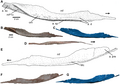 Angular
 -
 Articular
 -
Atlantal intercentrum and ribs
-
Cervical neural arch
-
 Dorsal neural arch


المصادر
- ^ أ ب ت ث ج Zanno, L.E.; Drymala, S.; Nesbitt, S.J.; Scheider, V.P. (2015). "Early crocodylomorph increases top tier predator diversity during rise of dinosaurs". Scientific Reports. 5: 9276. doi:10.1038/srep09276.
- ^ أ ب ت ث ج ح خ د خطأ استشهاد: وسم
<ref>غير صحيح؛ لا نص تم توفيره للمراجع المسماة:0 - ^ "Revealed: the terrifying 9ft-long crocodile that walked upright". The Guardian. March 20, 2015.
- ^ أ ب ت Zhou L (18 March 2015). "Before There Were Crocodiles, There Was the "Carolina Butcher"". Smithsonian Magazine. خطأ استشهاد: وسم
<ref>غير صالح؛ الاسم "smithsonian" معرف أكثر من مرة بمحتويات مختلفة.
| |||||||||||||||||||||||||||||||
| |||||||||||||||||||||||||||||||
| |||||||||||||||||||||||||||||||


