بوروندي
جمهورية بوروندي Republic of Burundi | |
|---|---|
 Flag
 Coat of arms
| |
الشعار:
| |
| النشيد: Burundi bwacu Our Burundi | |
![موقع بوروندي (dark green) [Legend]](/w/index.php?title=%D9%85%D9%84%D9%81:Burundi_(orthographic_projection).svg&filetimestamp=20140314000855&) | |
| Capital and أكبر مدينة | گيتگا |
| أكبر مدينة | العاصمة |
| اللغات الرسمية | |
| اللغات الدارجة | |
| الجماعات العرقية | |
| الدين (2020)[1] |
|
| صفة المواطن | بورونديون |
| الحكومة | جمهورية رئاسية |
• الرئيس | Évariste Ndayishimiye[2] |
| Prosper Bazombanza | |
| Nestor Ntahontuye | |
| Gervais Ndirakobuca | |
| Gélase Daniel Ndabirabe | |
| Gamaliel Nkurunziza | |
| التشريع | Parliament |
| Senate | |
| National Assembly | |
| Establishment history | |
| 1680–1966 | |
• جزء من شرق أفريقيا الألماني | 1890–1916 |
• جزء من رواندا-أوروندي | 1916–1962 |
• الاستقلال عن بلجيكا | 1 July 1962 |
• Republic | 28 November 1966 |
| 21 October 1993 – 15 May 2005 | |
| 17 May 2018 | |
| المساحة | |
• الإجمالية | 27،834 km2 (10،747 sq mi)[5] (142nd) |
• الماء (%) | 10[4] |
| Population | |
• 2024 التعداد | 14,151,540[6] (78th) |
• Density | 565/km2 (1،463.3/sq mi) (25th) |
| ن.م.إ. (ق.ش.م.) | 2025 estimate |
• الإجمالي | ▲ $13.980 billion[7] (161st) |
• للفرد | ▲ US$1,020[7] (185th) |
| ن.م.إ. (الاسمي) | 2025 estimate |
• الإجمالي | ▲ US$6.750 billion[7] (157th) |
• Per capita | ▲ US$489[7] (186th) |
| جيني (2020) | ▼ 37.5[8] medium inequality |
| HDI (2023) | ▲ 0.439[9] low (187th) |
| العملة | Burundian franc (FBu) (BIF) |
| Time zone | ت.ع.م.+2 (CAT) |
| مفتاح الهاتف | +257 |
| النطاق العلوي للإنترنت | .bi |
بوروندي ( Burundi[أ] officially the Republic of Burundi,[ب] هي بلد حبيس في منطقة البحيرات العظمى الأفريقية في جنوب شرق أفريقيا، تحدها رواندا من الشمال، تنزانيا من الشرق والغرب وجمهورية الكونغو الديمقراطية من الغرب. وعتبر في بعض الأحيان جزء من وسط أفريقيا. عاصمتها مدينة بوجمبورا. بالرغم من أنها بلد حبيس، إلى أن معظم حدودها الجنوبية الغربية تطل على بحيرة تنگانيقا.
The Twa, Hutu, and Tutsi peoples have lived in Burundi for at least 500 years. For more than 200 of those years, Burundi was an independent kingdom. In 1885، خضعت للاستعمار الألماني حيث أضيفت للمستعمرة الألمانية تنجانيقا (حالياً تنزانيا) وبعد الحرب العالمية الأولي وضعت تحت انتداب بلجيكا في سنة 1382 هـ، وأعلنت بها الجمهورية بعد عامين من استقلالها . تطل العاصمة بوجمبورا على بحيرة تنجانيقا حوالي 600 كم2 من المياه العذبة، وبها من الاحياء الجميلة والشوارع الفسيحة، والسوق الذي يسمى بالسواحلية (سوكوني) تجد به كل ما تريد من مصنوعات محلية الا البضائع المستوردة والخضروات والاسماك الطازجة من البحيرة إلى السوق مباشرة، يبلغ تعداد سكان العاصمة حوالي 3,300,000 نسمة، يدين معظم السكان بالمسيحية ونسبة المسلمون مابين 15% إلى 20% وبها جالية عربية أسهمت في تطور البلاد الشرق أفريقية ولا ننسى الجالية الآسيوية.
Burundi remains primarily a rural society, with just 13.4% of the population living in urban areas in 2019.[11] Burundi is densely populated, and many young people emigrate in search of opportunities elsewhere. Roughly 81% of the population are of Hutu origin, 18% are Tutsi, and fewer than 1% are Twa.[12] The official languages are Kirundi, French, and English—Kirundi being officially recognised as the sole national language.[13]
One of the smallest countries in Africa, Burundi's land is used mostly for subsistence agriculture and grazing. Deforestation, soil erosion, and habitat loss are major ecological concerns.[14] اعتبارا من 2005[تحديث], the country was almost completely deforested. Less than 6% of its land was covered by trees, with over half of that being for commercial plantations.[15] Burundi is the poorest country in the world by nominal GDP per capita and is one of the least developed countries.[16][17] It faces widespread poverty, corruption, instability and authoritarianism. Burundi is a member of the African Union, Common Market for Eastern and Southern Africa, United Nations, East African Community, OIF and the Non-Aligned Movement.
أصل الاسم
Modern Burundi takes its name from the precolonial Kingdom of Burundi (Urundi), a polity that had emerged by the 16th century.[11][18] The colonial capital Usumbura was officially renamed Bujumbura at independence in 1962.[19][11]
التاريخ
Burundi is one of the few countries in Africa (along Rwanda, Botswana, Lesotho, and Eswatini) to be a direct territorial continuation of a pre-colonial era African state. The early history of Burundi, and especially the role and nature of its three dominant ethnic groups—the Twa, Hutu and Tutsi—is debated amongst academics.[20]
مملكة بوروندي
من المحتمل أن يكون شعب التوا أول سكان ما يعرف ببوروندي الآن. وربما عاشوا هناك في عصور ما قبل التاريخ. وأصبح شعب الهوتو في نهاية الأمر أكبر مجموعة في بوروندي؛ إلا أنه من غير المعروف متى جاءوا إلى المنطقة.
بحلول القرن الخامس عشر الميلادي غزا التوتسي بوروندي من جهة إثيوبيا. كان التوتسي أكثر قوة من الهوتو الذين وافقوا على زراعة المحاصيل من أجل التوتسي، وبالمقابل وافق التوتسي على حماية الهوتو؛ إلا أن مجموعة صغيرة من طبقة النبلاء، تعرف باسم الجانوا، ظلوا يحكمون بوروندي. وينحدر الجانوا من سلالة التوتسي غير أنهم لم يعتبروا من التوتسي أو الهوتو. ولقد حكموا كلا من التوتسي والهوتو، وحازوا ثراء عريضًا. ولبوروندي ملك يطلق عليه اسم الموامي، غير أن الجانوا يقيّدون سلطاته.
الاستعمار
وفي 1897 احتل الألمان المنطقة المعروفة الآن ببوروندي ورواندا. وكانت المنطقة التي تعرف في السابق باسم رواندا ـ أوروندي، جزءًا من إقليم شرق إفريقيا الألماني. وفي 1916، وإبان الحرب العالمية الأولى، احتلت بلجيكا البلاد. وفي 1923 أصبحت رواندا ـ أوروندي، إقليمًا تحت الانتداب تديره بلجيكا.
الاستقلال والحرب الأهلية
.svg&filetimestamp=20090729182406&)

عام 1946 صوتت أوروندي لتصبح مملكة بوروندي المستقلة. واقترعت رواندا لتصبح جمهورية رواندا، ثم أصبحتا دولتين مستقلتين في الأول من يوليو 1962. وكان التوتسي حينئذ قد سيطروا على بوروندي.
المحاولة الأولى للديمقراطية
عقب استقلال بوروندي أدى سوء الظن المتبادل بين الهوتو والتوتسي، إلى اضطراب مستمر في المنطقة؛ حيث عارضت الهوتو حكم التوتسي. وفي 1965 اغتال متعصبون رئيس الوزراء بيير نجنداندوموي. وفي وقت لاحق من العام نفسه أطلق متمردون من الجيش النار على ليوبولد بيها، خليفة نجنداندوموي. شُفي ليوبولد، ولكن حل محله مايكل مايكامبيرو قائد الجيش في بوروندي. وفي 1966 أطاح مايكامبيرو بالملك وأعلن بوروندي جمهورية، ونصب نفسه رئيسًا. وفي 1972 أدت ثورة فاشلة، قام بها الهوتو ضد التوتسي إلى مقتل حوالي مائة ألف شخص، معظمهم من الهوتو. وفي 1976 أصبح العقيد جان باتيستا باجازا رئيسًا؛ بعد أن قاد مجموعة من ضباط الجيش ضد الحكومة.
اتفاقيات السلام
في 1981 أقر الناخبون دستورًا جديدًا للبلاد، نص على قيام مجلس وطني. في 1982م انتخب المجلس باعتباره أول هيئة تشريعية في بوروندي منذ 1965م.
تدهورت العلاقات تحت قيادة باجازا، بين حكومة بوروندي والكنيسة الكاثوليكية ذات النفوذ؛ حيث أصبحت إقامة الصلوات تحتاج إذنًا من الحكومة. أدى عدم الرضا في صفوف الجيش، بسبب العلاقات مع الكنيسة، إلى الإطاحة بباجازا في سبتمبر 1987، خلف الرائد بيير بيويوا باجازا وعمل من أجل إتاحة حريات دينية أكبر في بوروندي. أقرت بوروندي دستورًا ديمقراطيًا جديدًا في مارس 1992. وجرت أول انتخابات رئاسية بالبلاد في يونيو 1993، فاز فيها زعيم الجبهة من أجل الديمقراطية ملتشور نداداي، من الهوتو، وأصبح رئيسًا لبوروندي. وفي أكتوبر من نفس العام اغتاله بعض الجنود التوتسي في محاولة انقلابية. أعقب هذه المحاولة حرب أهلية عرقية واسعة. وفي يناير 1994، عين البرلمان سايبرين نتاياميرا، من الهوتو أيضًا، رئيسًا مؤقتًا للبلاد. وفي أبريل من نفس العام لقي نتاياميرا والرئيس الرواندي جوفنال هيبارمانا مصرعهما بعد إسقاط الطائرة التي كانت تقلهما أثناء هبوطها في مطار كيجالي عاصمة رواندا. اختار البرلمان سلفستر نتبانتجينا، من الهوتو رئيسًا جديدًا. ظلت أحداث العنف العرقية تراوح مكانها في بوروندي بعد الانقلاب الدامي الذي حدث عام 1993. وفي يوليو 1996، أطاح انقلاب عسكري دبر له التوتسي بالرئيس نتبانتجينا وحكومته وعين بايويا رئيساً للبلاد.
تدخل الأمم المتحدة
2006 حتى الآن

السياسة

منذ استقلالها عن فرنسا عام 1962، فبوروندي تحكمها أقلية التوتسي. ولدى اجراء أول انتخابات ديمقراطية عام 1993، فاز زعيم حزب الهوتو ملكيور نداداي فأصبح أول رئيس من الأغلبية الهوتو، وبعد عدة أشهر قامت مجموعة من الضباط التوتسي باسقاط طائرته، واندلعت حرب أهلية انتهت ببقاء السلطة في يد أقلية التوتسي. تحت إلحاح دولي قَبٍل الزعيم الجنوب أفريقي نلسون ماندلا، على مضض، ترؤس لجنة المصالحة لفترة ثم انسحب لرفض التوتسي مبدأ "لكل شخص صوت" الذي سينهي احتكار أقلية التوتسي للسلطة.
أبقت بوروندى بعد الإستقلال على النظام الملكي الوراثي، الذي إستمر حتى عام 1966. وقامت في أثناء ذلك الأكثرية من الهوتو بعدة محاولات للتخلص من سيطرة الأقلية من التوتسي، إلا أن هذه المحاولات التي ذهب ضحيتها عدد كبير جداً من التوتسي، لم تنجح وإنتهت بقيام إنقلاب عسكري أنهى النظام الملكي وأعلن الجمهورية، قاده مايكل مايكامبيرو ونصب نفسه رئيساً للبلاد.
ولم تتوقف المواجهات السياسية القائمة على خلفية عرقية، فقامت على عدة محاولات للتخلص من سيطرة الأقلية من التوتسي، إلا أن هذه المحاولات التي هذب ضحيتها عدد كبير جداً من التوتسي، لم تنجح وإنتهت بقيام بإنقلاب عسكري أنهى النظام الملكي، وأعلن الجمهورية، قاده مايكل مايكامبيرو ونصب نفسه رئيساً للبلاد.
ولم تتوقف المواجهات السياسية القائمة على خلفية عرقية، فقامت عدة محاولات إنقلابية للإطاحة بجماعة إنتقامية، أكثر من 80 ألف ضحية من الهوتو، أكثرهم من المثقفين، وشرد منهم أكثر من 100 ألف، هربوا إلى البلاد المجاورة.
وفي 1972 أدت ثورة فاشلة، قام بها الهوتو ضد التوتسي إلى مقتل حوالي مائة ألف شخص، معظمهم من الهوتو. وفي 1976 أصبح العقيد جان باتيستا باجازا رئيساً، بعد أن قاد مجموعة من ضباط الجيش ضد الحكومة.
ومنذ الحين خيم على بوروندى هدوء نسبي إستمر حتى عام 1995، تمكنت في أثناءه من إصلاح بعض ما نتج عن الإضطرابات المستمرة من أضرار إلا أن إندلاع المواجهة في مطلع عام 1995، قد أعاد البلاد من جديد إلى مداومة الصراعات العرقية، حتى تم التوصل إلى إتفاق السلام في العام وتولى الرئيس الحالي بيير نكورونزيزا قيادة البلاد.
العلاقات الخارجية
العلاقات مع مصر
وتكتسب بوروندى أهمية لمصر من كونها إحدى دول منطقة البحيرات العظمى الأفريقية، حيث منابع النيل، كما تربطها بمصر علاقات تجارية بصفتها عضواً في دول الكوميسا، وتعد منطقة البحيرات من أغنى مناطق أفريقيا بالماء ومصادر الثروة، بل هي أغنى مناطق أفريقيا فهي خزان ماء ضخم وهي منبع نهر النيل وهي الغنية بالمعادن والأحجار الكريمة، وبها شلالات إنجا التي تكفي لسد إحتياجات القارة الأفريقية من الطاقة الكهربائية.
العلاقات مع إسرائيل
ولايوجد تواجد إسرائيلي علني في بوروندي على الرغم من وجود علاقات دبلوماسية بين البلدين إلا أنه لا يوجد تبادل للسفارات وللسفراء المقيمين حيث يقوم سفير إسرائيل المقيم في أديس آبابا بإثيوبيا بتمثيل إسرائيل لدى بوروندي كسفير غير مقيم.
وتتبع إسرائيل سياسة التكتم والغموض في علاقاتها مع بوروندى ولا توجد مصلحة مباشرة لإسرائيل في بوروندى إذ إن إهتمات إسرائيل بالمنطقة الواقعة فيها بوروندى إهتمامات أمنية في المقام الأول وهو ما يبرر حالة الغموض في العلاقة، ونادراً ما يتم تبادل الزيارات الرسمية على مستوى رفيع بين البلدين وكانت آخر زيارة رسمية "معلنة" لمسئول بوروندى إلى إسرائيل في مايو 2008 التي قامت يها وزيرة الخارجية الرواندية لتل أبيب كما كانت زيارة السفير الإسرائيلي لبورنودى في مارس الماضي هي آخر زيارة إسرائيلية معلنة لبوروندى وتقدم إسرائيل دورات تدريبية للبورونديين في مجالات الزراعة ولكن التعاون الأهم "إستخباراتي" إذ تقوم إسرائيل بمساعدة بوروندى في مجالت التنصت وجمع المعلومات الإستخباراتية.
التقسيمات الادارية
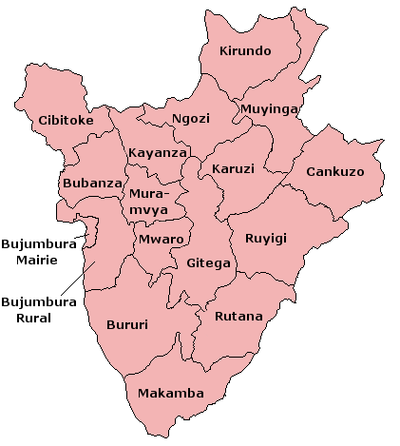
تنقسم بوروندي إلى 18 محافظة،[11] 117 كميون،[21] و2.638 تل.[22]
والمحافظات هي:
|
|
الجغرافيا

تبلغ مساحة بوروندي ( 27,800 كيلومتر ، وتشرف أرضها من الغرب على حافة أخدود شرقي أفريقيا وحيث بحيرة تنجانيقا، ثم ترتفع أرضها مكونة سلاسل جبلية بركانية، يصل ارتفاعها إلى أكثر من 1,800 متر ، ثم تسود أرضها هضية تمتد حتي حدودها مع تنزانيا، وأبرز أنهارها رويزيزي وهناك روافد عديدة تصل إلى نهر كاجيرا، أول منابع النيل من الجنوب .
تبلغ مساحة بوروندي 27,834كم². وتمتد حدودها الغربية على طول الأخدود العظيم. وتشمل هذه المنطقة الجزء الشمالي من بحيرة تنجانيقا ونهر روسيزي. ويرتفع الجزء الشمالي الغربي لبوروندي من الوادي، إلى أكثر من 2,680م فوق سطح البحر. ويتكون معظم السطح في غرب بوروندي من صخور بركانية. وعادة ما تكون التربة المتكونة على سطح الهضبة البركانية خصبة؛ إلا أن الأمطار الغزيرة في هذه المنطقة جرفت معظم المواد الكيميائية المفيدة، ثم أدت أساليب الزراعة البدائية إلى إنهاك التربة وتعريتها.
وتغطي هضاب شديدة الانحدار شرقي ووسط بوروندي. وتتكون مستنقعات في أسفل الجروف؛ وتنتج التربة بالقرب من هذه المستنقعات محاصيل أفضل من تلك التي تنتج في غرب بوروندي. وتغطي مرتفعات أخرى جنوب بوروندي.
المناخ
مناخ بوروندي ينتمي إلى النمط الاستوائي الرطب ، غير أن الارتفاع عدل من حرارتها ، وأشد جهاتها حرارة القسم الغربي حيث الأخدود الأفريقي وأمطار هذا القسم أقل نسبياً من القسم المرتفع من أرض بوروندي .وتشتهر باعتدال الجو بها أيضاً إذ تبلغ الحرارة في المتوسط 28 مئوية. ويتساقط المطر بها في موسم الامطار 7 أشهر.
يبلغ متوسط درجة الحرارة في بوجومبورا في الأخدود العظيم حوالي 23°م. ويصل متوسط درجة الحرارة في المناطق الجبلية الغربية من البلاد 17°م. ويبلغ المتوسط السنوي للأمطار 150سم. يبلغ متوسط درجة الحرارة في منطقة الهضاب 20°م. والمتوسط السنوي للأمطار 120سم.
الاقتصاد


الزراعة الحرفة الأساسية لدى سكان بوروندي، وتمارس الزراعة على المنحدرات وحول المجاري النهرية والوديان المنخفضة، وفي المناطق الشرقية من البلاد، والحاصلات الغذائية تشغل نصيباً كبيراً من الأرض الزراعية، فمنها الذرة، واليام، والكاسفا، والقمح، والشعير، وثمثل الحاصلات الزراعية في القطن والشاي والبن والتبغ ونخيل الزيت وإلى جانب الزراعة ثروة رعوية وغابية وقدرت الثروة الحيوانية سنة (1408 هـ -1988 م) بحوالي (43,000) من الماشية من الأغنام و(750,000 ) من الأغنام.
يزرع السكان الموز، الفاصوليا، المنيهوت (الكاسافا) الذرة الشامية والبطاطا الحلوة لغذائهم. ويربي آخرون الأبقار والمواشي. ويعد البن أهم المحاصيل التي تزرع للتصدير. وتشمل الصادرات الأخرى الشاي، والقطن. توجد في بوروندي خامات من الفحم النباتي والنيكل.
يزرع السكان البن الروبوستا سريع الذوبان في الأراضي التي يصل ارتفاعها إلى حوالي 1,400م فوق سطح البحر، بينما يزرعون البن العربي، وهو الأكثر قيمة، في الأراضي التي يتراوح ارتفاعها ما بين 1,400م و 1,800م فوق مستوى سطح البحر.
يعد السمك غذاءً مهمًا للسكان، ويبلغ محصول الصيد من بحيرة تنجانيقا حوالي تسعة آلاف طن متري من الأسماك كل عام.
معظم الطرق في بوروندي غير معبدة، كما لا توجد بها خطوط سكك حديدية. وتحمل البواخر عبر بحيرة تنجانيقا البضائع بين بوجومبورا، وكيجوما في تنزانيا، وكاليمي في الكونغو الديمقراطية (زائير سابقًا) ويوجد في بوجومبورا مطار دولي. تعد تجارة بوروندي خارج الحدود باهظة الثمن وصعبة؛ لأنه يجب شحن البضائع وتفريغها من السفن وعربات النقل الحديدية مرات عدة، قبل أن تبلغ وجهتها النهائية.
Studies since 2007 have shown Burundians to have extremely poor levels of satisfaction with life; the World Happiness Report 2018 rated them the world's least happy.[23][24]
Some of Burundi's natural resources include uranium, nickel, cobalt, copper and platinum.[25] Besides agriculture, other industries include: the assembly of imported components; public works construction; food processing, and light consumer goods such as blankets, shoes, and soap.
In regards to telecommunications infrastructure, Burundi is ranked last in the World Economic Forum's Networked Readiness Index (NRI) – an indicator for determining the development level of a country's information and communication technologies.[26] Lack of access to financial services is a serious problem for the majority of the population, particularly in densely populated rural areas: only 2% of the population holds bank accounts, and fewer than 0.5% use bank lending services. Microfinance, however, plays a larger role, with 4% of Burundians being members of microfinance institutions – a larger share of the population than that reached by banking and postal services combined. 26 licensed microfinance institutions offer savings, deposits, and short- to medium-term credit. The dependence of the sector on donor assistance is limited.[27]
Burundi is part of the East African Community and a potential member of the planned East African Federation. Burundi economy has declined since 1990s, and Burundi is behind all neighbouring countries. Burundi was ranked 127th in the Global Innovation Index in 2025.[28][29]
العملة
Burundi's currency is the Burundian franc. It is nominally subdivided into 100 centimes, though coins have never been issued in centimes in independent Burundi; centime coins were circulated only when Burundi used the Belgian Congo franc. Monetary policy is controlled by the central bank, Bank of the Republic of Burundi.
النقل

Burundi's transport network is limited and underdeveloped. According to a 2012 DHL Global Connectedness Index, Burundi is the least globalised of 140 surveyed countries.[30] Bujumbura International Airport is the only airport with a paved runway and is serviced by four airlines (Brussels Airlines, Ethiopian Airlines, Kenya Airways, and RwandAir). Kigali is the city with the most daily flight connections to Bujumbura.
اعتبارا من 2005[تحديث] less than 10% of the roads were paved, and اعتبارا من 2012[تحديث] private bus companies were the main operators of buses on the international route to Kigali; however, there were no bus connections to the other neighbouring countries (Tanzania and the Democratic Republic of Congo).[31] Bujumbura is connected by a passenger and cargo ferry (the MV Mwongozo) to Kigoma in Tanzania.[32] There is a long-term plan to link the country via rail to Kigali and then onward to Kampala and Kenya.
الديموغرافيا


تعتبر بوروندي من أكثر مناطق أفريقيا ازدحماً بالسكان إذ بلغ عدد سكانها في سنة (1408 هـ) (5,153,000 نسمة) وهذا العدد كبير بالنسبة لمساحتها التي تتجاوز (27,000 كيلومتر)، لذا ترتفع كثافة السكان بها ، وينتمي السكان إلى ثلاثة مجموعات عرقية، فالجماعات الزنجية من قبائل الهوتو ويشكلون أكثر من ثلاثة أرباع سكان بوروندي وتعمل هذه الجماعات في الزراعة، والمجموعة الثانية تتكون من قبائل التوتسي وتنتمي إلى أصول حامية اختلطت بالزنوج، وتشكل حوالي 15% من جملة السكان، والمجموعة الثالثة من الاقزام ونسبتها ضئيلة، يضاف إلى ما سبق جماعات مهاجرة تشكل أقلية من مالي والسنغال وغينيا ومن الهند ومن باكستان، ثم جالية عربية، ويشكل المسلمين ربع السكان والمسيحيون 65% والباقي من الوثنين. ترتفع نسبة المسلمين بين الأجانب ويقدر عدد المسلمين بحوالي (1,288,000 نسمة)، وصل الإسلام بوروندي من شرقي أفريقيا ، حيث كانت قوافل الدعاة والتجار تتحرك بين الساحل والداخل ، وازدهرت الدعوة الإسلامية في بوروندي في عهد سلاطين زنجبار .التركيبة السكانية مكونة من قبائل الهوتو 75% والتوتسي 25%، وتعد السواحلية لغة التجارة في بوروندي ويلم بها معظم السكان، فإذا كنت مثلا تتجول في السوق ستجد عبارة (قريبو) تعني (تفضل) بالعربية على لسان الباعة أصحاب المحلات وهي تدل على مدى الارتباط اللغوي والثقافي العربي الموجود في دول شرق افريقيا، وليس من قبيل المصادفة ان تتضمن السواحلية 60% من المفردات العربية.
الديانات
الصحة
Burundi has the worst hunger and malnourishment rates of all 120 countries ranked in the Global Hunger Index.[35] The civil war in 1962 put a stop on the medical advancements in the country.[36] Burundi again went into a violent cycle in 2015, jeopardising the citizens' medical care.[37]
Like other countries in Sub-Saharan Africa, Burundi uses indigenous medicine in addition to biomedicine. In the 1980s, Burundi's health authorities asked the United Nations Development Program for support to develop quality control for and begin new research on pharmaceuticals from medicinal plants.[36] At the same time, the Burundi Association of Traditional Practitioners was founded, which teamed up with the governments agency to set up the Centre for Research and Promotion of Traditional Medicine in Burundi.[36] The recent influx of international aid has supported the work of biomedical health systems. However, international aid workers have traditionally stayed away from indigenous medicine.[36]
Common diseases include malaria and typhoid fever.[38] Violence has limited the country's access to medication and hospital equipment. As of 2015, roughly 1 out of 10 children die before age 5 from preventable and treatable illnesses such as pneumonia, diarrhoea, and malaria.[37] While the fertility rate is high, the infant death rate is 61.9 deaths for every 1,000 live births.[38] The life expectancy as of 2015 was 60.1 years.[38] In 2013, Burundi spent 8% of their GDP on healthcare.[38]
الثقافة

Burundi's culture is based on local tradition and the influence of neighbouring countries, though cultural prominence has been hindered by civil unrest. Since farming is the main industry, a typical Burundian meal consists of sweet potatoes, maize, rice and peas. Due to the expense, meat is eaten only a few times per month.
When several Burundians of close acquaintance meet for a gathering they drink impeke, a beer, together from a large container to symbolise unity.[39] Another traditional alcoholic beverage widely consumed is isongo, a type of banana wine.
Notable Burundians include:
- Footballer Mohamed Tchité
- Footballer Saido Berahino
- Dungannon Swifts F.C. midfielder Gaël Bigirimana
- OGC Nice defensive midfielder Youssouf Ndayishimiye
- Vital'O FC winger Saidi Ntibazonkiza
- Olympic gold medalist Venuste Niyongabo
- Olympic and world silver medalist Francine Niyonsaba
- Professor of Economics Léonce Ndikumana,
- Philanthropist Deogratias Niyizonkiza,
- Writer and model Esther Kamatari,
- Humanitarian Marguerite Barankitse,
- Singer Jean-Pierre Nimbona, popularly known as Kidumu
- Singer Mugani Désiré popularly known as Big Fizzo
- Singer Antoine Marie Rugerinyange popularly known as Africa Nova
- Singer Prosper Magloire Christian Martial Burikukiye popularly known as Bahaga
- Singer Jeanine Rema popularly known as Khadja Nin,
- Singer Jean Christophe Matata
Crafts are an important art form in Burundi and are attractive gifts to many tourists. Basket weaving of inkoko and ibiseke is a popular craft for local artisans,[40] as well as other crafts such as masks, shields, statues and pottery.[41]


Drumming is an important part of the cultural heritage. The world-famous Royal Drummers of Burundi, who have performed for over 40 years, are noted for traditional drumming using the karyenda, amashako, ibishikiso and ikiranya drums.[42] Dance often accompanies drumming performance, which is frequently seen in celebrations and family gatherings. The abatimbo, which is performed at official ceremonies and rituals and the fast-paced abanyagasimbo are some famous Burundian dances. Some musical instruments of note are the umwironge (flute), inanga(zither), ikembe, indonongo, umuduri, inanga, amayugi and the inyagara.[41]


Oral tradition is strong, relaying history and life lessons through storytelling, poetry and song. Imigani, indirimbo, amazina and ivyivugo are literary genres in Burundi.[43]

Basketball and track and field are noted sports. Martial arts are popular as well. There are five major judo clubs: Club Judo de l'Entente Sportive, in Downtown, and four others throughout the city.[44] Association football is a popular pastime throughout the country, as are Ikibugu (mancala) games, a type of the bao game traditionally played all over East Africa.

Most Christian holidays are celebrated, with Christmas being the largest.[45] Burundian Independence Day is celebrated annually on 1 July.[46] In 2005, the Burundian government declared Eid al-Fitr, an Islamic holiday, to be a public holiday.[47]
التعليم

As of 2022, Burundi invested the equivalent of 5% of its GDP in education.[48] In 2012, the adult literacy rate was estimated to be 75% for men and women between the ages of 15 and 24, while the youth literacy rate was much higher at 93%.[48] Burundi has a comparatively high literacy rate to other countries in the region, which is only about 10% lower than the global average.[48] Ten percent of Burundian boys are allowed a secondary education.[49]
Burundi has one public university, University of Burundi. There are museums in the cities, such as the Burundi Geological Museum in Bujumbura, and the Burundi National Museum and the Burundi Museum of Life in Gitega.
In 2010 a new elementary school was opened in the small village of Rwoga that is funded by the pupils of Westwood High School, Quebec, Canada.[50][51]
العلوم والتكنولوجيا
A 2013 government planning document identified training researchers as an area of policy importance. Researcher density grew from 40 to 55 researchers per million inhabitants between 2011 and 2018. Still, with six scientific publications per million inhabitants, Burundi has one of the lowest publication rates in Central and East Africa.[52] Some 97.5% of publications involved foreign co-authorship between 2017 and 2019, with Ugandans figuring among the top five partners.[52] The amount of funding available to each researcher more than doubled from PPP$14,310 (2005 currency value) to PPP$22,480, since the domestic research effort has also risen since 2012, from 0.11% to 0.21% of GDP.[52] Between 2011 and 2019, Burundi scientists produced several articles on HIV, tropical communicable diseases, and tuberculosis in country, aligned with the country's sustainable development goals.[52] With regard to material sciences, Burundi's publication intensity doubled from 0.6 to 1.2 articles per million inhabitants between 2012 and 2019, placing it in the top 15 for sub-Saharan Africa for this strategic technology.[52] Medical sciences remain the main focus of research: medical researchers accounted for 4% of the country's scientists in 2018 but 41% of scientific publications between 2011 and 2019.[52]
Burundi ranked 181 of 195 countries on the Global Health Security Index in 2021.[53] This ranking sheds light on the low number of research staff and small laboratory network that the country currently has. The country also lacks lab capacity for testing of five critical diseases, as outlined by the WHO.[54] Despite being low on the index, Burundi is home to a research university, the National Veterinary Laboratory, and an Institute on Nutritional Sciences.[55][54]
انظر أيضاً

.svg&filetimestamp=20130223182533&)
المصادر
- ^ "National Profiles". Archived from the original on 10 October 2022. Retrieved 10 October 2022.
- ^ "Burundi's ruling party wins presidential election". Reuters. 26 May 2020. Archived from the original on 28 August 2023. Retrieved 28 June 2023.
- ^ خطأ استشهاد: وسم
<ref>غير صحيح؛ لا نص تم توفيره للمراجع المسماةKB - ^ (in fr)Annuaire statistique du Burundi. ISTEEBU. July 2015. p. 105. Archived from the original. You must specify the date the archive was made using the
|archivedate=parameter. http://www.isteebu.bi/images/annuaires/annuaire%202013%20pdf%20fin.pdf. Retrieved on 17 December 2015. - ^ "Quelques données pour le Burundi" (in الفرنسية). ISTEEBU. Archived from the original on 28 July 2017. Retrieved 17 December 2015.
- ^ "Burundi Population (2024) – Worldometer". www.worldometers.info (in الإنجليزية). Retrieved 2024-10-23.
- ^ أ ب ت ث "World Economic Outlook Database, April 2025" (in الإنجليزية).
- ^ "World Bank Open Data".
- ^ "Human Development Report 2025" (PDF). United Nations Development Programme. 6 May 2025. Archived (PDF) from the original on 6 May 2025. Retrieved 6 May 2025.
- ^ "Constitution de la République du Burundi promulguée le 07 juin 2018". 3 July 2018. Archived from the original on 16 June 2022. Retrieved 17 May 2022.
- ^ أ ب ت ث (in en)Burundi, Central Intelligence Agency, 2024-01-31, https://www.cia.gov/the-world-factbook/countries/burundi/, retrieved on 2024-02-05
- ^ Eggers, p. ix.
- ^ Maurer, Sous la direction de Bruno (1 October 2016). Les approches bi-plurilingues d'enseignement-apprentissage: autour du programme Écoles et langues nationales en Afrique (ELAN-Afrique): Actes du colloque du 26–27 mars 2015, Université Paul-Valéry, Montpellier, France. Archives contemporaines. ISBN 978-2-8130-0195-5. Archived from the original on 10 April 2018. Retrieved 10 April 2018 – via Google Books.
- ^ Bermingham, Eldredge, Dick, Christopher W. and Moritz, Craig (2005). Tropical Rainforests: Past, Present, and Future. Chicago, Illinois: University of Chicago Press, p. 146. ISBN 0-226-04468-8
- ^ Butler, Rhett A. (2006). "Burundi". Mongabay. Archived from the original on 2006-05-05.
- ^ United Nations (May 5, 2025) (in en). Specific country data: Burundi. United Nations. Archived from the original. You must specify the date the archive was made using the
|archivedate=parameter. https://hdr.undp.org/data-center/specific-country-data. - ^ "GDP per capita". Our World in Data (in الإنجليزية). Archived from the original on 2026-05-09. Retrieved 2026-05-21.
- ^ "Kingdom of Burundi". Encyclopaedia Britannica. Retrieved 6 September 2025.
- ^ "Bujumbura, Burundi (1899–)". BlackPast. 11 February 2014. Retrieved 6 September 2025.
- ^ Uvin, Peter (1999). "Ethnicity and Power in Burundi and Rwanda: Different Paths to Mass Violence". Comparative Politics. 31 (3): 253–271. doi:10.2307/422339. JSTOR 422339. PMID 20120547.
- ^ خطأ استشهاد: وسم
<ref>غير صحيح؛ لا نص تم توفيره للمراجع المسماةstate - ^ Kavamahanga, D. Empowerment of people living with HIV/AIDS in Gitega Province, Burundi at the Internet Archive. International Conference on AIDS 2004. July 15, 2004. NLM Gateway. Retrieved on June 22, 2008.
- ^ Collinson, Patrick (14 March 2018). "Finland is the happiest country in the world, says UN report". The Guardian. Archived from the original on 14 March 2018. Retrieved 15 March 2018.
- ^ White, A. (2007). A Global Projection of Subjective Well-being: A Challenge to Positive Psychology? Archived 25 أكتوبر 2016 at the Wayback Machine Psychtalk 56, 17–20. Retrieved 8 June 2008.
- ^ Eggers, p. xlviii.
- ^ "Countries – Network Readiness Index". Archived from the original on 2021-12-10. Retrieved 2026-08-14.
- ^ "Burundi: Financial Sector Profile". Archived from the original on 13 May 2011. Retrieved 30 November 2010.
{{cite web}}: CS1 maint: bot: original URL status unknown (link) mfw4a.org - ^ "GII Innovation Ecosystems & Data Explorer 2025". WIPO. Retrieved 2025-10-16.
- ^ Dutta, Soumitra; Lanvin, Bruno (2025). Global Innovation Index 2025: Innovation at a Crossroads (in الإنجليزية). World Intellectual Property Organization. p. 19. doi:10.34667/tind.58864. ISBN 978-92-805-3797-0. Retrieved 2025-10-17.
- ^ Globalisation: Going backwards Archived 29 يونيو 2017 at the Wayback Machine, The Economist (22 December 2012). Retrieved 4 April 2014.
- ^ "Buses in Burundi". www.bus-planet.com. Archived from the original on 26 December 2016. Retrieved 27 August 2019.
- ^ "Travel to Burundi". 2017-04-05. Archived from the original on 5 April 2017. Retrieved 2020-01-27.
- ^ Pew Research Center's Religion & Public Life Project: Burundi. Pew Research Center. 2010.
- ^ Burundi. U.S. Department of State. State.gov (2010-11-17). Retrieved on 2012-11-24.
- ^ Jillian Keenan, The Blood Cries Out Archived 12 يناير 2018 at the Wayback Machine. "In one of Africa's most densely populated countries, brothers are killing brothers over the right to farm mere acres of earth. There's just not enough land to go around in Burundi — and it could push the country into civil war." Foreign Policy (FP)
- ^ أ ب ت ث Falisse, Jean-Benoit; Masino, Serena; Ngenzebuhoro, Raymond (2018). "Indigenous medicine and biomedical health care in fragile settings: insights from Burundi". Health Policy and Planning. 33 (4): 483–493. doi:10.1093/heapol/czy002. hdl:20.500.11820/461331f7-1c9d-45f2-b778-933e8c1c4735. PMID 29452365. S2CID 4917618.
- ^ أ ب "Panalpina flies UNICEF relief to Burundi; 70 tons of primary medical care goods arrived in Burundi". African Press Organization. 30 November 2015. [dead link]
- ^ أ ب ت ث "Burundi". Worldmark Encyclopedia of the Nations. [dead link]
- ^ "Eating the Burundian Way". Archived from the original on 16 June 2006. Retrieved 21 July 2008.
{{cite web}}: CS1 maint: bot: original URL status unknown (link) Cultural Profiles Project. Citizenship and Immigration Canada. Retrieved 30 June 2008. - ^ Levin, Adam (2005). The Art of African Shopping. Cape Town, South Africa: Struik, p. 36. ISBN 978-1-77007-070-7
- ^ أ ب "Burundi Arts and Literature". Archived from the original on 1 October 2006. Retrieved 21 July 2008.
{{cite web}}: CS1 maint: bot: original URL status unknown (link) Cultural Profiles Project. Citizenship and Immigration Canada. Retrieved 30 June 2008. - ^ Center for the Arts Presents the Royal Drummers of Burundi Archived 3 مايو 2017 at the Wayback Machine. The Mason Gazette. 14 September 2006. George Mason University. Retrieved 20 July 2008.
- ^ Vansina, Jan (1985). Oral Tradition as History. Madison, Wisconsin: University of Wisconsin Press, p. 114. ISBN 0-299-10214-9
- ^ "Sports and Recreation". Archived from the original on 16 June 2006. Retrieved 24 November 2012.
{{cite web}}: CS1 maint: bot: original URL status unknown (link), Cultural Profiles Project. Citizenship and Immigration Canada. Retrieved 20 July 2008. - ^ "Burundi Holidays". Archived from the original on 1 October 2006. Retrieved 21 July 2008.
{{cite web}}: CS1 maint: bot: original URL status unknown (link) Cultural Profiles Project. Citizenship and Immigration Canada. Retrieved 30 June 2008. - ^ Trawicky, Bernard and Gregory, Ruth Wilhelme (2000) Anniversaries and Holidays, Chicago, Illinois: American Library Association. p. 110. ISBN 0-8389-0695-8
- ^ Burundi celebrates Muslim holiday Archived 17 يونيو 2017 at the Wayback Machine. BBC. 3 November 2005. Retrieved 30 June 2008.
- ^ أ ب ت "IDEA". USAID. Archived from the original on 14 November 2023. Retrieved 2023-11-14.
- ^ "Learning in Burundi". Archived from the original on 1 October 2006. Retrieved 21 July 2008.
{{cite web}}: CS1 maint: bot: original URL status unknown (link) Cultural Profiles Project. Citizenship and Immigration Canada. cp-pc.ca - ^ Bridge To Burundi Archived 26 ديسمبر 2016 at the Wayback Machine. Retrieved 4 April 2014.
- ^ Westwood Bridge to Burundi Archived 26 ديسمبر 2016 at the Wayback Machine. Facebook. Retrieved 4 April 2014.
- ^ أ ب ت ث ج ح Njoki Kingiri; Awono Onana (11 June 2021). Schneegans, S.; Straza, T.; Lewis, J. (eds.). Central and East Africa. In UNESCO Science Report: the Race Against Time for Smarter Development. Paris: UNESCO. pp. 496–533. ISBN 978-92-3-100450-6. Archived from the original on 16 September 2021. Retrieved 8 September 2021.
- ^ "Burundi". GHS Index (in الإنجليزية الأمريكية). Retrieved 2026-02-08.
- ^ أ ب Global Health Security Index (2021). Country profile: Burundi. https://ghsindex.org/wp-content/uploads/2021/12/Burundi.pdf This document is a compilation of all questions, justifications, and sources used to determine the 2021 Global Health Security Index scores for Burundi.
- ^ "IAEA Helps Burundi Ensure Food Security with Healthy Cattle". www.iaea.org (in الإنجليزية). 2024-10-03. Retrieved 2026-02-08.
- الأقلية المسلمة في أفريقيا - سيد عبد المجيد بكر .
- جريدة الدستور المصرية - عدد السبت 5 يونيو 2010
المراجع
- Eggers, Ellen K. (2006). Historical Dictionary of Burundi. Lanham, Maryland: Scarecrow Press, Incorporated. ISBN 0-8108-5302-7. 3rd. edition.
قراءات إضافية
- Abdallah, Ahmedou Ould Burundi on the Brink, 1993–95: A UN Special Envoy Reflects on Preventive Diplomacy
- Allen, J. A.; et al. (2003). Africa South of the Sahara 2004: South of the Sahara. New York, New York: Taylor and Francis Group. ISBN 1-85743-183-9.
{{cite book}}: Explicit use of et al. in:|author=(help) - Bentley, Kristina and Southall, Roger An African Peace Process: Mandela, South Africa, and Burundi
- Chrétien, Jean-Pierre The Great Lakes of Africa: Two Thousand Years of History
- Daley, Patricia Gender and Genocide in Burundi: The Search for Spaces of Peace in the Great Lakes Region
- Gates, Henry Lewis (1999). Africana: The Encyclopedia of the African and African American Experience. New York, New York: Basic Civitas Books. ISBN 0-465-00071-1.
{{cite book}}: Unknown parameter|coauthors=ignored (|author=suggested) (help) - Ewusi, Kale and Akwanga, Ebenezer Burundi's Negative Peace: The Shadow of a Broken Continent in the Era of Nepad
- Jennings, Christian Across the Red River: Rwanda, Burundi and the Heart of Darkness
- Kidder, Tracy, Strength in What Remains (A biography of a Burundian immigrant to the U.S.)
- Krueger, Robert (2007). From Bloodshed to Hope in Burundi: Our Embassy Years during Genocide. Austin, Texas: University of Texas Press. ISBN 0-292-71486-6.
{{cite book}}: Unknown parameter|coauthors=ignored (|author=suggested) (help) - Lemarchand, Rene Burundi: Ethnic Conflict and Genocide
- Melady, Thomas Patrick Burundi: The Tragic Years
- Nivonzima, David and Fendell, Len Unlocking Horns: Forgiveness and Reconciliation in Burundi
- Uvin, Peter Life After Violence: A People's Story of Burundi
- Watt, Nigel Burundi: The Biography of a Small African Country
- Weinstein, Warren (2006). Historical Dictionary of Burundi. Metuchen, New Jersey: Scarecrow Press, Incorporated. ISBN 0-8108-0962-1. 1st. edition.
وصلات خارجية
- (بالفرنسية) Official Burundi government website
- Official Website of the Ministry of Justice of Burundi
- (كورية) Books4burundi
- Chief of State and Cabinet Members
- Burundi entry at The World Factbook
- Burundi from UCB Libraries GovPubs
- بوروندي at the Open Directory Project
- Burundi from the BBC News
 Wikimedia Atlas of Burundi
 بوروندي travel guide from Wikivoyage
- Key Development Forecasts for Burundi from International Futures

| التاريخ | |
|---|---|
| السياسة | |
| الجغرافيا | |
| الاقتصاد والبنية التحتية | |
| الثقافة والمجتمع | الاتصالات • الديموغرافيا • التعليم • الجماعات العرقية • كرة القدم • الصحة • Kirundi • العطلات العامة • اللغات • الإعلام • الموسيقى • الدين |

التوابع | غير معترف بها 1 جزئياً في آسيا. 2 تتضمن التوابع/الملحقات جزيرة أسنسيون و ترستان دا كونيا. | ||||||||||||||||


.svg&filetimestamp=20150612155141&)

.svg)
الدول الأعضاء والمراقبة في الفرنكوفونية | ||
|---|---|---|
| الأعضاء |
|  |
| المراقبون | ||
1 عضو زميل.
2 مؤقتاً يشار إليها في الفرنكوفونية باسم "جمهورية مقدونيا اليوغوسلاڤية السابقة"؛ انظر الخلاف حول تسمية مقدونيا. | ||
| قائمة المستعمرات والمحميات الألمانية السابقة | |||
|---|---|---|---|
| المستعمرات | أفريقيا | ڤيتولاند • شرق أفريقيا الألماني (تنگانيقا • رواندا • بوروندي) • مثلث كيونگا • جنوب غرب أفريقيا الألماني (ناميبيا) • غرب أفريقيا الألماني (كامرون • نويكامرون • توگولاند) | |
| المحيط الهادي | غينيا الجديدة الألمانية (جزر سولمون الألمانية • جزر مارشال الألمانية • جزر كارولين • جزر ماريانا • ناورو • پالاو) • ساموا الألمانية | ||
| امتيازات | الصين | كياوتشو الألمانية • تسينگتاو • تيينتسين |  
|
| غير معترف بها | أنتارتيكا | سوابيا الجديدة | |
خطأ استشهاد: وسوم <ref> موجودة لمجموعة اسمها "lower-alpha"، ولكن لم يتم العثور على وسم <references group="lower-alpha"/>
- CS1 الفرنسية-language sources (fr)
- CS1 maint: bot: original URL status unknown
- Articles with dead external links from November 2023
- Articles with dead external links from May 2023
- CS1 الإنجليزية الأمريكية-language sources (en-us)
- Short description is different from Wikidata
- Articles containing فرنسية-language text
- Articles containing Kirundi-language text
- Pages using infobox country with unknown parameters
- مقالات فيها عبارات متقادمة منذ 2005
- جميع المقالات التي فيها عبارات متقادمة
- Articles with hatnote templates targeting a nonexistent page
- مقالات فيها عبارات متقادمة منذ 2012
- CS1 errors: unsupported parameter
- بوروندي
- بلدان وأراضي البانتو
- بلدان أفريقيا الوسطى
- بلدان أفريقيا
- بلدان ومناطق ناطقة بالفرنسية
- بلدان حبيسة
- بلدان نامية
- دول أعضاء في الفرانكوفونية
- دول أعضاء الاتحاد الأفريقي
- الدول الأعضاء في الأمم المتحدة
- جمهوريات
- دول ومناطق تأسست في 1962
- دول وأراضي ناطقة بالسواحيلية
- جنوب شرق أفريقيا