ممر دريك


ممر دريك (Drake Passage إسپانية: Pasaje de Drake) أو Mar de Hoces—بحر هوسيس—، هو مسطح مائي بين الحافة الجنوبية لأمريكا لجنوبية عند كيپ هورن، تشيلي وجزر شتلاند الجنوبية في أنتراكتيتا. يصل الممر بين المنطقة الجنوبية الغربية للمحيط الأطلسي (بحر سكوشيا) والمنطقة الجنوبية الغربية للمحيط الهادي ويمتد إلى المحيط المتجمد الجنوبي.
The Drake Passage is considered one of the most treacherous voyages for ships to make. The Antarctic Circumpolar Current, which runs through it, meets no resistance from any landmass, and waves top 40 أقدام (12 m), giving it a reputation for being "the most powerful convergence of seas".[1]
As the Drake Passage is the narrowest passage (choke point) around Antarctica, its existence and shape strongly influence the circulation of water around Antarctica and the global oceanic circulation, as well as the global climate. The bathymetry of the Drake Passage plays an important role in the global mixing of oceanic water. Part of the water body is named Southern Zone Sea.
التاريخ
In 1525, Spanish navigator Francisco de Hoces is assumed to have discovered the Drake Passage after having been blown south away from the entrance of the Strait of Magellan.[2] Though he and his ship and crew disappeared, and his exact path and fate are unknown, the Drake Passage is referred to as the Mar de Hoces (Sea of Hoces) in Spanish maps and sources, while almost always in the rest of the Spanish-speaking countries it is mostly known as Pasaje de Drake (in Argentina, mainly), or Paso Drake (in Chile, mainly).
سمي الممر على اسم القرصان المقاول الإنگليزي فرانسيس دريك. وكانت سفينته الوحيدة المتبقية، قد انفجرت في الجنوب بعد عبورها مضيق ماجلان في سبتمبر 1578. وقد تضمن هذا الحادث وجود اتصال مفتوح بين المحيطين الأطلسي والهادي.
وقبل ذلك بنصف قرن، وبعد أن دفعتهم عاصفة باتجاه الجنوب من مدخل مضيق ماجلان اعتقد طاقم البحار الإسباني فرنشيسكو ده هوسيز أنهم أبصروا نهاية للأرض واستنتجوا وجود ذلك البحر في عام 1525[2] ولهذا السبب يطلق بعض المؤرخين من إسپانيا وأمريكا اللاتينية عليه مار ده هوسيز على اسم سفينة الملاحة الإسپانية مار دي هوسيز.
وقد كانت أول رحلة بحرية عبر الممر المائي هي إندراخت (Eendracht) التي قادها الملاح الهولندي ويلم سخوتن عام 1616، حيث تم اكتشاف كيب هورن وتسميتها في هذه العملية.
ويعتبر الممر المائي الواسع 800 كم (500 ميل) الواقع بين كيپ هورن وجزيرة لفنجستون جنوب جزر شيتلاند هو أقصر ممر مائي يربط القارة القطبية الجنوبية ببقية العالم. ويتمثل الحد الفاصل بين المحيطين الأطلسي والهادئ أحيانًا في خط يُرسم من كيب هورن إلى جزيرة سنو (Snow Island) 130 كيلومتر شمال القارة القطبية الجنوبية). وبدلاً من ذلك فإن خط الزوال الذي يمر من خلال كيب هورن قد يعتبر الحد الفاصل بين المحيطين. وكل من الحدين يمر بداخل ممر دريك (Drake Passage).
ويتسم الممران المائيان حول كيب هورن ومضيق ماجلان وقناة بيگل (Beagle Channel) بالضيق الشديد، بحيث يوجد فراغ صغير يكفي لمرور سفينة واحدة وبصفة خاصة سفينة شراعية للمناورة. كما يمكن أن يتم حصر السفن في الجليد، وأحيانًا تهب الرياح بقوة كبيرة بحيث لا يمكن لأي مركب شراعي أن يسير في عكس اتجاهها. ومن ثم، فضلت معظم السفن الشراعية المرور عبر ممر دريك المائي، الذي يُعتبر مساحة مفتوحة من الماء تمتد لمئات الأميال على الرغم من الظروف بالغة الصعوبة. تقع جزر دييگو راميريز (Diego Ramírez) شديدة الصغر على بُعد 50 كم (31 ميلاً) جنوب كيپ هورن.
ولا توجد هناك أي أرض حول العالم تتسم بالأهمية تقع على خطوط عرض ممر دريك المائي، الذي يمثل أهمية للتدفق غير المحصور من التيار القطبي الجنوبي المحيط بالقارة القطبية الجنوبية والذي يحمل في طياته كمية كبيرة من الماء (حوالي 600 ضعف من تدفق مياه نهر الأمازون) من خلال الممر وحول القارة القطبية الجنوبية.
تُمثل السفن العابرة للممر منصات مشاهدة جيدة للحيتان والدلافين وطيور البحر الكثيرة التي تشمل طائر النوء الكبير وسلالات أخرى من طائر النوق وطائر القطرس والبطريق.
ويُعرف عن الممر أنه كان مغلقًا منذ حوالي 41 مليون.[3] طبقًا للدراسة الكيميائية لأسنان الأسماك الموجودة في الصخور الرسوبية للمحيط. وقبل فتح الممر، كان المحيطان الأطلسي والهادئ مفصولين عن بعضهما بالكامل وكانت القارة القطبية الجنوبية أكثر دفئًا ولا يوجد بها غطاء جليدي. وقد تسبب الوصل بين المحيطين الكبيرين في إنشاء التيار القطبي الجنوبي المحيط بالقارة القطبية الجنوبية وإلى انخفاض درجة حرارة القارة بشكل كبير.
الجغرافيا
The Drake Passage opened when Antarctica separated from South America due to plate tectonics, however, there is much debate about when this occurred, with estimates ranging from 49 to 17 million years ago.[4][5] The Shackleton fracture zone is under the sea on the Drake Passage zone.
The opening had a major effect on the global oceans due to deep currents, such as the Antarctic Circumpolar Current (ACC). This opening could have been a primary cause of changes in global circulation and climate, as well as the rapid expansion of Antarctic ice sheets, because, as Antarctica was encircled by ocean currents, it was cut off from receiving heat from warmer regions.[6]
The 800-كيلومتر-wide (500 mi) passage between Cape Horn and Livingston Island is the shortest crossing from Antarctica to another landmass. The boundary between the Atlantic and Pacific Oceans is sometimes taken to be a line drawn from Cape Horn to Snow Island (130 كيلومتر (81 mi) north of mainland Antarctica), though the International Hydrographic Organization defines it as the meridian that passes through Cape Horn: 67° 16′ W.[7] Both lines lie within the Drake Passage.
The other two passages around the southern extremity of South America — the Strait of Magellan and the Beagle Channel — have frequent narrows, leaving little maneuvering room for a ship, as well as unpredictable winds and tidal currents. Most sailing ships thus prefer the Drake Passage, which is open water for hundreds of miles.
No significant land sits at the latitudes of the Drake Passage. This is important to the unimpeded eastward flow of the Antarctic Circumpolar Current, which carries a huge volume of water through the passage and around Antarctica.
The passage hosts whales, dolphins, and seabirds including giant petrels, other petrels, albatrosses, and penguins.
الأهمية في علم المحيطات الطبيعي

The presence of the Drake Passageway allows the three main ocean basins (Atlantic, Pacific and Southern) to be connected via the Antarctic Circumpolar current (ACC), the strongest oceanic current, with an estimated transport of 100–150 Sv (Sverdrups, million m3/s). This flow is the only large-scale exchange occurring between the global oceans, and the Drake passage is the narrowest passage on its flow around Antarctica. As such, a significant amount of research has been done in understanding how the shape of the Drake passage (bathymetry and width) affects the global climate.
التفاعلات المحيطية والمناخية
Major features of the modern ocean's temperature and salinity fields, including the overall thermal asymmetry between the hemispheres, the relative saltiness of deep water formed in the northern hemisphere, and the existence of a transequatorial conveyor circulation, develop after Drake Passage is opened.[8]

The importance of an open Drake Passage extends farther than the Southern Ocean latitudes. The Roaring Forties and the Furious Fifties blow around Antarctica and drive the Antarctic Circumpolar Current (ACC). As a result of Ekman Transport, water gets transported northward from the ACC (on the left-hand side while facing the stream direction). Using a Lagrangian approach, water parcels passing through the Drake Passage can be followed in their journey in the oceans. Around 23 Sv of water is transported from the Drake Passage to the equator, mainly in the Atlantic and Pacific Oceans.[9] This value is not far from the Gulf Stream transport in the Florida Strait (33 Sv[10]), but is an order of magnitude lower than the transport of the ACC (100–150 Sv). Water transported from the Southern Ocean to the Northern Hemisphere contributes to the global mass balance and permits the meridional circulation across the oceans.
Several studies have linked the current shape of the Drake Passage to an effective Atlantic meridional overturning circulation (AMOC). Models have been run with different widths and depths of the Drake Passage, and consequent changes in the global oceanic circulation and temperature distribution have been analyzed:[8][11] It appears that the "conveyor belt" of the global thermohaline circulation appears only in presence of an open Drake Passage, subject to wind forcing.[8] With a closed Drake Passage, there is no North Atlantic Deep Water (NADW) cell, and no ACC. With a shallower Drake Passage, a weak ACC appears, but still no NADW cell.[11]

It has also been shown that present-day distribution of dissolved inorganic carbon can be obtained only with an open Drake Passage.[12]
Regarding the global surface temperature, an open (and sufficiently deep) Drake Passage cools the Southern Ocean and warms the high latitudes of the Northern Hemisphere. The isolation of Antarctica by the ACC (that can flow only with an open Drake Passage) is credited by many researchers with causing the glaciation of the continent and global cooling in the Eocene epoch.
الاضطراب والاختلاط
Diapycnal mixing is the process by which different layers of a stratified fluid mix. It directly affects vertical gradients, thus it is of great importance to all gradient-driven types of transport and circulation (including thermohaline circulation). Mixing drives the global thermohaline circulation; without internal mixing, cooler water would never rise above warmer water, and there would be no density (buoyancy)-driven circulation. However, mixing in the interior of most of the ocean is thought to be ten times weaker than required to support the global circulation.[13][14][15] It has been hypothesised that the extra-mixing can be ascribed to breaking of internal waves (Lee waves).[16] When a stratified fluid reaches an internal obstacle, a wave is created that can eventually break, mixing the fluid's layers. It has been estimated that the diapycnal diffusivity in the Drake Passage is ~20 times the value immediately to the west in the Pacific sector of the Antarctic Circumpolar Current (ACC).[14] Much of the energy that is dissipated through internal wave breaking (around 20% of the wind energy put into the ocean) is dissipated in the Southern Ocean.[17]
In short, without the coarse topography in the depths of the Drake Passage, oceanic internal mixing would be weaker, and the global circulation would be affected.

الأهمية التاريخية في أرصاد علم المحيطات
Worldwide satellite measurements of oceanic properties have been available since the 1980s. Before then, data could be only gathered through oceanic ships taking direct measurements. The Antarctic Circumpolar Current (ACC) has been (and is) surveyed making repeated transects. South America and the Antarctic Peninsula constrain the ACC in the Drake Passage; the convenience of measuring the ACC across the passage lays in the clear boundaries of the current in that stripe. Even after the advent of satellite altimetry data, direct observations in the Drake Passage have not lost their exceptionality. The relative shallowness and narrowness of the passage makes it particularly suitable to assess the validity of horizontally and vertically changing quantities (such as velocity in Ekman's theory[18]).
In addition, the strength of the ACC makes meanders and pinching cold-core cyclonic rings easier to observe.[19]
الوحيش
Wildlife in the Drake Passage includes the following species:
الطيور
- Sooty shearwater
- White-chinned petrel
- Southern giant petrel
- Northern giant-petrel
- Black-browed albatross
- Campbell albatross
- Grey-headed albatross
- Atlantic yellow-nosed albatross
- Indian yellow-nosed albatross
- Buller's albatross
- Salvin's albatross
- Shy albatross
- Southern royal albatross
- Northern royal albatross
- Wandering albatross
- Light-mantled albatross
- Sooty albatross
- Great shearwater
- Great-winged petrel
- Kerguelen petrel
- Southern fulmar
- Cape petrel
- Soft-plumaged petrel
- White-headed petrel
- Atlantic petrel
- Grey petrel
- Antarctic prion
- Slender-billed prion
- Blue petrel
- Black-bellied storm petrel
- Wilson's storm-petrel
الحيتانيات
معرض الصور
-
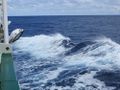 البحر الهائج في ممر دريك.
 -
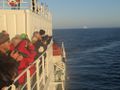 السياح يشاهدون الحيتان في ممر دريك.
 -
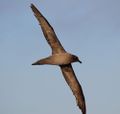 النوارس تحلق فوق ممر دريك.
 -
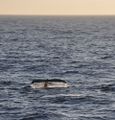 الحيتان الحدباء من المشاهد الشائعة في ممر دريك.
 -
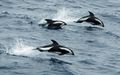 Hourglass dolphins leaping in the Passage
 -
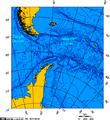 ممر دريك أو مير دي هوسيس بين أمريكا الجنوبية وأنتراكتيكا.
 -
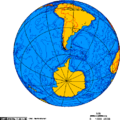 ممر دريك.


Notable people
- Jamie Douglas-Hamilton (living), adventurer
- Francisco de Hoces (deceased), sailor
- Bárbara Hernández (living), open water swimmer
انظر أيضاً
- Southern Zone Sea
- Shackleton fracture zone
- فرانسيس دريك
- گراسي ده نودال
- مضيق ماجلان
- قناة بيگل
- مضيق برانسفيلد
- Sars Bank
- جزيرة إليزابث
- Timeline of Francis Drake's circumnavigation
المصادر
- ^ "6 men become 1st to cross perilous Drake Passage unassisted". AP NEWS. Associated Press. 2019-12-28. Retrieved 2020-10-30.
- ^ أ ب Oyarzun, Javier, Expediciones españolas al Estrecho de Magallanes y Tierra de Fuego, 1976, Madrid: Ediciones Cultura Hispánica ISBN 978-84-7232-130-4 خطأ استشهاد: وسم
<ref>غير صالح؛ الاسم "Oyarzun" معرف أكثر من مرة بمحتويات مختلفة. - ^ Helen Briggs (21 April 2006). "Fossil gives clue to big chill". BBC News. Retrieved 2007-11-01.
- ^ Scher, Howie D.; Martin, Ellen E. (21 April 2006). "Timing and Climatic Consequences of the Opening of Drake Passage". Science. 312 (5772): 428–430. Bibcode:2006Sci...312..428S. doi:10.1126/science.1120044. PMID 16627741. S2CID 19604128.
- ^ van de Lagemaat, Suzanna H.A.; Swart, Merel L.A.; Vaes, Bram; Kosters, Martha E.; Boschman, Lydian M.; Burton-Johnson, Alex; Bijl, Peter K.; Spakman, Wim; van Hinsbergen, Douwe J.J. (April 2021). "Subduction initiation in the Scotia Sea region and opening of the Drake Passage: When and why?". Earth-Science Reviews. 215 103551. Bibcode:2021ESRv..21503551V. doi:10.1016/j.earscirev.2021.103551. hdl:20.500.11850/472835. S2CID 233576410.
- ^ Livermore, Roy; Hillenbrand, Claus-Dieter; Meredith, Mik e; Eagles, Graeme (2007). "Drake Passage and Cenozoic climate: An open and shut case?". Geochemistry, Geophysics, Geosystems (in الإنجليزية). 8 (1): n/a. Bibcode:2007GGG.....8.1005L. doi:10.1029/2005GC001224. ISSN 1525-2027.
- ^ International Hydrographic Organization, Limits of Oceans and Seas, Special Publication No. 28, 3rd edition, 1953 [1] Archived 2011-10-08 at the Wayback Machine, p.4
- ^ أ ب ت Toggweiler, J. R.; Bjornsson, H. (2000). "Drake Passage and palaeoclimate". Journal of Quaternary Science (in الإنجليزية). 15 (4): 319–328. Bibcode:2000JQS....15..319T. doi:10.1002/1099-1417(200005)15:4<319::AID-JQS545>3.0.CO;2-C. ISSN 1099-1417.
- ^ Friocourt, Yann; Drijfhout, Sybren; Blanke, Bruno; Speich, Sabrina (2005-07-01). "Water Mass Export from Drake Passage to the Atlantic, Indian, and Pacific Oceans: A Lagrangian Model Analysis". Journal of Physical Oceanography (in الإنجليزية). 35 (7): 1206–1222. Bibcode:2005JPO....35.1206F. doi:10.1175/JPO2748.1. ISSN 1520-0485.
- ^ Heiderich, Joleen; Todd, Robert E. (2020-08-01). "Along–Stream Evolution of Gulf Stream Volume Transport". Journal of Physical Oceanography. 50 (8): 2251–2270. Bibcode:2020JPO....50.2251H. doi:10.1175/JPO-D-19-0303.1. hdl:1912/26689. ISSN 0022-3670. S2CID 219927256.
- ^ أ ب ت Sijp, Willem P.; England, Matthew H. (2004-05-01). "Effect of the Drake Passage Throughflow on Global Climate". Journal of Physical Oceanography (in الإنجليزية). 34 (5): 1254–1266. Bibcode:2004JPO....34.1254S. doi:10.1175/1520-0485(2004)034<1254:EOTDPT>2.0.CO;2. ISSN 0022-3670.
- ^ Fyke, Jeremy G.; D'Orgeville, Marc; Weaver, Andrew J. (May 2015). "Drake Passage and Central American Seaway controls on the distribution of the oceanic carbon reservoir". Global and Planetary Change (in الإنجليزية). 128: 72–82. Bibcode:2015GPC...128...72F. doi:10.1016/j.gloplacha.2015.02.011. OSTI 1193435.
- ^ Munk, Walter H. (August 1966). "Abyssal recipes". Deep Sea Research and Oceanographic Abstracts (in الإنجليزية). 13 (4): 707–730. Bibcode:1966DSRA...13..707M. doi:10.1016/0011-7471(66)90602-4.
- ^ أ ب Watson, Andrew J.; Ledwell, James R.; Messias, Marie-José; King, Brian A.; Mackay, Neill; Meredith, Michael P.; Mills, Benjamin; Naveira Garabato, Alberto C. (2013-09-19). "Rapid cross-density ocean mixing at mid-depths in the Drake Passage measured by tracer release". Nature (in الإنجليزية). 501 (7467): 408–411. Bibcode:2013Natur.501..408W. doi:10.1038/nature12432. ISSN 0028-0836. PMID 24048070. S2CID 1624477.
- ^ Ledwell, James R.; Watson, Andrew J.; Law, Clifford S. (August 1993). "Evidence for slow mixing across the pycnocline from an open-ocean tracer-release experiment". Nature (in الإنجليزية). 364 (6439): 701–703. Bibcode:1993Natur.364..701L. doi:10.1038/364701a0. ISSN 0028-0836. S2CID 4235009.
- ^ Nikurashin, Maxim; Ferrari, Raffaele (2010-09-01). "Radiation and Dissipation of Internal Waves Generated by Geostrophic Motions Impinging on Small-Scale Topography: Application to the Southern Ocean". Journal of Physical Oceanography (in الإنجليزية). 40 (9): 2025–2042. Bibcode:2010JPO....40.2025N. doi:10.1175/2010JPO4315.1. ISSN 1520-0485. S2CID 1681960.
- ^ Nikurashin, Maxim; Ferrari, Raffaele (June 2013). "Overturning circulation driven by breaking internal waves in the deep ocean". MIT Web Domain (in الإنجليزية الأمريكية). Massachusetts Institute of Technology. 40 (12): 3133. Bibcode:2013GeoRL..40.3133N. doi:10.1002/grl.50542. hdl:1721.1/85568. S2CID 16754887.
- ^ Polton, Jeff A.; Lenn, Yueng-Djern; Elipot, Shane; Chereskin, Teresa K.; Sprintall, Janet (2013-08-01). "Can Drake Passage Observations Match Ekman's Classic Theory?". Journal of Physical Oceanography (in الإنجليزية). 43 (8): 1733–1740. Bibcode:2013JPO....43.1733P. doi:10.1175/JPO-D-13-034.1. ISSN 0022-3670. S2CID 129749697.
- ^ Joyce, T.M.; Patterson, S.L.; Millard, R.C. (November 1981). "Anatomy of a cyclonic ring in the drake passage". Deep Sea Research Part A. Oceanographic Research Papers (in الإنجليزية). 28 (11): 1265–1287. Bibcode:1981DSRA...28.1265J. doi:10.1016/0198-0149(81)90034-0.
- ^ Lowen, James (2011). Antarctic Wildlife: A Visitor's Guide. Princeton: Princeton University Press. pp. 44–49, 112–158. ISBN 978-0-691-15033-8.
وصلات خارجية
 Media related to Drake Passage at Wikimedia Commons
- National Oceanography Centre, Southampton page of the important and complex bathymetry of the Passage
- A personal story describing crossing the Passage
- A NASA image of an eddy in the Passage
- Larger-scale images of the passage from the US Navy (Rain, ice edge and wind images)

- CS1 الإنجليزية الأمريكية-language sources (en-us)
- Pages using gadget WikiMiniAtlas
- Articles containing إسپانية-language text
- Pages using Lang-xx templates
- Pages with empty portal template
- Coordinates on Wikidata
- مضائق تشيلي
- مضائق أنتراكتيكا
- Geography of Magallanes y la Antártica Chilena Region
- حدود تشيلي
- القطب الجنوبي