داو (سفينة)

الداو Dhow ، هو اسم عام لعدد من السفن الشراعية ذات شراع واحد أو أكثر تستخدم في منطقة البحر الأحمر والمحيط الهندي. يقسم المؤرخون الداو إلى تلك السفن التي إخترعها العرب أو الهنود.[1][2]
حيث أنها عادة ما تكون سفن ذات هياكل طويلة رقيقة، تستخدم الداو بشكل رئيسي كسفن تجارية لحمل المواد الثقيلة، مثل الفواكه، المياه العذبة أو البضائع، على إمتداد سواحل شبه الجزيرة العربية، پاكستان، الهند، بنگلادش، وشرق أفريقيا. الداو الكبيرة يبلغ عدد طاقمها حوالي 30 فرد، والأصغر تحمل حوالي 12 فرد.
أصل الاسم
There are several versions of the origin of the word "dau". Previously, it was believed that it could be of Arabic or Persian origin (and although in the 21st century there is no such word in either Arabic or Persian, some Dutch documents from the 17th-18th centuries indicate that then the Persian word dawh meant "small ship"). Recently, most researchers are inclined to believe that this term comes from daw in the language of the Swahili people in East Africa, which means "vessel". However, regardless of the sources of its origin, the use of "dhow" as a collective term to refer to the boats of the Indian Ocean with characteristic "Arabian" sails, was introduced definitely by Europeans. Since in the European tradition ships were classified mainly according to their sailing equipment, all the ships of the Indian Ocean that carried similar Arabian sails and looked more or less the same to the untrained European eye were known to as Europeans by a single word, "dhow".[3]
At the same time, neither the Arabs nor the Indians use the term "dhow" to refer to their vessels collectively. The collective terms used in Arabic for ships are markab, khashab and falūka; falūka is related to the term fulk (عربية: فُلك) used in the Qur'an to describe Noah's ark.[4] On the other hand, the peoples of the Indian Ocean use separate special names for each type of ship, differing from each other mainly not in sailing rigging, but in size, hull design and number of masts.[5]
التاريخ
The exact origins of the dhow are lost to history. Most scholars believe that it originated in India from 600 BC to 600 AD, although there are some who claim that the sanbuk, a type of dhow, may be derived from the Portuguese caravel.[6][7] However, Portuguese caravels only appeared in the area in the late 15th century. The dhow was the ship of trade first used by the Somalis. The Somali people who are known to have the oldest surviving dhow which is called Beden, have traded with the ancient world from Egypt, Babylon, as well as the civilizations of the Far East, carrying valuable frankincense, myrrh, gold, etc. It was the Somali merchants that first introduced exotic animals from Africa to the Ming Dynasty. The dhow was used to transport a giraffe to the Chinese Emperor Yong Le's court, in 1414.[8] Another source suggests the ship that carried the giraffe to China was part of a large Chinese fleet led by Zheng He.[9]
Ships that are similar to the dhow are mentioned or described in the 1001 Nights including various ports where they harboured. The dhow is also associated with the pearl trade.[citation needed]
The Yemeni Hadhrami people, as well as Omanis, for centuries came to Beypore, in Kerala, India for their dhows. This was because of the good timber in the Kerala forests, the availability of good coir rope, and the skilled shipwrights. In former times, the sheathing planks of a dhow's hull was held together by coconut rope. Beypore dhows are known as 'Uru' in Malayalam, the local language of Kerala. Settlers from Yemen, known as 'Baramis', or 'Daramis' which could be derived from the word 'Hardamis' are still active in making urus in Kerala.
Dhows were extensively used for the Red Sea slave trade and the Indian Ocean slave trade, which the Royal Navy attempted to suppress. In his 1873 book, Captain G. L. Sulivan described "four different kinds of coasting dhows, as shown in the engravings, viz. the Bateele, the Badane, Bugala or genuine Dhow, and the Matapa boat".[10]
منذ القرن العشرين

In the 1920s, British writers identified الحديدة as the centre for dhow building. Those built in Al Hudaydah were smaller in size, and used for travel along the coasts. They were constructed of acacia found in Yemen.[11] They are distinguishable for their smaller triangular sails on movable bases to harvest the irregular winds of the Red Sea.[12]
Captain Alan Villiers (1903–1982) documented the days of sailing trade in the Indian Ocean by sailing on dhows between 1938 and 1939 taking numerous photographs and publishing books on the subject of dhow navigation.[13][14]
Even to the present day, dhows make commercial journeys between the Persian Gulf and East Africa using sails as their only means of propulsion. Their cargo is mostly dates and fish to East Africa and mangrove timber to the lands in the Persian Gulf. They often sail south with the monsoon in winter or early spring, and back again to Arabia in late spring or early summer.[15]
الملاحة
For celestial navigation, dhow sailors have traditionally used the kamal, an observation device that determines latitude by finding the angle of the Pole Star above the horizon.[16]
الأنواع
- البغلة، هي سفينة ثقيلة، عادة ما تبحر في المياه العميقة.
- البقارة، هي نوع صغير من الداو الصغيرة.[17].
- البارجة[18]
- البتيل، داو ذات شراعات طويلة مميزة.
- البادن، سفينة صغيرة الحجم.[19]
- البوم أو الدانجي، هي داو كبيرة الحجم.[20]
- الغنجة أو الكوتيا، هي سفينة كبيرة الحجم تشبه البغلة.[21]
- الجهازي، هي داو تقليدي للصيد أو التجارة، يشيع استخدامه على جزيرة لامو وسواحل عُمان. تستخدم كذلك في البحرين لصيد اللؤلؤ.[22] اسمها مشتق من كلمة jahāz (جهاز)، وتعني بالفارسية "السفينة".[23]
- الجالبوت، هي داو ذات حجم من صغير إلى متوسط.
- پتامار، داو هندي.
- الصنبوق، هو داو كبير الحجم يستخدم اليوم في الخليج العربي.[24][25]
- الشوعي، داو متوسط الحكم. كان يشيع استخدامه في الخليج العربي لأغراض الصيد وللتجارة الساحلية.
- الزروق، داو صغير، أكبر قليلاً من البارجة.[26]
معرض الصور
-
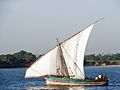 داو على سواحل دار السلام، تنزانيا.
 -
 داو في المحيط الهندي.
 -
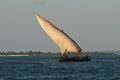 داو صغير في زنجبار.
 -
 رسم للبغلة، داو تقليدي يستخدم في المياه العميقة.
 -
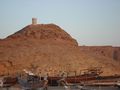 Construction and repair of dhows in Sur, Oman
 -
-
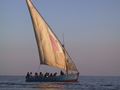
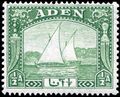 داو على طابع بريد لعام 1937 صادر في عدن.
 -
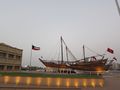
-
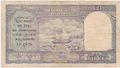 پاتمار، على عملة ورقية فئة 10 روپية هندية.
 -
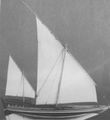 نموذج من الصنبوق.
 -
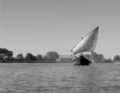 داو في شط العرب (1958)


انظر أيضاً

المصادر
- ^ Briggs, Philip. "Dhows of the swahili coast". Zanzibar Travel Guide. Retrieved 6 September 2012.
- ^ "THE HISTORY AND CONSTRUCTION OF THE DHOW". Nabataea.net. Retrieved 6 September 2012.
- ^ Hourani, George Fadlo; Carswell, John (1995). Arab Seafaring: In the Indian Ocean in Ancient and Early Medieval Times (expanded ed.). Princeton, N.J., USA: Princeton University Press. p. 89. ISBN 9780691000329.
- ^ Agius, Dionisius A. (2019). The Life of the Red Sea Dhow: A Cultural History of Seaborne Exploration in the Islamic World. London, U.K.: Bloomsbury Publishing. pp. 16–17. ISBN 978-1-78672-487-8.
- ^ Holtzman, Bob (2009-06-24). "Indigenous Boats: What's a Dhow?". Indigenous Boats. Retrieved 2024-04-13.
- ^ Taylor, James. "Traditional Arab sailing ships". The British-Yemeni Society. Archived from the original on 15 July 2012. Retrieved 6 September 2012.
- ^ Sanbuk – Robert's Model ships and boats
- ^ Chris McIntyre; Susan McIntyre (2013). Zanzibar. Bradt Travel Guides. p. 6. ISBN 978-1-84162-458-7.
- ^ Duyvendak, JJL (1938). The True Dates of the Chinese Maritime Expeditions in the Early Fifteenth Century. pp. 341–413.
- ^ Sulivan, G.L. (1873). Dhow Chasing in Zanzibar Waters and on the Eastern Coast of Africa: Narrative of Five Years' Experiences in the Suppression of the Slave Trade. S. Low, Marston, Low & Searle. p. 102. Retrieved 15 November 2021.
- ^ Prothero, GW (1920). Arabia. London: HM Stationery Office. p. 99.
- ^ "صناعة القوارب". yemen-nic.info. Retrieved 2021-03-12.
- ^ Villiers, Alan (2006). Sons of Sinbad : an account of sailing with the Arabs in their Dhows, in the Red Sea, round the coasts of Arabia, and to Zanzibar and Tanganyika; pearling in the Persian Gulf; and the life of the shipmasters and mariners of Kuwait. Facey, William, 1948–, Ḥijjī, Yaʻqūb Yūsuf., Pundyk, Grace., Markaz al-Buḥūth wa-al-Dirāsāt al-Kuwaytīyah (Kuwait). London: Arabian Pub. in association with the Centre for Research and Studies in Kuwait. ISBN 0954479238. OCLC 61478193.
- ^ Villiers, Allan (15 October 2018). Monsoon Seas the Story of the Indian Ocean (in الإنجليزية). Creative Media Partners, LLC. ISBN 9780343245221.
- ^ "Arab wayfinding on land and at sea: An historical comparison of traditional navigation techniques - ProQuest". www.proquest.com (in الإنجليزية). Archived from the original on 2024-07-10. Retrieved 2025-10-10.
- ^ Ives, Ronald L. (1961-09-01). "Navigating with the Kamal". Journal of Geography (in الإنجليزية). 60 (6): 268–273. Bibcode:1961JGeog..60..268I. doi:10.1080/00221346108982355.
- ^ "The Traditional Dhow". Ministry of Information, Sultanate of Oman. Retrieved 7 September 2012.
- ^ George Fadlo Hourani & John Carswell, Arab Seafaring in the Indian Ocean in Ancient and Early Medieval Times, Princeton University Press, 1995
- ^ Dhows
- ^ Dhow Ship - Types
- ^ Cog and Galley - Ghanjah
- ^ Dhow sailing in Kenya
- ^ Dionisius A. Agius. Classic Ships of Islam: From Mesopotamia to the Indian Ocean. BRILL, 2008. ISBN 9004158634. p. 316.
- ^ Oman, a Seafaring Nation, Ministry of Information, Oman 1979
- ^ Dionisius A. Agius. Classic Ships of Islam: From Mesopotamia to the Indian Ocean. BRILL, 2008. ISBN 9004158634. p. 314.
- ^ "Zaruq". Retrieved 6 September 2012.
قراءات إضافية
- Clifford W. Hawkins, The dhow: an illustrated history of the dhow and its world.
- Marion Kaplan, Twilight of the Arab dhow.
- Esmond Bradley Martin and Chryssee Perry Martin; foreword by Elspeth Huxley, Cargoes of the east : the ports, trade, and culture of the Arabian Seas and western Indian Ocean.
- Esmond Bradley Martin, The decline of Kenya's dhow trade.
- Anthony Jack, Arab dhows.
- Henri Perrier, Djibouti's dhows.
- Tessa Rihards, Dhow building : survival of an ancient craft.
- Richard LeBaron Bowen, Essay on the tradition of painting eyes, known as oculi, on the bows of boats among mariners and fishermen from ancient times to the present. Found particularly in the Indian Ocean region.