الجبال الكرپاتية
| الكرپاتية | |
|---|---|
 الكربات الغربية الداخلية، تاترا العالية، پولندا | |
| أعلى نقطة | |
| القمة | قمة گرلاتشوڤسكي Gerlachovský štít |
| الارتفاع | 2،655 متر[convert: unknown unit]  |
| التسمية | |
| الجغرافيا | |
 The different sections of the Carpathians with the borders of constituent countries in black, and the rivers in blue | |
| البلد | جمهورية التشيك |
| نطاق الإحداثيات | 47°00′N 25°30′E / 47°N 25.5°E |
الجبال الكرپاثية جزء من سلسلة جبال عظيمة في أوروبا الوسطى، وتمتد إلى مسافة 1,500 كم على طول الحدود بين سلوفاكيا وبولندا، وإلى داخل رومانيا. وأعلى ارتفاع في هذه الجبال جبل قمة گرلاتشوڤسكي ستيت 2,655 م في سلسلة جبال تاترا في سلوفاكيا، وجبل ريزي 2,499 م في بولندا.
وجبال الكرباثيان امتداد لسلسلة جبال تضم الألب، إلا أن قممها أقل ارتفاعًا من الألب؛ بجانب أنها تضم عددًا قليلاً من البحيرات والأنهار الجليدية والشلالات. وتحتوي جبال كارباثيان على العديد من المعادن؛ من بينها ترسبات عالية من الفحم الحجري والملح. وتأتي مقادير هائلة من الأخشاب من غابات التنوب والبلوط والزان التي تغطي المنحدرات السفلى لهذه الجبال. وتتجول الذئاب وحيوانات الوشق والدببة في هذه الغابات بحرية. وتحفل وديان كارباثيان بمزارع خصبة، ويجتاز الناس هذه الجبال عبر ممرات ضيقة.
The Carpathians provide habitat for the largest European populations of brown bears, wolves, chamois, and lynxes, with the highest concentration in Romania,[2][3][4] as well as over one-third of all European plant species.[5] The mountains and their foothills also have many thermal and mineral waters, with Romania having one-third of the European total.[6][7]
Romania is likewise home to the second-largest area of virgin forests in Europe after Russia, totaling 250,000 hectares (65%), most of them in the Carpathians,[8] with the Southern Carpathians constituting Europe's largest unfragmented forest area.[9] Rates of forest loss due to clearcutting, and deforestation due to illegal logging in the Carpathians are high.[10]
الاسم


In modern times, the range is called Karpaty in Czech, Polish and Slovak and Карпати [kɐrˈpɑtɪ] استمع in Ukrainian, Карпати / Karpati in Serbo-Croatian, Carpați [karˈpatsʲ] استمع in Romanian, Карпаты in Rusyn, Karpaten [kaʁˈpaːtn̩] استمع in German and Kárpátok [ˈkaːrpaːtok] in Hungarian.[11][12] Although the toponym was recorded by Ptolemy in the second century AD,[13] the modern form of the name is a neologism in most languages.[11]
الأسماء التاريخية
In late Roman documents, the Eastern Carpathian Mountains were referred to as Montes Sarmatici (meaning Sarmatian Mountains).[14] The Western Carpathians were called Carpates, a name that is first recorded in Ptolemy's Geographia (second century AD).[15]
In the Scandinavian Hervarar saga, which relates ancient Germanic legends about battles between Goths and Huns, the name Karpates appears in the predictable Germanic form as Harvaða fjöllum (see Grimm's law). "Inter Alpes Huniae et Oceanum est Polonia" ("Between the Hunic Alps and the ocean lies Poland") by Gervase of Tilbury, was described in his Otia Imperialia ("Recreation for an Emperor") in 1211.[16] Thirteenth- to fifteenth-century Hungarian documents named the mountains Thorchal, Tarczal, or less frequently Montes Nivium ("Snowy Mountains").[16]
Havasok ("Snowy Mountains") was its medieval Hungarian name. Rus' chronicles referred to it as "Hungarian Mountains".[12][11] Later sources, such as Dimitrie Cantemir and the Italian chronicler Giovanandrea Gromo, referred to the range as "Transylvania's Mountains", while the 17th-century historian Constantin Cantacuzino translated the name of the mountains in an Italian-Romanian glossary to "Rumanian Mountains".[11]
أصل الاسم
The etymology of the Carpathians is not clearly established, but the name "Carpates" is highly associated with the old Dacian tribes called "Carpes" or "Carpi" who lived in an area to the east of the Carpathians, from the east, northeast of the Black Sea to the Transylvanian Plain in the present day Romania and Moldova.
الكلمات المحتملة كجذور

Karpates is considered a Paleo-Balkan name, with evidence provided by the Albanian kárpë / kárpa, pl. kárpa / kárpat ('rock, stiff'), and the Messapic karpa 'tuff (rock), limestone' (preserved as càrpë 'tuff' in Bitonto dialect and càrparu 'limestone' in Salentino).[17][18][19][20][21][13] This connection is further supported by the fact that also the oronym Beskydy, a series of mountain ranges in the Carpathians, has a meaning in Albanian: bjeshkë / bjeshkët 'high mountains, mountain pastures' (cf. also the Albanian oronym Bjeshkët e Namuna, the Accursed Mountains / Albanian Alps).[20][21]
The name Carpates may ultimately be from the Proto Indo-European root *sker-/*ker-, which meant mountain, rock, or rugged (cf. Albanian kárpë, Germanic root *skerp-, Old Norse harfr "harrow", Gothic skarpo, Middle Low German scharf "potsherd", and Modern High German Scherbe "shard", Lithuanian kar~pas "cut, hack, notch", Latvian cìrpt "to shear, clip").[22] The archaic Polish word karpa meant 'rugged irregularities, underwater obstacles/rocks, rugged roots, or trunks'. The more common word skarpa means a sharp cliff or other vertical terrain, cf. Old English scearp and English sharp.
The name may instead come from Indo-European *kwerp 'to turn', akin to Old English hweorfan 'to turn, change' (English warp) and Greek καρπός karpós 'wrist' (Karpathos island has the same root word), perhaps referring to the way the Carpathian mountain range bends or veers in an L-shape.[22]
الجغرافيا

Although commonly referred to as a mountain chain, the Carpathians do not form an uninterrupted chain of mountains, but consist of several orographically and geologically distinctive groups. The northwestern Carpathians begin in Slovakia and southern Poland. They surround Transcarpathia and Transylvania in a large semicircle, sweeping towards the southeast, and end on the Danube near Orșova in Romania. The total length of the Carpathians is over 1،500 km (930 mi).

The mountain chain's width varies between 12 و 500 km (7 و 311 mi). The highest altitudes of the Carpathians occur where they are widest, in the Transylvanian plateau and in the southern Tatra Mountains group. The highest range, in which Gerlachovský štít in Slovakia is the highest peak, is 2،655 m (8،711 ft) above sea level.
The Carpathians cover an area of 190،000 km2 (73،000 sq mi). After the Alps, they form the next-most extensive mountain system in Europe. Percentage of the range by country is: Czech Republic (3%) and Austria (1%) in the northwest through Slovakia (21%), Poland (10%), Ukraine (10%), Romania (50%) to Serbia (5%) in the south.
It was believed that no area of the Carpathian range was covered in snow all year round and there were no glaciers, but recent research by Polish scientists discovered one permafrost and glacial area in the Tatra Mountains.[27]
مقارنة مع الألپ

The Carpathians, which attain an altitude over 2،500 m (8،200 ft) in only a few places, lack the bold peaks, extensive snowfields, large glaciers, high waterfalls, and numerous large lakes that are common in the Alps. The Carpathians at their highest altitude are only as high as the middle region of the Alps, with which they share a common appearance, climate, and flora.
The Carpathians are separated from the Alps by the Danube, only meeting at the Leitha Mountains at Bratislava. The river also separates the Carpathians from the Balkan Mountains at Orșova in Romania. The valley of the March and Oder separates the Carpathians from the Silesian and Moravian chains, which belong to the middle wing of the great Central Mountain System of Europe.

Unlike the other wings of the system, the Carpathians, which form the watershed between the northern seas and the Black Sea, are surrounded on all sides by plains. The Pannonian plain is to the southwest, the Lower Danubian Plain to the south, with the southern part being in Bulgaria, and the northern – in (Romania), and the Galician plain to the northeast.
الممرات الجبلية
In the Romanian part of the main chain of the Carpathians, mountain passes include Prislop Pass, Tihuța Pass, Bicaz Canyon, Ghimeș Pass, Buzău Pass, Predeal Pass (crossed by the railway from Brașov to Bucharest), Turnu Roșu Pass (1,115 ft., running through the narrow gorge of the Olt River and crossed by the railway from Sibiu to Bucharest), Vulcan Pass, and the Iron Gate (both crossed by the railway from Timișoara to Craiova).
الجيولوجيا

The area now occupied by the Carpathians was once occupied by smaller ocean basins. The Carpathian mountains were formed during the Alpine orogeny in the Mesozoic[28] and Cenozoic by moving the ALCAPA (Alpine-Carpathian-Pannonian), Tisza and Dacia plates over subducting oceanic crust.[29]
The mountains take the form of a fold and thrust belt with generally north vergence in the western segment, northeast to east vergence in the eastern portion and southeast vergence in the southern portion. Currently, the area is the most seismically active in Central Europe.[30]
The external, generally northern, portion of the orogenic belt is a Tertiary accretionary wedge of a so-called Flysch belt (the Carpathian Flysch Belt) created by rocks scraped off the sea bottom and thrust over the North-European plate. The Carpathian accretionary wedge is made of several thin skinned nappes composed of Cretaceous to Paleogene turbidites. Thrusting of the Flysch nappes over the Carpathian foreland caused the formation of the Carpathian foreland basin.[31] The boundary between the Flysch belt and internal zones of the orogenic belt in the western segment of the mountain range is marked by the Pieniny Klippen Belt, a narrow complicated zone of polyphase compressional deformation, later involved in a supposed strike-slip zone.[32]

Internal zones in western and eastern segments contain older Variscan igneous massifs reworked in Mesozoic thick and thin-skinned nappes. During the Middle Miocene this zone was affected by intensive calc-alkaline[33] arc volcanism that developed over the subduction zone of the flysch basins. At the same time, the internal zones of the orogenic belt were affected by large extensional structure[34] of the back-arc Pannonian Basin.[35] The last volcanic activity occurred at Ciomadul about 30,000 years ago.[33]
The mountains started to gain their current shape from the latest Miocene onward.[36] At some locations solifluction deposits have formed on the slopes of the Carpathians.[36] Iron, gold and silver were found in great quantities[vague] in the Western Carpathians. After the Roman emperor Trajan's conquest of Dacia, he brought back to Rome over 165 tons of gold and 330 tons of silver.[37]
البيئة

The ecology of the Carpathians varies with altitude, ranging from lowland forests to alpine meadows. Foothill forests are primarily of broadleaf deciduous trees, including oak, hornbeam, and linden. European beech is characteristic of the montane forest zone. Higher-elevation subalpine forests are characterized by Norway spruce (Picea abies). Krummholz and alpine meadows occur above the treeline.[38]
Wildlife in the Carpathians includes Eurasian brown bear (Ursus arctos arctos), Eurasian wolf (Canis lupus lupus), Eurasian lynx (Lynx lynx), European wildcat (Felis silvestris), Tatra chamois (Rupicapra rupicapra tatrica), European bison (Bison bonasus), and golden eagle (Aquila chrysaetos).[38]
أقسام الجبال الكرباتية

1. الكرپات الغربية الخارجية
2. الكرپات الغربية الداخلية
3. الكرپات الشرقية الخارجية
4. الكرپات الشرقية الداخلية
5. الكرپات الجنوبية
6. الكرپات الرومانية الغربية
7. الهضبة الترانسلڤانية
8. الكرپات الصربية
أكبر سلسلة جبال في الكرپات هي جبال تاترا.
The section of the Carpathians within the borders of Ukraine is commonly known as the Ukrainian Carpathians. Classification of eastern sections of the Carpathians is particularly complex, since it was influenced by several overlapping traditions. Terms like Wooded Carpathians, Poloniny Mountains or Eastern Beskids are often used in varying scopes by authors belonging to different traditions.
-
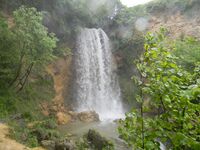 Beljanica region waterfall
 -
 Vrátna dolina, Slovakia
 -

-

-

-
 Kežmarok in Slovakia
 -
 Gorals in the Polish Carpathians
 -
 Szczawnica in Poland, Pieniny, 1939
 -
 The Feast of the Assumption of Mary in the Polish Carpathians


أعلى القمم
This is an (incomplete) list of the peaks of the Carpathians having summits over 2،500 متر (8،200 ft), with their heights, geologic divisions, and locations.
| Peak | Geologic divisions | Nation (Nations) | County (Counties) | Height (m) | Height (ft) |
|---|---|---|---|---|---|
| Gerlachovský štít | High Tatras | Slovakia | Prešov Region | 2،655 | 8،711 |
| Gerlachovská veža | 2،642 | 8،668 | |||
| Lomnický štít | 2،633 | 8،638 | |||
| Ľadový štít | 2،627 | 8،619 | |||
| Pyšný štít | 2،623 | 8،606 | |||
| Zadný Gerlach | 2،616 | 8،583 | |||
| Lavínový štít | 2،606 | 8،550 | |||
| Malý Ľadový štít | 2،602 | 8،537 | |||
| Kotlový štít | 2،601 | 8،533 | |||
| Lavínová veža | 2،600 | 8،500 | |||
| Malý Pyšný štít | 2،591 | 8،501 | |||
| Veľká Litvorová veža | 2،581 | 8،468 | |||
| Strapatá veža | 2،565 | 8،415 | |||
| Kežmarský štít | 2،556 | 8،386 | |||
| Vysoká | 2،547 | 8،356 | |||
| Moldoveanu | Făgăraș Mountains | Romania | Argeș | 2،544 | 8،346 |
| Negoiu | Sibiu | 2،535 | 8،317 | ||
| Viștea Mare | Brașov | 2،527 | 8،291 | ||
| Parângu Mare | Parâng Mountains | Alba, Gorj, Hunedoara | 2،519 | 8،264 | |
| Lespezi | Făgăraș Mountains | Sibiu | 2،517 | 8،258 | |
| Peleaga | Retezat Mountains | Hunedoara | 2،509 | 8،232 | |
| Păpușa | 2،508 | 8،228 | |||
| Vânătoarea lui Buteanu | Făgăraș Mountains | Argeș | 2،507 | 8،225 | |
| Omu (mountain) | Bucegi Mountains | Prahova, Brașov, Dâmbovița | 2،514 | 8،248 | |
| Cornul Călțunului | Făgăraș Mountains | Sibiu | 2،505 | 8،219 | |
| Ocolit (Bucura) | Bucegi Mountains | Prahova, Brașov, Dâmbovița | 2،503 | 8،212 | |
| Rysy | High Tatras | Poland, Slovakia | Lesser Poland Voivodeship, Prešov Region | 2،503 | 8،212 |
| Dara | Făgăraș Mountains | Romania | Sibiu | 2،500 | 8،200 |
أعلى القمم حسب البلد
This is a list of the highest national peaks of the Carpathians, their heights, geologic divisions, and locations.
| Peak | Geologic divisions | Nation (Nations) | County (Counties) | Height (m) | Height (ft) |
|---|---|---|---|---|---|
| Gerlachovský štít | High Tatras | Slovakia | Prešov Region | 2،655 | 8،711 |
| Moldoveanu | Făgăraș Mountains | Romania | Argeș | 2،544 | 8،346 |
| Rysy | High Tatras | Poland | Tatra County | 2،499 | 8،199 |
| Hoverla | Eastern Beskids (Chornohora) | Ukraine | Nadvirna Raion, Rakhiv Raion | 2،061 | 6،762 |
| Rtanj | Serbian Carpathians | Serbia | Zaječar District | 1،565 | 5،135 |
| Lysá hora | Moravian-Silesian Beskids | Czech Republic | Moravian-Silesian Region | 1،323 | 4،341 |
| Kékes | Mátra-Slanec Area (Mátra) | Hungary | Heves County | 1،014 | 3،327 |
| Hundsheimer Berg | Hundsheimer Berge | Austria | Niederösterreich | 481 | 1،578 |
المدن والبلدات
The table and the list may contain some localities near the Carpathians, not only in these mountains.
| المدينة | البلد | التعداد | أعلى منسوب [م] | خط العرض | خط الطول |
|---|---|---|---|---|---|
| Kraków | Poland | 804,237 | 383 | 50°03′41″N | 19°56′14″E |
| Banská Bystrica | Slovakia | 74,590 | 368 | 48°44′07″N | 19°08′43″E |
| Bratislava | Slovakia | 475,503 | 514 | 48°08′38″N | 17°06′35″E |
| Cluj-Napoca | Romania | 286,598 | 340 | 46°46′N | 23°35′E |
| Chernivtsi | Ukraine | 264,298 | 248 | 48°18′0″N | 25°56′0″E |
| Brașov | Romania | 237,589 | 538 | 45°40′N | 25°37′E |
| Košice | Slovakia | 225,044 | 206 | 48°43′N | 21°15′E |
| Ivano-Frankivsk | Ukraine | 238,196 | 260 | 48°55′22″N | 24°42′38″E |
| Oradea | Romania | 183,105 | 142 | 47°04′20″N | 21°55′16″E |
| Bielsko-Biała | Poland | 165,127 | 1,117 | 49°49′21″N | 19°2′40″E |
| Miskolc | Hungary | 143,502 | 945 | 48°06′15″N | 20°47′30″E |
| Sibiu | Romania | 134,309 | 415 | 45°47′34″N | 24°09′07″E |
| Târgu Mureș | Romania | 116,033 | 320 | 46°32′44″N | 24°33′45″E |
| Baia Mare | Romania | 108,759 | 228 | 47°39′24″N | 23°34′19″E |
| Uzhhorod | Ukraine | 115,449 | 169 | 48°37′26″N | 22°17′42″E |
| تارنوڤ | Poland | 105,922 | 384[39] | 50°00′45″N | 20°59′19″E |
| Râmnicu Vâlcea | Romania | 93,151 | 250 | 45°6′17″N | 24°22′32″E |
| Prešov | Slovakia | 82,927 | 296 | 49°00′06″N | 21°14′22″E |
| Mukachevo | Ukraine | 85,569 | 125 | 48°27′00″N | 22°45′00″E |
| Drohobych | Ukraine | 73,682 | 371[40] | 49°21′00″N | 23°30′00″E |
المدن والبلدات الأصغر:
- Piatra Neamț (Romania)
- Nowy Sącz (Poland)
- Suceava (Romania)
- Vršac (Serbia)
- Târgu Jiu (Romania)
- Drobeta-Turnu Severin (Romania)
- Reșița (Romania)
- Žilina (Slovakia)
- Bistrița (Romania)
- Zvolen (Slovakia)
- Deva (Romania)
- Zlín (Czech Republic)
- Hunedoara (Romania)
- Martin (Slovakia)
- Zalău (Romania)
- Przemyśl (Poland)
- Krosno (Poland)
- Sanok (Poland)
- Alba Iulia (Romania)
- Sfântu Gheorghe (Romania)
- Turda (Romania)
- Mediaș (Romania)
- Poprad (Slovakia)
- Spišská Nová Ves (Slovakia)
- Petroșani (Romania)
- Miercurea Ciuc (Romania)
- Făgăraș (Romania)
- Odorheiu Secuiesc (Romania)
- Boryslav (Ukraine)
- Jasło (Poland)
- Cieszyn (Poland)
- Nowy Targ (Poland)
- Żywiec (Poland)
- Zakopane (Poland)
- Petrila (Romania)
- Cugir (Romania)
- Târgu Neamț (Romania)
- Câmpulung Moldovenesc (Romania)
- Gheorgheni (Romania)
- Rakhiv (Ukraine)
- Vatra Dornei (Romania)
- Rabka-Zdrój (Poland)
- Bor (Serbia)
انظر أيضاً
- Karpatka—A Polish dessert named after the Carpathians
- RMS Carpathia a British ocean liner named after the Carpathians that rescued survivors of the RMS Titanic
- The Living Fire—A Ukrainian documentary film about the life of Carpathian shepherds
- Sudetes—A neighbouring mountain system whose uplift is related to that of the Carpathians
- Tourism in Poland
- Tourism in Romania
- Tourism in Serbia
- Tourism in Slovakia
- Tourism in Ukraine
- قائمة قمم الجبال في رومانيا
- ترانسلڤانيا
- گاليسيا (شرق اوروپا)
المصادر
- ^ ABOUT THE CARPATHIANS - Carpathian Heritage Society
- ^ Peter Christoph Sürth. "Braunbären (Ursus arctos) in Europa". Archived from the original on 15 August 2008. Retrieved 10 March 2011.
- ^ Peter Christoph Sürth. "Wolf (Canis lupus) in Europa". Archived from the original on 15 August 2008. Retrieved 10 March 2011.
- ^ Peter Christoph Sürth. "Eurasischer Luchs (Lynx lynx) in Europa". Archived from the original on 15 August 2008. Retrieved 10 March 2011.
- ^ "Carpathian montane conifer forests – Encyclopedia of Earth" (MediaWiki). www.eoearth.org. Retrieved 4 August 2010.
- ^ București, stațiune balneară – o glumă bună? Archived 14 مارس 2012 at the Wayback Machine in Capital, 19 January 2009. Retrieved: 26 April 2011
- ^ Ruinele de la Baile Herculane si Borsec nu mai au nimic de oferit Archived 13 يوليو 2019 at the Wayback Machine in Ziarul Financiar, 5 May 2010. Retrieved: 26 April 2011
- ^ Salvați pădurile virgine! in Jurnalul Național, 26 October 2011. Retrieved: 31 October 2011
- ^ Europe: New Move to Protect Virgin Forests in Global Issues, 30 May 2011. Retrieved 31 October 2011.
- ^ Neslen, Arthur (31 May 2018). "Romania breaks up alleged €25m illegal logging ring". The Guardian (in الإنجليزية البريطانية). ISSN 0261-3077. Retrieved 11 July 2019.
- ^ أ ب ت ث Moldovanu 2010, p. 18.
- ^ أ ب Blazovich 1994, p. 332.
- ^ أ ب Buza 2011, p. 24.
- ^ E.g. in work Tractatus de duabus Sarmatiis, Asiana et Europiana, et de contentis in eis by Mathias de Miechow, first edition from 1517. Second book, chapter 1.
- ^ Smith, William (1854). Dictionary of Greek and Roman Geography (in الإنجليزية). London: Walton and Maberly. OCLC 1060852129.
- ^ أ ب . Dictionary of National Biography (in الإنجليزية). London: Smith, Elder & Co. 1885–1900.
- ^ Matasović, Ranko (1995). "Skokove 'ilirske' etimologije". Folia onomastica Croatica (in Croatian) (4): 89–101.
{{cite journal}}: CS1 maint: unrecognized language (link) p. 96 - ^ Demiraj, Bardhyl (1997). Albanische Etymologien: Untersuchungen zum albanischen Erbwortschatz. Leiden Studies in Indo-European (in الألمانية). Vol. 7. Amsterdam, Atlanta: Rodopi. p. 213.
- ^ Cortelazzo, Manlio; Marcato, Carla (1998). "càrpë". In Manlio Cortelazzo (ed.). I dialetti italiani: dizionario etimologico, Volume 1. UTET. p. 120. ISBN 978-88-02-05211-3.
- ^ أ ب Çabej, Eqrem. (1972). Studime Filologjike. universiteti shtetëror i Tiranës.
- ^ أ ب Çabej, Eqrem (1985). "The Problem of the Place of Formation of the Albanian Language". The Albanians and their Territories. Academy of Sciences of Albania. Tiranë: 8 Nëntori. pp. 63–99. p. 67.
- ^ أ ب Room, Adrian (1997). Placenames of the World. MacFarland and Co. ISBN 0-7864-0172-9. OCLC 36045929.
- ^ خطأ استشهاد: وسم
<ref>غير صحيح؛ لا نص تم توفيره للمراجع المسماةvisiteurope.com - ^ خطأ استشهاد: وسم
<ref>غير صحيح؛ لا نص تم توفيره للمراجع المسماةcarpathianconvention.org - ^ [1] Archived 1 أغسطس 2019 at the Wayback Machine Bulletin of the Natural History Museum, pg. 54, Valuing the geological heritage of Serbia (UDC: 502.171:55(497.11), Aleksandra Maran (2010), Retrieved 15 November 2016
- ^ خطأ استشهاد: وسم
<ref>غير صحيح؛ لا نص تم توفيره للمراجع المسماةbooks.google.rs - ^ Gądek, Bogdan; Gradiecz, Mariusz. "Glacial Ice and Permafrost Distribution in the Medena Kotlina (Slovak Tatras): Mapped with Application of GPR and GST Measurements" (PDF). Landform Evolution in Mountain Areas. Studia Geomorphologica Carpatho-Balcanica. Retrieved 3 February 2013.
- ^ Plašienka, D. (2002). "Origin and growth of the Western Carpathian orogenetic wedge during the mesozoic" (PDF). Geologica Carpathica. 53.
- ^ Mantovani, E.; Viti, M.; Babbucci, D.; Tamburelli, C.; Albarello, D. (2006). "Geodynamic connection between the indentation of Arabia and the Neogene tectonics of the central–eastern Mediterranean region". In Dilek, Y.; Pavlides, S. (eds.). Postcollisional Tectonics and Magmatism in the Mediterranean Region and Asia. Special Papers. Vol. 409. Geological Society of America. doi:10.1130/2006.2409(02). ISBN 978-0-8137-2409-6. OCLC 65425994.
- ^ Braclawska, Agnieszka; Idziak, Adam Filip (1 January 2019). "Unification of data from various seismic catalogues to study seismic activity in the Carpathians Mountain arc". Open Geosciences (in الإنجليزية). 11 (1): 837–842. Bibcode:2019OGeo...11...65B. doi:10.1515/geo-2019-0065. hdl:20.500.12128/11936. ISSN 2391-5447. S2CID 208868314.
- ^ Nehyba, S.; Šikula, J. (2007). "Depositional architecture, sequence stratigraphy and geodynamic development of the Carpathian Foredeep (Czech Republic)" (PDF). Geologica Carpathica. 58 (1): 53–69.
- ^ Mišík, M. (1997). "The Slovak Part of the Pieniny Klippen Belt After the Pioneering Works of D. Andrusov" (PDF). Geologica Carpathica. 48 (4): 209–220.
- ^ أ ب Pácskay, Z.; Lexa, J.; Szákacs, A. (2006). "Geochronology of Neogene magmatism in the Carpathian arc and intra-Carpathian area" (PDF). Geologica Carpathica. 57 (6): 511–530.
- ^ Dolton, G.L. (2006). "Pannonian Basin Province, Central Europe (Province 4808)—Petroleum geology, total petroleum systems, and petroleum resource assessment". U.S. Geological Survey Bulletin. 2204–B.
- ^ Royden, L.H.; Horváth, F.; Rumpler, J. (1983). "Evolution of the Pannonian basin system. 1. Tectonics". Tectonics. 2 (1): 61–90. Bibcode:1983Tecto...2...63R. doi:10.1029/TC002i001p00063.
- ^ أ ب Starkel, Leszek (1969). "L'évolution des versants des Carpates à flysch au quaternaire". Biuletyn Peryglacjalny (in French). 18: 349–379.
{{cite journal}}: CS1 maint: unrecognized language (link) - ^ "Dacia-Province of the Roman Empire". United Nations of Roma Victor. Archived from the original on 13 July 2019. Retrieved 14 November 2010.
- ^ أ ب "Carpathian montane conifer forests". Terrestrial Ecoregions. World Wildlife Fund.
- ^ "St. Martin's Parish Church in Zawada". VisitMalopolska (in الإنجليزية البريطانية). Archived from the original on 11 February 2025. Retrieved 2025-12-04.
- ^ "Drohobych topographic map, elevation, terrain". Topographic maps (in الإنجليزية). Retrieved 2025-12-04.
وصلات خارجية

| Carpathian Mountains
]].- The Framework Convention for the Protection and Sustainable Development of the Carpathians
- Pictures and images from the Romanian Carpathians
- Orographic map highlighting Carpathian mountains
- Alpinet - Romanian mountain guide
- Carpati.org - Romanian mountain guide
Divisions, Groups, and Ranges of the Carpathian Mountains | ||||||
|---|---|---|---|---|---|---|
| Western Carpathians |
| | ||||
| Eastern Carpathians |
| |||||
| Southern Carpathians | ||||||
| Western Romanian Carpathians | ||||||
| Serbian Carpathians | ||||||
| Adjacent regions | ||||||
| Grouping by country | ||||||


- Pages using gadget WikiMiniAtlas
- CS1 الإنجليزية البريطانية-language sources (en-gb)
- Articles incorporating Cite DNB template
- CS1 الألمانية-language sources (de)
- Short description matches Wikidata
- Articles with hatnote templates targeting a nonexistent page
- Missing redirects
- Convert errors
- Articles containing تشيكية-language text
- Articles containing ألمانية-language text
- Articles containing مجرية-language text
- Articles containing پولندية-language text
- Articles containing رومانية-language text
- Articles containing صربية-language text
- Articles containing سلوڤاكية-language text
- Articles containing أوكرانية-language text
- Articles containing روسين-language text
- Coordinates on Wikidata
- Wikidata value to be checked for Infobox mountain
- Pages using infobox mountain with unknown parameters
- Pages with أوكرانية IPA
- Pages including recorded pronunciations
- Articles containing صربو-كرواتية-language text
- Pages with رومانية IPA
- Pages with ألمانية IPA
- Pages with مجرية IPA
- Articles containing نورسية القديمة-language text
- Articles containing إنگليزية القديمة (ح. 450-1100)-language text
- Articles containing Ancient Greek (to 1453)-language text
- All Wikipedia articles needing clarification
- Wikipedia articles needing clarification from September 2022
- سلاسل جبال اوروبا
- Mountain ranges of the Carpathians
- سلاسل جبال التشيك
- سلاسلا جبال صربيا
- سلاسل جبال سلوفاكيا
- سلاسل جبال بولندا
- سلاسل جبال رومانيا
- أقاليم فيزيوغرافية
- Saga locations