جسيم دون ذري
| النموذج العياري لفيزياء الجسيمات |
|---|
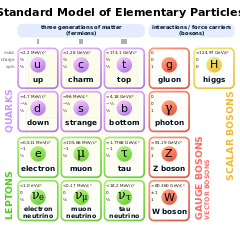 |
الجسيمات دون الذرية هي التي تكون ذات أحجام أصغر من الذرّة من هذه الجسيمات البروتونات والالكترونات والنيترونات التي منها تتكون الذرة كما إن منها جسيمات أخرى تنتج من التفاعلات النووية لكنها غير مستقرة إذ سرعان ما تتلاشى على هيئة جسيمات أخرى أو طاقة إشعاعية وقسم العلماء الجسيمات دون الذرية إلى ثلاثة أقسام رئيسية اللپتونات والكواركات والپوزونات هذه الأنواع تمثل الجسيمات الأولية أي التي لم يثبت حتى الآن إنها تتكون من جسيمات اصغر منها ولكنها قد تدخل في تكوين جسيمات أخرى فالكواركات مثلاً هي الجسيمات التي يتكون منها كل من الپروتون والنيوترون أما الإلكترون فهو من اللپتونات.[1]

إن حجم الجسيمات الأولية أصغر بمقدار مئة مليون مرة من حجم الذرات وبعضها عمره قصير جداً يصل إلى أجزاء من الثانية.[2]
التاريخ
The term "subatomic particle" is largely a retronym of the 1960s, used to distinguish a large number of baryons and mesons (which comprise hadrons) from particles that are now thought to be truly elementary. Before that hadrons were usually classified as "elementary" because their composition was unknown.
فيما يلي قائمة للاكتشافات الهامة:
| Particle | Composition | Theorized | Discovered | Comments |
|---|---|---|---|---|
| Electron e− | elementary (lepton) | G. Johnstone Stoney (1874) | J. J. Thomson (1897) | Minimum unit of electrical charge, for which Stoney suggested the name in 1891.[3] |
| alpha particle α | composite (atomic nucleus) | never | Ernest Rutherford (1899) | Proven by Rutherford and Thomas Royds in 1907 to be helium nuclei. |
| Photon γ | elementary (quantum) | Max Planck (1900) Albert Einstein (1905) | Ernest Rutherford (1899) as γ rays | Necessary to solve the thermodynamic problem of black-body radiation. |
| Proton p | composite (baryon) | long ago | Ernest Rutherford (1919, named 1920) | The nucleus of 1H. |
| Neutron n | composite (baryon) | Ernest Rutherford (ح.1918) | James Chadwick (1932) | The second nucleon. |
| Antiparticles | Paul Dirac (1928) | Carl D. Anderson (e+, 1932) | Revised explanation uses CPT symmetry. | |
| Pions π | composite (mesons) | Hideki Yukawa (1935) | César Lattes, Giuseppe Occhialini (1947) and Cecil Powell | Explains the nuclear force between nucleons. The first meson (by modern definition) to be discovered. |
| Muon μ− | elementary (lepton) | never | Carl D. Anderson (1936) | Called a "meson" at first; but today classed as a lepton. |
| Kaons K | composite (mesons) | never | 1947 | Discovered in cosmic rays. The first strange particle. |
| Lambda baryons Λ | composite (baryons) | never | University of Melbourne (Λ0, 1950)[4] | The first hyperon discovered. |
| Neutrino ν | elementary (lepton) | Wolfgang Pauli (1930), named by Enrico Fermi | Clyde Cowan, Frederick Reines (ν e, 1956) |
Solved the problem of energy spectrum of beta decay. |
| Quarks (u, d, s) |
elementary | Murray Gell-Mann, George Zweig (1964) | No particular confirmation event for the quark model. | |
| charm quark c | elementary (quark) | 1970 | 1974 | |
| bottom quark b | elementary (quark) | 1973 | 1977 | |
| Weak gauge bosons | elementary (quantum) | Glashow, Weinberg, Salam (1968) | CERN (1983) | Properties verified through the 1990s. |
| top quark t | elementary (quark) | 1973 | 1995 | Does not hadronize, but is necessary to complete the Standard Model. |
| Higgs boson | elementary (quantum) | Peter Higgs et al. (1964) | CERN (2012) | Thought to be confirmed in 2013. More evidence found in 2014.[5] |
| Tetraquark | composite | ? | Zc(3900), 2013, yet to be confirmed as a tetraquark | A new class of hadrons. |
| Pentaquark | composite | ? | Yet another class of hadrons. اعتبارا من 2019[تحديث] several are thought to exist. | |
| Graviton | elementary (quantum) | Albert Einstein (1916) | Interpretation of a gravitational wave as particles is controversial. | |
| Magnetic monopole | elementary (unclassified) | Paul Dirac (1931) | undiscovered | |
انظر أيضاً

مراجع
- ^ "Subatomic particles". NTD. Retrieved 5 June 2012.
{{cite web}}: Unknown parameter|تاريخ الأرشيف=ignored (help); Unknown parameter|مسار الأرشيف=ignored (help) - ^ Heisenberg, W. (1927), "Über den anschaulichen Inhalt der quantentheoretischen Kinematik und Mechanik" (in de), Zeitschrift für Physik 43 (3–4): 172–198, doi:, Bibcode: 1927ZPhy...43..172H.
- ^ Klemperer, Otto (1959). "Electron physics: The physics of the free electron". Physics Today. 13 (6): 64–66. Bibcode:1960PhT....13R..64K. doi:10.1063/1.3057011.
- ^ Some sources such as "The Strange Quark". indicate 1947.
- ^ "CERN experiments report new Higgs boson measurements". cern.ch. 23 June 2014.
للاستزادة
- للقارئ العام
- Feynman, R.P. & Weinberg, S. (1987). Elementary Particles and the Laws of Physics: The 1986 Dirac Memorial Lectures. Cambridge Univ. Press.
- Brian Greene (1999). The Elegant Universe. W.W. Norton & Company. ISBN 978-0-393-05858-1.
- Oerter, Robert (2006). The Theory of Almost Everything: The Standard Model, the Unsung Triumph of Modern Physics. Plume.
- Schumm, Bruce A. (2004). Deep Down Things: The Breathtaking Beauty of Particle Physics. Johns Hopkins University Press. ISBN 0-8018-7971-X.
- Martinus Veltman (2003). Facts and Mysteries in Elementary Particle Physics. World Scientific. ISBN 978-981-238-149-1.
- كتب دراسية
- Coughlan, G.D., J.E. Dodd, and B.M. Gripaios (2006). The Ideas of Particle Physics: An Introduction for Scientists, 3rd ed. Cambridge Univ. Press. An undergraduate text for those not majoring in physics.
- Griffiths, David J. (1987). Introduction to Elementary Particles. John Wiley & Sons. ISBN 978-0-471-60386-3.
- Kane, Gordon L. (1987). Modern Elementary Particle Physics. Perseus Books. ISBN 978-0-201-11749-3.
وصلات خارجية
- Subatomic particle (physics) على موسوعة بريتانيكا
- particleadventure.org: The Standard Model.
- cpepweb.org: Particle chart.
- University of California: Particle Data Group.
- Annotated Physics Encyclopædia: Quantum Field Theory.
- Jose Galvez: Chapter 1 Electrodynamics (pdf).
| الأولية |
| ||||||||||||||||||||||||
|---|---|---|---|---|---|---|---|---|---|---|---|---|---|---|---|---|---|---|---|---|---|---|---|---|---|
| مركبة |
| ||||||||||||||||||||||||
| أشباه الجسيمات | |||||||||||||||||||||||||
| القوائم | |||||||||||||||||||||||||
| متعلقات | |||||||||||||||||||||||||
