Mohs' scale of mineral hardness

The Mohs scale (/moʊz/ ( استمع) MOHZ) of mineral hardness is a qualitative ordinal scale, from 1 to 10, characterizing scratch resistance of minerals through the ability of harder material to scratch softer material.
The scale was introduced in 1812 by the German geologist and mineralogist Friedrich Mohs, in his book Versuch einer Elementar-Methode zur naturhistorischen Bestimmung und Erkennung der Fossilien (تر. Attempt at an Elementary Method for the Natural-Historical Determination and Recognition of Fossils);[1][2][أ] it is one of several definitions of hardness in materials science, some of which are more quantitative.[3]
The method of comparing hardness by observing which minerals can scratch others is of great antiquity, having been mentioned by Theophrastus in his treatise On Stones, ح. 300 BC, followed by Pliny the Elder in his Naturalis Historia, ح. AD 77.[4][5][6] The Mohs scale is useful for identification of minerals in the field, but is not an accurate predictor of how well materials endure in an industrial setting.[7]
Reference minerals
The Mohs scale of mineral hardness is based on the ability of one natural sample of mineral to visibly scratch another mineral. Minerals are chemically pure solids found in nature. Rocks are mixtures of one or more minerals.
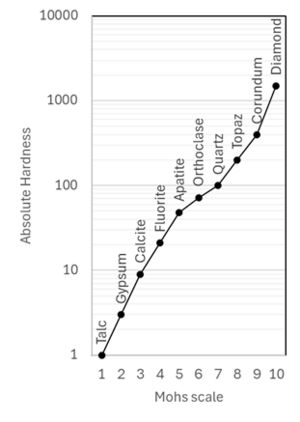
Mohs scale along the horizontal axis
matched with the absolute hardness
of each of the Mohs reference-
minerals along the vertical; notice
that the vertical scale is logarithmic.

Diamond was the hardest known naturally occurring mineral when the scale was designed, and defines the top of the scale, arbitrarily set at 10. The hardness of a material is measured against the scale by finding the hardest material that the given material can scratch, or the softest material that can scratch the given material. For example, if some material is scratched by apatite but not by fluorite, its hardness on the Mohs scale would be between 4 and 5.[8]
Technically, "scratching" a material for the purposes of the Mohs scale means creating non-elastic dislocations visible to the naked eye. Frequently, materials that are lower on the Mohs scale can create microscopic, non-elastic dislocations on materials that have a higher Mohs number. While these microscopic dislocations are permanent and sometimes detrimental to the harder material's structural integrity, they are not considered "scratches" for the determination of a Mohs scale number.[9]
Each of the ten hardness values in the Mohs scale is represented by a reference mineral, most of which are widespread in rocks.
The Mohs scale is an ordinal scale. For example, corundum (9) is twice as hard as topaz (8), but diamond (10) is about four times as hard as corundum, for absolute hardness.[10] The table below shows the comparison with the absolute hardness measured by a sclerometer, with images of the reference minerals in the rightmost column.[11][12]
Mohs
hardnessReference
mineralChemical formula Absolute
hardness[13]Example image 1 Talc Mg
3Si
4O
10(OH)
21 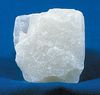
2 Gypsum CaSO
4·2H2O2 
3 Calcite CaCO
314 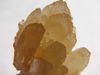
4 Fluorite CaF
221 
5 Apatite Ca
5(PO
4)
3(OH,Cl,F)48 
6 Orthoclase
feldsparKAlSi
3O
872 
7 Quartz SiO
2100 
8 Topaz Al
2SiO
4(OH,F)
2200 
9 Corundum Al
2O
3400 
10 Diamond C 1500 


Examples
 | هذا القسم يحتاج المزيد من الأسانيد للتحقق. (November 2022) (Learn how and when to remove this template message) |
Below is a table of more materials by Mohs scale. Some of them have a hardness between two of the Mohs scale reference minerals. Some solid substances that are not minerals have been assigned a hardness on the Mohs scale. Hardness may be difficult to determine, or may be misleading or meaningless, if a material is a mixture of multiple substances. For example, granite has been assigned by some sources a Mohs hardness between 6 and 7, but it is a rock made of several minerals, each with its own Mohs hardness. Topaz-rich granite is mainly composed of topaz (Mohs 8), quartz (Mohs 7), orthoclase (Mohs 6), plagioclase (Mohs 6–6.5), and mica (Mohs 2–4).
Hardness Substance 0.2–0.4 Potassium[14] 0.5–0.6 Lithium[14] 1 Talc 1.5 Lead[14] 2 Hardwood[15] 2–2.5 Plastic 2.5 Zinc[14] 2.5–3 Copper[14] 3 Brass 3.5 Adamite 3.5–4 Sphalerite 4 Iron[14] 4–4.5 Ordinary steel 4.5 Colemanite 5 Apatite 5–5.5 Goethite 5.5 Glass 5.5–6 Opal 6 Rhodium[14] 6–6.5 Rutile 6.5 Silicon[14] 6.5–7 Jadeite 7 Porcelain 7–7.5 Garnet 7.5 Tungsten[14] 7.5–8 Emerald 8 Topaz 8.5 Chromium[14] 9 Sapphire 9–9.5 Moissanite 9.5–near 10 Boron[14] 10 Diamond
Use
Despite its lack of precision, the Mohs scale is relevant for field geologists, who use it to roughly identify minerals using scratch kits. The Mohs scale hardness of minerals can be commonly found in reference sheets.
Mohs hardness is useful in milling. It allows the assessment of which type of mill and grinding medium will best reduce a given product whose hardness is known.[16]
Electronic manufacturers use the scale for testing the resilience of flat panel display components (such as cover glass for LCDs or encapsulation for OLEDs), as well as to evaluate the hardness of touch screens in consumer electronics.[17]
Comparison with Vickers scale
Comparison between Mohs hardness and Vickers hardness:[18]
Mineral
nameHardness (Mohs) Hardness (Vickers)
(kg/mm2)Tin 1.5 VHN10 = 7–9 Bismuth 2–2.5 VHN100 = 16–18 Gold 2.5 VHN10 = 30–34 Silver 2.5 VHN100 = 61–65 Chalcocite 2.5–3 VHN100 = 84–87 Copper 2.5–3 VHN100 = 77–99 Galena 2.5 VHN100 = 79–104 Sphalerite 3.5–4 VHN100 = 208–224 Heazlewoodite 4 VHN100 = 230–254 Goethite 5–5.5 VHN100 = 667 Chromite 5.5 VHN100 = 1,278–1,456 Anatase 5.5–6 VHN100 = 616–698 Rutile 6–6.5 VHN100 = 894–974 Pyrite 6–6.5 VHN100 = 1,505–1,520 Bowieite 7 VHN100 = 858–1,288 Euclase 7.5 VHN100 = 1,310 Chromium 8.5 VHN100 = 1,875–2,000
Footnotes
- ^
In demselben Jahre (1812) wurde MOHS als Professor am Joanneum angestellt und veröffentlichte den ersten Teil seines Werkes Versuch einer Elementarmethode zur naturhistorischen Erkennung und Bestimmung der Fossilien [sic], in welcher die bekannte Härteskala aufgestellt wurde.— von Groth (1926) [In the same year (1812) MOHS was employed as a professor at the Joanneum and published the first part of his work Attempt at an elementary method for the natural-historical recognition and determination of fossils [sic], in which the well-known hardness scale was set up.[1]]
See also
المراجع
- ^ أ ب von Groth, Paul Heinrich (1926). Entwicklungsgeschichte der Mineralogischen Wissenschaften [History of the development of the mineralogical sciences] (in الألمانية). Berlin: Springer. p. 250.
- ^ "Mohs hardness". Encyclopædia Britannica (online ed.).
- ^ "Mohs scale of hardness". Mineralogical Society of America. Retrieved 10 فبراير 2021.
- ^ Theophrastus. Theophrastus on Stones. Retrieved 10 ديسمبر 2011 – via Farlang.com.
- ^ Pliny the Elder. "Book 37, Chap. 15". Naturalis Historia.
Adamas: Six varieties of it. Two remedies.
- ^ Pliny the Elder. "Book 37, Chap. 76". Naturalis Historia.
The methods of testing precious stones.
- ^ "Hardness". Materials Mechanical Hardness. Non-Destructive Testing Resource Center. Archived from the original on 14 فبراير 2014.
- ^ "Mohs scale of mineral hardness". American Federation of Mineralogical Societies – via amfed.org.
- ^ Geels, Kay (26 April 2000). Materialographic Preparation from Sorby to the Present. The Struers metallographic library. Copenhagen, DK: Struers A/S. pp. 5–13. Archived from the original. You must specify the date the archive was made using the
|archivedate=parameter. http://www.struers.com/resources/elements/12/2474/35art2.pdf. - ^ Davis, Richard (ديسمبر 2018). "Why the Mohs scale remains relevant for metrology [Basic Metrology]". IEEE Instrumentation & Measurement Magazine. Vol. 21, no. 6. pp. 49–51. doi:10.1109/MIM.2018.8573594.
- ^ "What is important about hardness?". Amethyst galleries. Mineral gallery. Archived from the original on 30 ديسمبر 2006 – via galleries.com.
- ^ "Mineral hardness and hardness scales". Inland Lapidary. Archived from the original on 17 أكتوبر 2008 – via inlandlapidary.com.
- ^ Mukherjee, Swapna (2012). Applied Mineralogy: Applications in industry and environment. Springer Science & Business Media. p. 373. ISBN 978-94-007-1162-4 – via Google books.
- ^ أ ب ت ث ج ح خ د ذ ر ز Samsonov, G.V., ed. (1968). "Mechanical properties of the elements". Handbook of the Physicochemical Properties of the Elements. New York, NY: IFI-Plenum. p. 432. doi:10.1007/978-1-4684-6066-7. ISBN 978-1-4684-6068-1.
- ^ "Mohs Hardness Scale: Testing the Resistance to Being Scratched". geology.com. Retrieved 9 أغسطس 2021.
- ^ "Size reduction, comminution". Grinding and milling. PowderProcess.net. Retrieved 27 أكتوبر 2017.
- ^ Purdy, Kevin (16 مايو 2014). "Hardness is not toughness: Why your phone's screen may not scratch, but will shatter". Computerworld. IDG Communications Inc. Retrieved 16 أبريل 2021.
- ^ Ralph, Jolyon. "Welcome to mindat.org". mindat.org. Hudson Institute of Mineralogy. Retrieved 16 أبريل 2017.
Further reading
- Cordua, William S. (c. 1990). "The hardness of minerals and rocks". Lapidary Digest – via gemcutters.org.
- Raden, Aja (2016). Gem: The definitive visual guide (in الإنجليزية). New York, NY: DK Publishing. ISBN 978-1-4654-5356-3.
- Kostov, R. I. (2009) Hardness of minerals in three Eastern Medieval gemmological treatises from the XIth and XIIIth century. – Geology and Mineral Resources, 16, 7-8, 27-29 (in Bulgarian).
- Articles containing ألمانية-language text
- CS1 الألمانية-language sources (de)
- Short description with empty Wikidata description
- Use dmy dates from August 2024
- Pages including recorded pronunciations
- Articles needing additional references from November 2022
- All articles needing additional references
- Materials science
- Mineralogy
- Hardness tests
- 1812 in science
- 1812 in the Confederation of the Rhine