جاسبار بوهان
Gaspard Bauhin | |
|---|---|
 | |
| وُلِدَ | 17 January 1560 |
| توفي | 5 ديسمبر 1624 (aged 64) Basel, Switzerland |
| أسماء أخرى | Caspar Bauhin; Casparus Bauhinus |
| المدرسة الأم | University of Basel (M.D., 1581) |
| عـُرِف بـ | Pinax theatri botanici |
| السيرة العلمية | |
| المجالات | Botany |
| أبرز الطلاب | Emmanuel Stupanus |
| Author abbrev. (botany) | C.Bauhin |
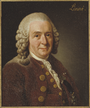
Gaspard Bauhin or Caspar Bauhin (لاتينية: Casparus Bauhinus; 17 January 1560 – 5 December 1624), was a Swiss botanist whose Pinax theatri botanici (1623) described thousands of plants and classified them in a manner that draws comparisons to the later binomial nomenclature of Linnaeus. He was a disciple of the famous Italian physician Girolamo Mercuriale and he also worked on human anatomical nomenclature.
Bauhin described the ileocecal valve in 1588—hence the name Bauhin's Valve or Valve of Bauhin—in the preface of his first writing, De corporis humani partibus externis tractatus, hactenus non editus. Linnaeus honored the Bauhin brothers Gaspard and Jean in the genus name Bauhinia.[1]
Biography

Jean and Gaspard were the sons of Jean Bauhin (1511–1582), a French surgeon to the King who had to leave his native country on becoming a convert to Protestantism. Gaspard was born in Basel. From 1572 he studied in his hometown, Padua, Bologna, Montpellier, Paris and Tübingen. He was awarded his medical doctorate at the University of Basel in 1581 and started giving private lectures in botany and anatomy. In 1582 he was appointed to the Greek professorship at the same university, as well as in 1589 to the new established chair of anatomy and botany.[2] After the death of Felix Platter in 1614, Bauhin was made professor of the practice of medicine and city physician (Stadtarzt).[3] He was rector of the University of Basel in 1592, then again in 1611 and 1619; during the second rectorate the university tried in vain to win back from the city council the freedoms of 1460, which were lost in 1532.[4]
As a impressive example of how independent scientific disciplines as botany were established at early modern universities, Bauhin systematically trained a whole generation of scholars to become qualified botanists, while the University of Basel became the undisputed center of the science in the German-speaking world around 1600.[5] With regard to empirical research, Bauhin’s herbarium was with more than 4,000 species one of the most extensive of its time. Its scientific layout and design corresponded to Bauhin's plan of a 'general history' (or catalogue) of all existing plants. To further his career, young Bauhin built up a large network of correspondents. These connections also allowed him to collect foreign and exotic botanical samples. With more than 2,500 letters preserved, his correspondence is a larger source corpus than even that of famous contemporary botanist Carolus Clusius.
Following the Phytopinax (Basel, 1596), Bauhin’s earliest botanical publication, the Pinax theatri botanici (Basel, 1623, English: Illustrated exposition of plants) was a landmark of botanical history, describing some 6,000 species and classifying them.[1] The classification system was not particularly innovative, using traditional groups such as "trees", "shrubs", and "herbs", and using other characteristics such as utilization, for instance grouping spices into the Aromata. He did ‘correctly’, by the standards of modern botany, group grasses, legumes, and several others. His most important contribution is in the description of genera and species. He introduced many names of genera that were later adopted by Linnaeus, and remain in use.[2] For species he carefully pruned the descriptions down to as few words as possible; in many cases a single word sufficed as description, thus giving the appearance of a two-part name. However, the single-word description was still a description intended to be diagnostic, not an arbitrarily-chosen name (in the Linnaean system, many species names honor individuals, for instance).[citation needed]
In addition to Pinax Theatri Botanici, Gaspard planned another work, a Theatrum Botanicum, meant to be comprised in twelve parts folio, of which he finished three; only one, however, was published (1658), long after his death. He also gave a copious catalogue of the plants growing in the environs of Basel, its flora, and edited the works of Pietro Andrea Mattioli (1500–1577) with considerable additions.[2] His principal work on anatomy was Theatrum Anatomicum infinitis locis auctum (1592).[3]
Works

- (as editor), Petri Andreae Matthioli Opera Omnia, Johannes König, Basel, 1574.
- Theatrum anatomicum infinitis locis auctum, ad morbos accommodatum, Basel, 1592.
- Theatrum Anatomicum, Frankfurt am Main, 1605.
- Phytopinax seu enumeratio plantarum (in اللاتينية). Basel. 1596 – via Sebastian Henricpetri.
- Anatomica corporis virilis et muliebris historia, Leiden, 1597.
- Animadversiones in historiam generalem plantarum (in اللاتينية). Frankfurt am Main. 1601 – via Melchior Hartmann.
- Prodromos theatri botanici (in اللاتينية). 1620. The introduction to his projected magnum opus.
- Prodromos theatri botanici (in اللاتينية). Basel. 1671 – via Johann König.
- Pinax theatri botanici, Basel, 1623.
- Pinax theatri botanici (in اللاتينية). Basel. 1671 – via Johann König.
- Vivae imagines partium corporis humani (in اللاتينية). Frankfurt am Main. 1640 – via Matthäus Merian (I).
- Theatrum Botanicum, 1658.
- Histoire des plantes de l'Europe, et des plus usitées qui viennent d'Asie, d'Afrique, & de l'Amérique […], 2 voll., Lyon, 1671.
See also
References
- ^ أ ب Gunn, Mary (1981). Botanical exploration of southern Africa : an illustrated history of early botanical literature on the Cape flora : biographical accounts of the leading plant collectors and their activities in southern Africa from the days of the East India Company until modern times. L. E. W. Codd. Cape Town: Published for the Botanical Research Institute by A.A. Balkema. p. 15. ISBN 0-86961-129-1. OCLC 8591273.
- ^ أ ب ت Isely, Duane (2002). One hundred and one botanists. West Lafayette, Indiana: Purdue University Press. pp. 49–52. ISBN 1-55753-283-4. OCLC 947193619.
- ^ أ ب Chisholm 1911.
- ^ "Bauhin Caspar". University of Basel. Archived from the original on 28 أكتوبر 2021. Retrieved 14 ديسمبر 2020.
- ^ Walter, Tilmann (2025). "Roots of modern botany: The Basel professor Caspar Bauhin (1560–1624) and his botanical network". History of Science 63: 245–273. doi/10.1177/00732753251365584
- This article incorporates text from a publication now in the public domain: Chisholm, Hugh, ed. (1911). . دائرة المعارف البريطانية. Vol. 3 (eleventh ed.). Cambridge University Press. p. 539.
{{cite encyclopedia}}: Cite has empty unknown parameter:|coauthors=(help)

External links
- University of Kyoto Archived 17 أكتوبر 2016 at the Wayback Machine Online Pinax theatri botanici (1623)
- Online Galleries, History of Science Collections, University of Oklahoma Libraries High resolution images of works by and/or portraits of Gaspard Bauhin in .jpg and .tiff format.
- Images from Theatrum anatomicum From The College of Physicians of Philadelphia Digital Library
- Caspari (Gaspard) Bauhini, Prodromos Theatri Botanici (1620) Digitized Copy on Archive.org

| الأعمال المنشورة |
|  |
|---|---|---|
| عام | ||
| حواريو لينايوس | ||
| أشخاص ذوو صلة | ||
| تقدير |
| |


- Short description with empty Wikidata description
- Use dmy dates from August 2021
- Articles containing لاتينية-language text
- Articles containing ألمانية-language text
- Articles with unsourced statements from November 2023
- علماء نبات ذوي مختصرات اسمية
- CS1 اللاتينية-language sources (la)
- مقالات المعرفة المحتوية على معلومات من دائرة المعارف البريطانية طبعة 1911
- Wikipedia articles incorporating text from the 1911 Encyclopædia Britannica
- 1560 births
- 1624 deaths
- Scientists from Basel-Stadt
- 17th-century Swiss botanists
- Swiss mycologists
- 16th-century Swiss medical doctors
- Academic staff of the University of Basel
- Members of the Lincean Academy
- 16th-century Swiss botanists