المنكب، غرناطة
المنكب
Almuñécar | |
|---|---|
| المنكب | |
 Almuñécar | |
.svg&filetimestamp=20260101111845&) Flag _2.svg&filetimestamp=20110930221540&) الدرع | |
 | |
  المنكب الموقع في إسبانيا | |
| الإحداثيات: 36°44′N 3°41′W / 36.733°N 3.683°W | |
| البلد |  إسپانيا إسپانيا |
| المنطقة |  منطقة الأندلس منطقة الأندلس |
| البلدية | غرناطة |
| Comarca | Costa Tropical |
| المنطقة القضائية | Almuñécar |
| Founded | ~800BC |
| الحكومة | |
| • Alcalde | Juan José Ruiz Joya (2022) (PP) |
| المساحة | |
• الإجمالي | 83٫36 كم² (32٫19 ميل²) |
| المنسوب | 24 m (79 ft) |
| أعلى منسوب | 87 m (285 ft) |
| أوطى منسوب | 0 m (0 ft) |
| التعداد (2024-01-01) | |
• الإجمالي | 27٬311 |
| • الكثافة | 330/km2 (850/sq mi) |
| صفة المواطن | Sexitano, -na o almuñequero, -ra |
| منطقة التوقيت | UTC+1 (CET) |
| • الصيف (التوقيت الصيفي) | UTC+2 (CEST) |
| الرمز البريدي | |
| اللغة الرسمية | الإسبانية |
| الموقع الإلكتروني | Official website |
المُنَكَّب[1][2][3] (بالإسبانية: Almuñécar) مدينة بمقاطعة غرناطة من منطقة الأندلس ذاتية الحكم بجنوب إسبانيا. بلغ عدد سكانها 27,311 نسمة عام 2024.
Since 1975, the town has become one of the most important tourist towns in Granada province and on the Costa Granadina; it has good transport connections and a football (soccer) stadium.
Almuñécar's coat of arms, which shows the turbaned heads of three Barbary pirates floating in the sea, was granted to the town by King Carlos I in 1526 for its having destroyed a Berber raiding force.
السياسة
Juan José Ruiz Joya is the current mayor of Almuñecar. The city council elected Ruiz Joya, local leader of the People's Party (Partido Popular), on 2022.
التاريخ
Almuñécar began as a Phoenician colony named Sexi, and even today, some of its inhabitants still call themselves Sexitanos. Under the Moors, Almuñécar blossomed as the fishing town of al-Munakkab (عربية: المُنَكَّب) or Ḥiṣn-al-Munakkab (حصن المنكب). Although the Phoenician and Roman history of the district was known from Greek and Roman sources it was not until the 1950s that significant archaeological evidence was discovered.
القِدم
الفينيقيون
The Phoenicians first established a colony in Almuñécar in about 800 BC and this developed for six hundred years into an important port and town with the name of Ex or Sexi and with a large fish salting and curing industry that was a major supplier of Greece and Rome. They also supplied a prized fish paste called garum made from the intestines of small fishes by a process of fermentation.[4][5] Archaeological evidence comes chiefly from Phoenician cemeteries, the earlier Laurita necropolis on the hillside at Cerro San Cristobal and the later necropolis at Punte de Noy. An extensive collection of Phoenician grave goods and other artifacts is on display in the town museum located at the Castle of San Miguel and in the 'Cueva de Siete Palacios'.
الرومان
The Romans came to southern Spain at the time of the Second Punic War between Rome and Carthage in 218 BC as part of their campaign to subdue the Phoenician settlements along the coast. During 700 years of Roman rule the town and its industry prospered, and in 49 BC the municipality (one of 20 cities in Spain honoured at that time) was given the title Firmium Julium Sexi in recognition of the town's loyalty to Rome.
Major evidence of the fish salting and curing industry was uncovered during excavations in the 1970s and 1980s in the extensive Majuelo Botanical Gardens. These revealed the great extent of the rebuilding and modernising of the industry under Roman influence. A segment of the site has been carefully conserved, giving some idea of the size of the industry. This industry required not only large quantities of fish and sea salt, produced in many places along the coast, but also a constant supply of fresh running water.
To meet this demand the Romans built in the 1st century AD four miles of water conduit in the valleys of the Rio Seco and the Rio Verde, including five significant aqueducts. All, remarkably, are still standing and four of them are still in use after 2,000 years – adapted by the Moors over the centuries to serve the needs of crop irrigation. The Roman water supply also served the town and recent excavations in the town centre have uncovered the fifth aqueduct and the Roman baths.
The Romans were probably the first to fortify the Castle of Saint Miguel, although frequent rebuilding has obliterated most of the very extensive Roman fortifications. These included a bridge from the castle to the 'Peñon del Santo' with a massive 100 قدم (30 m) high arch that survived until at least 1800.
Just below the castle on the landward side is the 'Cueva de Siete Palacios', which translates as 'Cave of the Seven Palaces'. However, it is not actually a cave, rather it is the largest remnant of a Roman palace yet found in Almuñécar, having survived for hundreds of years as 'social housing' until the 'cave dwellers' were re-housed in the 1970s. Only then did its true origins become apparent. It now houses the town museum.
Other important Roman remains in the district include a Roman bridge at Cotobro and Roman tombs in several locations.
العصور الوسطى
القوط الغربيون
With the decline of the Western Roman Empire in the 5th century, Germanic peoples, including the Visigoths, crossed the Pyrenees mountain range into the Iberian peninsula. By 456 the Visigoths emerged as the dominant power, and expanded their territory onto the southwestern Mediterranean coast. However, Hispania remained relatively Romanized under their rule. The Visigoths adopted Roman culture and language, and maintained many of the old Roman institutions,[6] although much of the economic structure collapsed, and at Almuñécar the fish curing industry declined rapidly. The Catholic bishops were the rivals of Visigothic power and culture until the end of the 6th and beginning of the 7th century—the period of transition from Arianism to Catholicism in the Visigothic kingdom.
المسلمون
_3.svg&filetimestamp=20220313002331&)
In 755 Umayyad Abd ar-Rahman I of Damascus, the founder of the Emirate of Cordoba, arrived from North Africa to establish his kingdom. The castle remained the stronghold of the city and the seat of government and its walls were strengthened. Extensive dungeons were built for those out of favour with local rulers, but also baths for the use of the social elite during the al-Andalus centuries.
The cross on Peñon del Santo, the rock at the old harbour entrance, marks the defeat of the Arabs, their surrender at Almuñécar, and the annexation to the Kingdom of Castille in 1489. The Arabic name المُنَكَّب (al-Munakkab, surrounded by mountains) gave origin to present-day Almuñécar.[7]
العصر الحديث والحاضر
Following the restoration of Christian rule, new architectural statements were made – for example the construction of a new church was started in 1557 and completed to the latest design in 1600, the first Baroque-style church in the province of Granada. The old town was also Christianised (or perhaps paganised – by the Goddess of fertility herself), as in the building of the water fountain on the Calle Real (Royal Street), dated to 1559 and with the royal cypher above, but at that time using the existing Roman water supply from Las Angosturas first installed 1500 years earlier.
In 1562, a Spanish fleet sank in a storm in La Herradura Bay.
In 1563, Ottoman corsair Turgut Reis landed at the shores of the province of Granada and captured the coastal settlements in the area, including Almuñécar, along with 4,000 prisoners.
The castle was again extensively rebuilt and placed under the patronage of San Miguel. It was rebuilt and heavily fortified by the Christian King Charles III and last defended (by the French) in the Napoleonic Wars. Just one tower was partly destroyed but also most of the internal buildings. This was the work of the crew of the British vessel, HMS Hyacinth, acting in collaboration with Spanish partisans from Nerja on 27 May 1812. They caused the French garrison to flee and then attempted to render the castle unusable but with little success – owing to the gunpowder being damp. However, the Castle was finished as a military stronghold and following a cholera outbreak in 1830 the castle became the town cemetery, from which use it was cleared in 1986, to permit the restoration which is still in progress.
At the beginning of the Spanish Civil War Almuñécar was where English poet and author Laurie Lee was rescued by the Royal Navy in the summer of 1936. The story is featured in his book, As I Walked Out One Midsummer Morning. In earlier editions the town is referred to as "Castillo" to disguise people's identities.
The town's economy benefited from the raise of national and international tourism since the 1970s as well as neighbour Motril.
المأكل
Almuñécar's gastronomy focuses mainly on fresh fish and subtropical fruit. Monkfish (rape), red sea bream (besugo), squids (calamares), grouper (mero), croaker (corvina), and shellfish paella are typical examples of local seafood. There are several restaurants next to the beach where meals featuring these can be eaten al fresco (at tables outside) in the sea breezes. Pub crawls with stops at several bars to try different tapas are also popular.
The soil in the area is very fertile, and due to the semi-tropical climate, tropical fruits can be grown here. The most notable are mangos, avocados, loquats, and cherimoyas, but it is also easy to find papayas, guavas, lychees, kiwis, figs and even prickly pears, the fruit of the Opuntia ficus-indica cactus, which are used to make ice cream and jams sold in several local coffee shops.
Until the 1960s, Almuñécar had an important role as a sugar cane producer.
Some typical dessert cakes still made locally include:
- Cazuela Mohína: an almond-based cake made with brown sugar, sesame and aniseed.
- Torta de Alhajú: an almond cake wrapped in wafers and honey.
- Merengazo: a sponge cake topped with egg white meringue.
النقل
الطرق
Almuñécar is connected to the coastal highway A7, with Almería to the East and Malaga to the West. The A-44 highway, also known as Autovía de Sierra Nevada-Costa Tropical, runs north of the city.
السكك الحديدية
Almuñécar does not have a railway connection.
العبّارات
Almuñécar has a small marina, accessible by private boats. The Port of Motril is located less than 20 kilometers from Almuñécar and offers ferry services and even commercial cruises.
النقل الجوي
Almuñécar does not have its own airport, but there are two airports within a 90-kilometer radius: Federico García Lorca Granada Airport (GRX) and Malaga - Costa del Sol Airport (AGP).
معرض صور
-
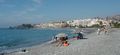 Almuñécar Playa Velilla
 -
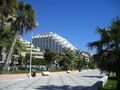 Promenade and Hotel Helios, Playa San Cristobal, Almuñécar
 -
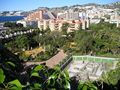 Excavated ruins of the Phoenician fish salting factory within the Majuelo Park
 -
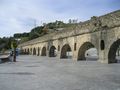 The Roman aqueduct at Torrecuevas near the source of the Rio Verde about 4 km (2 mi) north of Almuñécar
 -
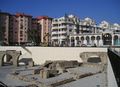 Recently excavated Roman aqueduct and baths in the town centre
 -
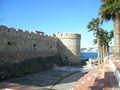 The castle of San Miguel
 -
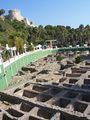 Vestiges de l'industrie antique de poissons
 -
 The statue of Abd-ar-Rahman I founder of The Emirate of Cordoba who landed at Almuñécar in 755 AD
 -
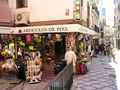 In the old town of Almuñécar
 -
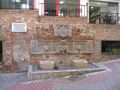 The Royal fountain in Calle Real built in 1559 but using the existing Roman water supply
 -
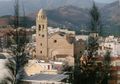 The church of the Incarnation in Almuñécar
 -
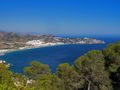 La Herradura Bay as seen from Cerro Gordo, at sunset


المدن الشقيقة
 Fürstenfeldbruck، باڤاريا، ألمانيا
 Livry-Gargan، إل دي فرانس، فرانسا
 Cerveteri، لاسيو، إيطاليا
 Puerto de la Cruz، إسپانيا
 Hendersonville، كاليفورنيا الشمالية، الولايات المتحدة


وصلات خارجية
- Almuñécar Official Site
- Local Tourist Guide to Almuñécar and La Herradura
- Bus Timetables
- Webcam in Rio Verde/Rio Seco
- Webcam in Playa de Tesorillo
- Webcam in Playa de San Cristobal
- Photographic Guide to Almuñécar
المراجع
- ^ «المنكب: (بالضم ثم الفتح وتشديد الكاف وفتحها وباء موحدة، من نكبت الشيء فهو منكب كأنك تعطيه منكبك) وهو بلد على ساحل جزيرة الأندلس من أعمال ألبيرة، بينه وبين غرناطة أربعون ميلاً». ياقوت الحموي، معجم البلدان.
- ^ «شلوبينية: قرية مسكونة على ضفة البحر، بينها وبين المنكب عشرة أميال». الحميري، صفة جزيرة الأندلس.
- ^ «والمنكب مدينة حسنة متوسطة، كثيرة مصايد السمك، وبها فواكه جمة.

The Roman aqueduct in the Rio Seco valley about 2 km (1 mi) north of Almuñécar وفي بلدة المنكب بناء مربع قائم كالصنم، أسفله واسع وأعلاه ضيق وبه حفيران من جانبيه متصلان من أسفله إلى أعلاه، وبإزائه من الناحية الواحدة في الأرض حوض كبير يأتي إليه الماء من نحو ميل على ظهر قناطر كثيرة معقودة من الحجر الصلد فيصب ماؤها في ذلك الحوض. ويذكر أهل المعرفة من أهل المنكب أن ذلك الماء كان يصعد إلى أعلى المنار وينزل من الناحية الأخرى فيجري هناك إلى رحى صغيرة كانت وبقي موضعه الآن على جبل مطل على البحر ولا يدرى المراد من ذلك ما كان. ومن مدينة المنكب في البر إلى غرناطة أربعون ميلاً». الإدريسي، نزهة المشتاق في اختراق الآفاق.
- ^ Richard Hosking (2006). Authenticity in the Kitchen: Proceedings of the Oxford Symposium on Food and Cookery 2005. Oxford Symposium. ISBN 978-1-903018-47-7. Retrieved 23 June 2013.
- ^ Wilhelmina Feemster Jashemski; Frederick G. Meyer (19 September 2002). The Natural History of Pompeii. Cambridge University Press. p. 274. ISBN 978-0-521-80054-9. Retrieved 23 June 2013.
- ^ Roger Collins (1998). Spain: An Oxford Archaeological Guide. Oxford University Press. pp. 19–20. ISBN 978-0-19-285300-4. Retrieved 23 June 2013.
Once prevalent interpretations of the late Visigothic kingdom as being decadent and demoralized are now discounted.
- ^ Rodríguez-Gómez, María Dolores (January 2020). "ganadería nazarí compraventa árabe". En F. Toro Ceballos (Coord.), Estudios de Frontera. 11. La Realidad Bifronte de la Frontera. Homenaje a Carmen Argente del Castillo Ocaña, Jaén: Diputación Provincial, Pp. 475-491. ISBN: 978-84-121301-7-1.

- Initial information in this article is based on that in its German equivalent.
- Olivier de Busschère; The Guide to Almuñécar and La Herradura, Costa XXI.
.svg&filetimestamp=20120115204131&)
| عواصم البلديات |  | |
|---|---|---|
| مدن موانئ | الجزيرة الخضراء • المنكب • ابن المدينة • Chipiona • El Puerto de Santa María • سهيل • ماربيا • مقور • Motril • نرخا • San Fernando • شلوقة • تورِّمولينوس | |
| مدن أخرى | ||
- Pages using gadget WikiMiniAtlas
- Short description is different from Wikidata
- Coordinates on Wikidata
- Official website different in Wikidata and Wikipedia
- Pages using infobox settlement with deprecated parameters
- Articles containing explicitly cited عربية-language text
- بلديات غرناطة
- قنوات مائية رومانية خارج روما
- مواقع أثرية في اسبانيا
- مواقع رومانية في اسبانيا
- مستعمرات فينيقية في اسبانيا
- أماكن مأهولة في غرناطة