هامور جالوت الأطلسي
| هامور جالوت الأطلسي | |
|---|---|

| |
التصنيف العلمي 
| |
| أصنوفة غير معروفة (أصلحها): | Epinephelidae |
| Genus: | Epinephelus |
| Species: | E. itajara
|
| Binomial name | |
| Epinephelus itajara (Lichtenstein, 1822)
| |
| Synonyms[2] | |
| |
The Atlantic goliath grouper or itajara (Epinephelus itajara), historically known as the jewfish,[3][4] is a saltwater fish of the grouper family and one of the largest species of bony fish. The species can be found in the West Atlantic ranging from northeastern Florida, south throughout the Gulf of Mexico and the Caribbean Sea, and along South America to Brazil. In the East Pacific it ranges from Mexico to Peru.[5] In the East Atlantic, the species ranges in West Africa from Senegal to Cabinda. The species has been observed at depths ranging from 1 إلى 100 متر (3 إلى 300 ft).[1]
أصل الاسم
The Atlantic goliath grouper was historically referred to as the "jewfish", and there are several theories as to the name's origin. A 1996 review of the term's history from its first recorded usage in 1697 concluded that the species' physical characteristics were frequently connected to "mainstay caricatures of anti-Semitic beliefs", whereas the interpretation that the fish was regarded as kosher food had little support.[6] Alternate explanations include derivation from the Italian word "giupesce", which means "bottom fish", or mispronunciation of the name "jawfish".[4] In 1927, the New York Aquarium changed the fish's name to Junefish after protests.[7] In 2001, the American Fisheries Society changed the name to "goliath grouper" after complaints that the nickname was culturally insensitive.[4][8]
Description

The Atlantic goliath grouper can grow to lengths of 2.5 متر (8 أقدام) and weigh up to 363 كيلوغرام (800 رطل).[9] The species ranges in coloration from brownish yellow to grey to greenish and has small black dots on the head, body and fins. Individuals less than 1 متر (3 أقدام) in length have three to four faint vertical bars present on their sides.[9] The species has an elongate body with a broad, flat head and small eyes. The lower jaw has 3 to 5 rows of teeth with no front canines. The scales are ctenoid.[10] The dorsal fins are continuous with the rays of the soft dorsal fin being longer than the spines of the first dorsal fin.[9] The pectoral fins are rounded and notably larger than the pelvic fins. The caudal fin is also rounded.[9] The species typically preys on slow moving fish and crustaceans.[11]
Habitat
Adult individuals are typically found in rocky reefs, wrecks, artificial reefs, and oil platforms. The species can also be found in coral reef habitats, but are much more abundant in rocky reef environments.[12] Juveniles mainly inhabit mangrove environments, but can also be found in holes and under ledges of swift tidal creeks that drain mangroves.[13] Mangroves serve as an essential nursery habitat for the Atlantic goliath grouper and provide specific suitable water conditions to nurture healthy, sustained goliath grouper populations.[14] Juvenile goliath groupers may remain in mangrove nursery habitats for 5 to 6 years before leaving towards deeper offshore reef habitats at around 1 meter in length.[14]
Reproduction
The Atlantic goliath grouper has a longevity of 37 years and reaches first maturity after 6 years, which leads to an estimated generation length of 21.5 years.[1] The species has been hypothesized to be protogynous hermaphrodites, but this has yet to be confirmed.[15] Males become sexually mature at around 115 سنتيمتر (45 in) in length, and at ages 4–6. Females mature at around 125 سنتيمتر (49 in), and at ages 6–8.[16] The species has relatively small spawning aggregations of less than 150 individuals with no evidence of spawning outside of these aggregations.[10]
Conservation
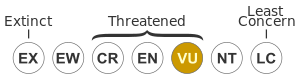
Atlantic goliath groupers are highly susceptible to rapid population decline due to overfishing and the exploitation of spawning aggregations.[10] The species has a brief annual larval settlement period, making the species' abundance extremely vulnerable to outside factors such as poor weather conditions.[17] High mercury concentrations in older males may lead to liver damage and/or death and reduce egg viability.[18] The degradation of mangroves, which serve as an important nursery habitat for the species provide a major threat to juvenile survival.[1] The species was previously classified as critically endangered in 2011 and is currently classified as vulnerable in 2021.[1] A 2016 stock assessment model indicates that there has been an absolute population reduction of around 33% from 1950 to 2014. There has been a complete moratorium on the fishing of this species in continental U.S. waters since 1990 and in U.S. Caribbean waters since 1993.[1]
In October 2021, Florida Fish and Wildlife proposed to allow the fishing of 200 juvenile goliath grouper per year including up to 50 from Everglades National Park. Recreational fishing of the species would be permitted in all state waters except those of Palm Beach County south through the Atlantic coast of the Keys.[19] The proposal was approved in March 2022, with the Florida Fish and Wildlife Commission planning to issue 200 permits per year through a lottery system, which came into effect in the spring of 2023.[20]
In popular culture

Portuguese street artist Bordalo II creates installations made of trash to highlight over-consumption. His works consisting of animals are created to highlight the destruction of species by waste caused by humans.[21] One of his public sculptures is the huge Plastic Mero, created from marine debris and installed in 2019 on the seafront in Funchal, Portugal.[22]
References
- ^ أ ب ت ث ج ح Bertoncini, A.A.; Aguilar-Perera, A.; Barreiros, J.; et al. (2018). "Epinephelus itajara". IUCN Red List of Threatened Species. 2018 e.T195409A145206345. doi:10.2305/IUCN.UK.2018-2.RLTS.T195409A145206345.en.
{{cite journal}}: Unknown parameter|errata=ignored (help) - ^ Froese, Rainer; Pauly, Daniel (eds.) (2019). "Epinephelus itajara" in FishBase. April 2019 version.
- ^ Tribune, Chicago (23 يوليو 2001). "Renaming the jewfish". chicagotribune.com (in الإنجليزية الأمريكية). Retrieved 7 مايو 2020.
- ^ أ ب ت "How the Jewfish Got Its Name". Jewish Telegraphic Agency (in الإنجليزية الأمريكية). Retrieved 4 أكتوبر 2021.
- ^ Epinephelus itajara (Lichtenstein, 1822) FishBase
- ^ Gould, R.G.; Atz, J.W. (1996). "The trouble with "jewfish" or what's in a name". Tropical Fish Hobbyist. 44 (12): 172–182.
- ^ The Jewish Tribune, 5 August 1927, p. 31
- ^ Espinosa, H.; Findley, L. T.; Lea, R. N.; Williams, J. D. (مايو 2001). "Recommended change in the common name for a marine fish: Goliath grouper to replace jewfish (Epinephelus itajara)". Fisheries Magazine. American Fisheries Society.
- ^ أ ب ت ث "Epinephelus itajara". Florida Museum (in الإنجليزية الأمريكية). 11 مايو 2017. Retrieved 4 أكتوبر 2021.
- ^ أ ب ت Sadovy Y., Eklund A.M. (1999). Synopsis of biological data on the Nassau grouper, Epinephelus striatus (Bloch, 1792) and the Jewfish, E. itajara (Lichtenstein, 1822). NOAA Technical Report NMFS 146, and FAO Fisheries Synopsis 157.
- ^ Artero, C; Koenig, CC; Richard, P; Berzins, R; Guillou, G; Bouchon, C; Lampert, L (15 أبريل 2015). "Ontogenetic dietary and habitat shifts in goliath grouper Epinephelus itajara from French Guiana". Endangered Species Research. 27 (2): 155–168. doi:10.3354/esr00661.
- ^ Bueno, L. S.; Bertoncini, A. A.; Koenig, C. C.; Coleman, F. C.; Freitas, M. O.; Leite, J. R.; De Souza, T. F.; Hostim-Silva, M. (6 يونيو 2016). "Evidence for spawning aggregations of the endangered Atlantic goliath grouper Epinephelus itajara in southern Brazil". Journal of Fish Biology. 89 (1): 876–889. Bibcode:2016JFBio..89..876B. doi:10.1111/jfb.13028. PMID 27264779.
- ^ Bullock, Lewis H.; Godcharles, Mark F. (1 يوليو 1982). "Range Extensions for Four Sea Basses (Pisces: Serranidae) from the Eastern Gulf of Mexico with a Color Note on Hemanthias leptus (Ginsburg)". Northeast Gulf Science. 5 (2). doi:10.18785/negs.0502.06.
- ^ أ ب Koenig, Christopher C; Coleman, Felicia C; Kingon, Kelly (1 أكتوبر 2011). "Pattern of Recovery of the Goliath Grouper Epinephelus itajara Population in the Southeastern US". Bulletin of Marine Science. 87 (4): 891–911. Bibcode:2011BuMS...87..891K. doi:10.5343/bms.2010.1056.
- ^ Koenig, Christopher C.; Coleman, Felicia C.; Malinowski, Christopher R. (4 أكتوبر 2019). "Atlantic Goliath Grouper of Florida: To Fish or Not to Fish". Fisheries. 45 (1): 20–32. doi:10.1002/fsh.10349. S2CID 202017187.
- ^ Bullock et al. (1992). Age, Growth, and Reproduction of Jewfish Epinephelus itajara in the Eastern Gulf of Mexico. U.S. Fishery Bulletin 90 (2):243-249. Retrieved 21 August 2014.
- ^ Cheung, WWL; Sadovy, Y; Braynen, MT; Gittens, LG (22 فبراير 2013). "Are the last remaining Nassau grouper Epinephelus striatus fisheries sustainable? Status quo in the Bahamas". Endangered Species Research. 20 (1): 27–39. doi:10.3354/esr00472. hdl:10722/190416.
- ^ Evers, DC; Graham, RT; Perkins, CR; Michener, R; Divoll, T (1 يوليو 2009). "Mercury concentrations in the goliath grouper of Belize: an anthropogenic stressor of concern". Endangered Species Research. 7: 249–256. doi:10.3354/esr00158.
- ^ "FWC approves a draft proposal for limited, highly regulated fishing of goliath grouper". Florida Fish & Wildlife Conservation Commission (in الإنجليزية). Retrieved 6 ديسمبر 2021.
- ^ "FWC approves limited recreational harvest of goliath grouper in state waters". Florida Fish And Wildlife Conservation Commission (in الإنجليزية). 3 مارس 2022. Archived from the original on 26 فبراير 2023. Retrieved 26 فبراير 2023.
- ^ "Bordalo II" (video (1 min.) + text). Street Art Bio. 5 أبريل 2022. Retrieved 30 يوليو 2023.
- ^ "'Plastic Mero'". Atlas Obscura. 5 يوليو 2022. Retrieved 30 يوليو 2023.
External links
- Florida Museum of Natural History description including alternate names
- Photos of هامور جالوت الأطلسي on Sealife Collection
- CS1 errors: unsupported parameter
- CS1 الإنجليزية الأمريكية-language sources (en-us)
- Short description with empty Wikidata description
- Articles with hatnote templates targeting a nonexistent page
- Missing redirects
- Use dmy dates from October 2025
- IUCN Red List vulnerable species
- Automatic taxobox cleanup
- Epinephelus
- Fish of the Atlantic Ocean
- Fish of Cuba
- Fish of the Dominican Republic
- Game fish
- Fish described in 1822
- Taxa named by Hinrich Lichtenstein