آكيس وگالاتيا

| سلسلة الآلهة اليونانية |
|---|
| آلهة الماء |
| حوريات الماء |
Acis and Galatea is a story from Greek mythology that originally appeared in Ovid's Metamorphoses. The story tells of the love between the mortal Acis and the Nereid (sea-nymph) Galatea; when the jealous Cyclops Polyphemus kills Acis, Galatea transforms her lover into an immortal river spirit. The episode was made the subject of poems, operas, paintings, and statues in the Renaissance and after.
الأسطورة
Galatea (Γαλάτεια; "she who is milk-white"), daughter of Nereus and Doris, was a sea-nymph anciently attested in the work of both Homer and Hesiod, where she is described as the fairest and most beloved of the 50 Nereids.[1] In Ovid's Metamorphoses she appears as the beloved of Acis, the son of Faunus and the river-nymph Symaethis, daughter of the River Symaethus. When a jealous rival, the Sicilian Cyclops Polyphemus, killed him with a boulder, Galatea then turned his blood into the Sicilian River Acis, of which he became the spirit.[2] This version of the tale occurs nowhere earlier and may be a fiction invented by Ovid, "suggested by the manner in which the little river springs forth from under a rock".[3] According to Athenaeus, ca 200 CE,[4] the story was first concocted by Philoxenus of Cythera as a political satire against the Sicilian tyrant Dionysius I of Syracuse, whose favourite concubine, Galatea, shared her name with the nymph. Others claim the story was invented to explain the presence of a shrine dedicated to Galatea on Mount Etna.[5]
الإشارات الثقافية

الأدبية والأوبرالية
رسم
-
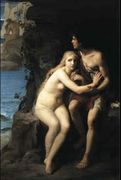 Acis and Galatea hiding from Polyphemus by Édouard Zier (1877)
 -
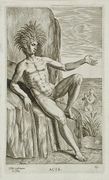 Acis by Philip Galle (1586)
 -
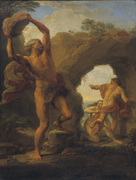 Atis and Galathea by Pompeo Batoni (1761)
 -
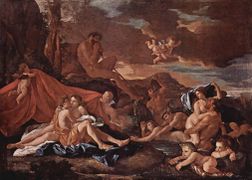 Acis and Galatea by Nicolas Poussin (circa 1629-1630)
 -
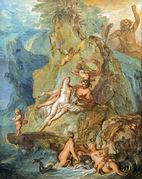 Acis and Galatea by Nicolas Bertin
 -
 Acis und Galatea by Jacob van Schuppen (circa 1730)
 -
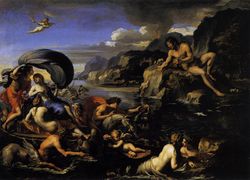 Acis, Galatea, and Polyphemus by François Perrier (1645 and 1650)
 -
 Coastal landscape with Acis and Galatea by Claude Lorrain (1657)
 -
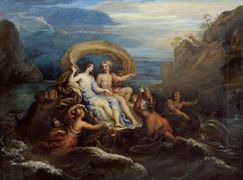 Acis and Galatea by Michel Corneille
 -
 Landscape with Polyphemus by Nicolas Poussin


.jpg&filetimestamp=20190606212853&)


نحت
-
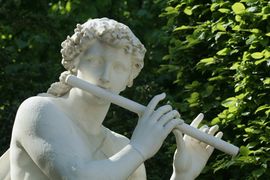 Acis playing the flute by Jean-Baptiste Tuby
 -
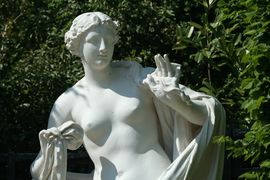 Galatea in the Gardens of Versailles
 -
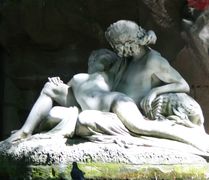 The lovers embrace on the Medici Fountain, Paris
 -
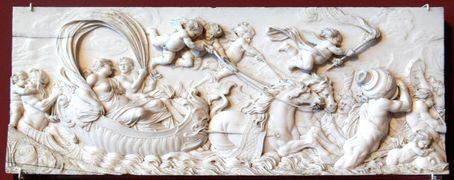 The lovers drawn over the sea, 17th-century German ivory carving
 -
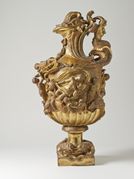 An Italian vase decorated with the Triumph of Galatea
 -
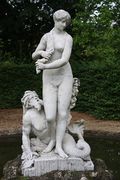 Gabriël Grupello's statue at Schwetzingen Palace
 -
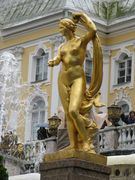 Nicola Michetti's statue at the Peterhof Palace
 -
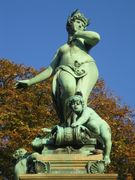 Galatea at the head of the Galatea water well, Stuttgart


.jpg&filetimestamp=20190606212903&)


ملاحظات
- ^ Hesiod, Theogony; Homer, Iliad.
- ^ Ovid, Metamorphoses xiii.750-68.
- ^ Schmitz, Leonhard (1867), "Acis", in Smith, William, Dictionary of Greek and Roman Biography and Mythology, 1, Boston, MA, pp. 13
- ^ Athenaeus, Deipnosophistae 1.6e
- ^ Scholiast on Theocritus' Idyll VI quoting the historian Duris and the poet Philoxenus of Cythera
المراجع
- Grimal, Pierre (1986). The Dictionary of Classical Mythology. Oxford: Basil Blackwell. ISBN 0-631-20102-5.
- Smith, Dictionary of Greek and Roman Biography and Mythology: Acis
This article incorporates text from the public domain Dictionary of Greek and Roman Biography and Mythology by William Smith (1867).


- Short description is different from Wikidata
- Articles with hatnote templates targeting a nonexistent page
- Missing redirects
- Pages using Sister project links with wikidata namespace mismatch
- Metamorphoses into bodies of water in Greek mythology
- شخصيات صقلية في الأساطير اليونانية
- نريدة
- آلهة البحر اليونانية
- أشعار أوڤيد
- شخصيات في الأساطير اليونانية