لا توافق

عدم التوافق Unconformity، هو سطح تعرية أو سطح عدم ترسيب واضح ومميز يفصل ما بين مجموعتين صخريتين ويدل وجود عدم التوافق على وجود ثغرة زمنية في الترسيب. In general, the older layer was exposed to erosion for an interval of time before deposition of the younger layer, but the term is used to describe any break in the sedimentary geologic record. The significance of angular unconformity (see below) was shown by James Hutton, who found examples of Hutton's Unconformity at Jedburgh in 1787 and at Siccar Point in Berwickshire in 1788, both in Scotland.[1][2]
The rocks above an unconformity are younger than the rocks beneath (unless the sequence has been overturned). An unconformity represents time during which no sediments were preserved in a region or were subsequently eroded before the next deposition. The local record for that time interval is missing and geologists must use other clues to discover that part of the geologic history of that area. The interval of geologic time not represented is called a hiatus. It is a kind of relative dating.
أنواع اللاتوافق
عدم التوافق التخالفي

disconformity is an unconformity between parallel layers of sedimentary rocks which represents a period of erosion or non-deposition.[3] Disconformities are marked by features of subaerial erosion. This type of erosion can leave channels and paleosols in the rock record.[4]
عدم التوافق التبايني

عدم التوافق التبايني nonconformity، نوع من عدم التوافق، يفصل بين صخور قديمة متبلرة نارية أو متحولة تعرضت لعوامل التعرية، وصخور رسوبية أحدث عمرا.[5] Namely, if the rock below the break is igneous or has lost its bedding due to metamorphism, then the plane of juncture is a nonconformity.[6]
عدم التوافق الزاوي

في هذا النوع تكون مجموعة الطبقات الأقدم مائلة أما مجموعة الطبقات الأحدث فهي افقية أو تكون المجموعتان مائلتين في اتجاهين مختلفين.[7] The whole sequence may later be deformed and tilted by further orogenic activity. A typical case history is presented by the Briançonnais realm (Swiss and French Prealps) during the Jurassic.[8][9]
Angular unconformities can occur in ash fall layers of pyroclastic rock deposited by volcanoes during explosive eruptions. In these cases, the hiatus in deposition represented by the unconformity may be geologically very short – hours, days or weeks.
شبه التوافق

شبه التوافق paraconformity، هو سطح عدم التوافق، يفصل بين مجموعتين متوازيتين من الطبقات، يصعب تعرفه أو تمييزه من فحص أسطح الطباقية، أو اعتمادا على الطبيعة الصخرية، ولكن يتميز باختلاف المحتوى الحفري على جانبيه. It is also called nondepositional unconformity or pseudoconformity.[10][11] Short paraconformities are called diastems.[12]
عدم التوافق الانقطاعي
وفيه تكون المجموعتان الصخريتان في وضع افقي تقريباً أو لهما نفس درجة الميل في نفس الاتجاه ويسمى كذلك التوافق الكاذب (نظراً لأن الجيولوجي قد ينخدع في تحديد سطح عدم التوافق)
ويمكن تمييز الطبقات من خلال المحتوى الاحفوري لها.
Buttress unconformity
A buttress unconformity, also known as onlap unconformity, occurs when younger bedding is deposited against older strata thus influencing its bedding structure.[13]
اللاتوافق المتدرج
A blended unconformity is a type of disconformity or nonconformity with no distinct separation plane or contact, sometimes consisting of soils, paleosols, or beds of pebbles derived from the underlying rock.[14]
معرض الصور
-
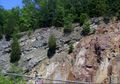
-
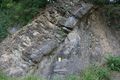 The "Taconic Unconformity" near Catskill, NY. This angular unconformity separates the Austin Glen Formation (Ordovician) from the overlying Rondout Formation (Silurian) and Manlius Formation (Devonian)
 -
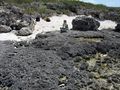 Eemian disconformity in a fossil coral reef on Great Inagua, The Bahamas. Foreground shows corals truncated by erosion; behind the geologist is a post-erosion coral pillar which grew on the disconformity after sea level rose again.
 -
![Hutton's angular unconformity at Siccar Point where 345 million year old Devonian Old Red Sandstone overlies 425 million year old Silurian greywacke.[15]](/w/images/thumb/5/53/Siccar_Point_red_capstone_closeup.jpg/120px-Siccar_Point_red_capstone_closeup.jpg) Hutton's angular unconformity at Siccar Point where 345 million year old Devonian Old Red Sandstone overlies 425 million year old Silurian greywacke.[15]
Hutton's angular unconformity at Siccar Point where 345 million year old Devonian Old Red Sandstone overlies 425 million year old Silurian greywacke.[15] -
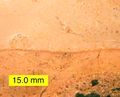 Disconformity with the Lower Cretaceous Edwards Formation overlying a Lower Permian limestone; hiatus is about 165 million years; Texas.
 -
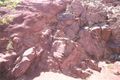 Nonconformity between the Pennsylvanian Fountain Formation (left) and Precambrian Gneiss (left) at Red Rocks Park, near Golden, Colorado
 -
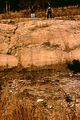 Unconformity (at the hammer) between underlying Mississippian Borden Formation and overlying Pennsylvanian Sharon Conglomerate, on US Rt. 35, near Jackson, Ohio
 -
 Angular unconformity on the west coast of Point Loma, California, facing north


![Hutton's angular unconformity at Siccar Point where 345 million year old Devonian Old Red Sandstone overlies 425 million year old Silurian greywacke.[15]](/w/index.php?title=%D9%85%D9%84%D9%81:Siccar_Point_red_capstone_closeup.jpg&filetimestamp=20120326131033&)


انظر أيضا
المصادر
- ^ Hutton's Unconformity Archived 2015-09-24 at the Wayback Machine
- ^ Keith Montgomery (2003). "Siccar Point and Teaching the History of Geology" (PDF). University of Wisconsin. Retrieved 2015-03-16.
- ^ Monroe J.S., Wicander R. & Hazlett R.W. (2007). Physical geology: exploring the Earth. Cengage Learning. p. 267. ISBN 9780495011484.
- ^ Boggs, Sam (2006). Principles of sedimentology and stratigraphy (4th ed.). Upper Saddle River, N.J.: Pearson Prentice Hall. p. 405. ISBN 0131547283.
- ^ عبد الجليل هويدي، محمد أحمد هيكل (2004). أساسيات الجيولوجيا التاريخية. مكتبة الدار العربية للكتب.
- ^ Stokes, W. Lee (1982). Essentials of Earth History 4th Edition. Prentice Hall, Inc. p. 65. ISBN 0-13-285890-8.
- ^ Boggs 2006, pp. 404-405.
- ^ Septfontaine M. (1984): Le Dogger des Préalpes médianes suisses et françaises - stratigraphie, évolution paléogéographique et paléotectonique.- Mém. Soc. Helv. Sci. Nat., vol. 97, 121 p. (Birkhäuser éd.)
- ^ Septfontaine M. (1995): Large scale progressive unconformities in Jurassic strata of the Prealps South of lake Geneva: interpretation as synsedimentary inversion structures. Paleotectonic implications. Eclogae geol. Helv., 88:3 553–576.
- ^ Catuneanu O. (2006). Principles of Sequence Stratigraphy. Elsevier. p. 15. ISBN 9780080473987.
- ^ Encyclopedia of Science and Technology: An International Reference Work, Volume 14. McGraw-Hill. 1966. p. 192.
- ^ Boggs 2006, p. 401.
- ^ Groshong R. H. (2013). 3-D Structural Geology: A Practical Guide to Surface and Subsurface Map. Springer Science & Business Media. ISBN 9783662039120.
- ^ Neuendorf K.K.E. (2005). Glossary of Geology. Springer. p. 73. ISBN 9780922152766.
- ^ Cliff Ford (2 September, 2003). "Siccar Point". Field Excursion Preview. University of Edinburgh School of GeoSciences. Retrieved 2008-10-20.
{{cite web}}: Check date values in:|date=(help)
- U.S. Bureau of Mines Dictionary of Mining, Mineral, and Related Terms published on CD-ROM in 1996.
- Keith Montgomery (2003). "Siccar Point and Teaching the History of Geology" (pdf). University of Wisconsin. Retrieved 2008-03-26.
• Septfontaine M. (1984): Le Dogger des Préalpes médianes suisses et françaises - stratigraphie, évolution paléogéographique et paléotectonique.- Mém. Soc. Helv. Sci. Nat., vol. 97, 121 p. (Birkhäuser éd.)
• Septfontaine M. (1995): Large scale progressive unconformities in Jurassic strata of the Prealps South of lake Geneva: interpretation as synsedimentary inversion structures. Paleotectonic implications.- Eclogae geol. Helv., 88/3, 553-576.